
Which Width and Length Basis Should Be Agreed Before Cutting or Splicing a Fabric Belt?
Agree the actual supplied-form dimensions, applicable tolerance basis and required measurement/acceptance record before treating a nominal width and length as complete. Keep roll length, cut length and finished endless dimensions clearly identified. A public standards abstract or catalogue nominal size does not supply the missing contract values.
On this page
 Open full-size image ↗
Agree the actual supplied-form dimensions, applicable tolerance basis and required measurement/acceptance record before treating a nominal width and length as complete. Keep roll length, cut length and finished endless dimensions clearly identified. A public standards abstract or catalogue nominal size does not supply the missing contract values.
A dimension needs a defined supplied form
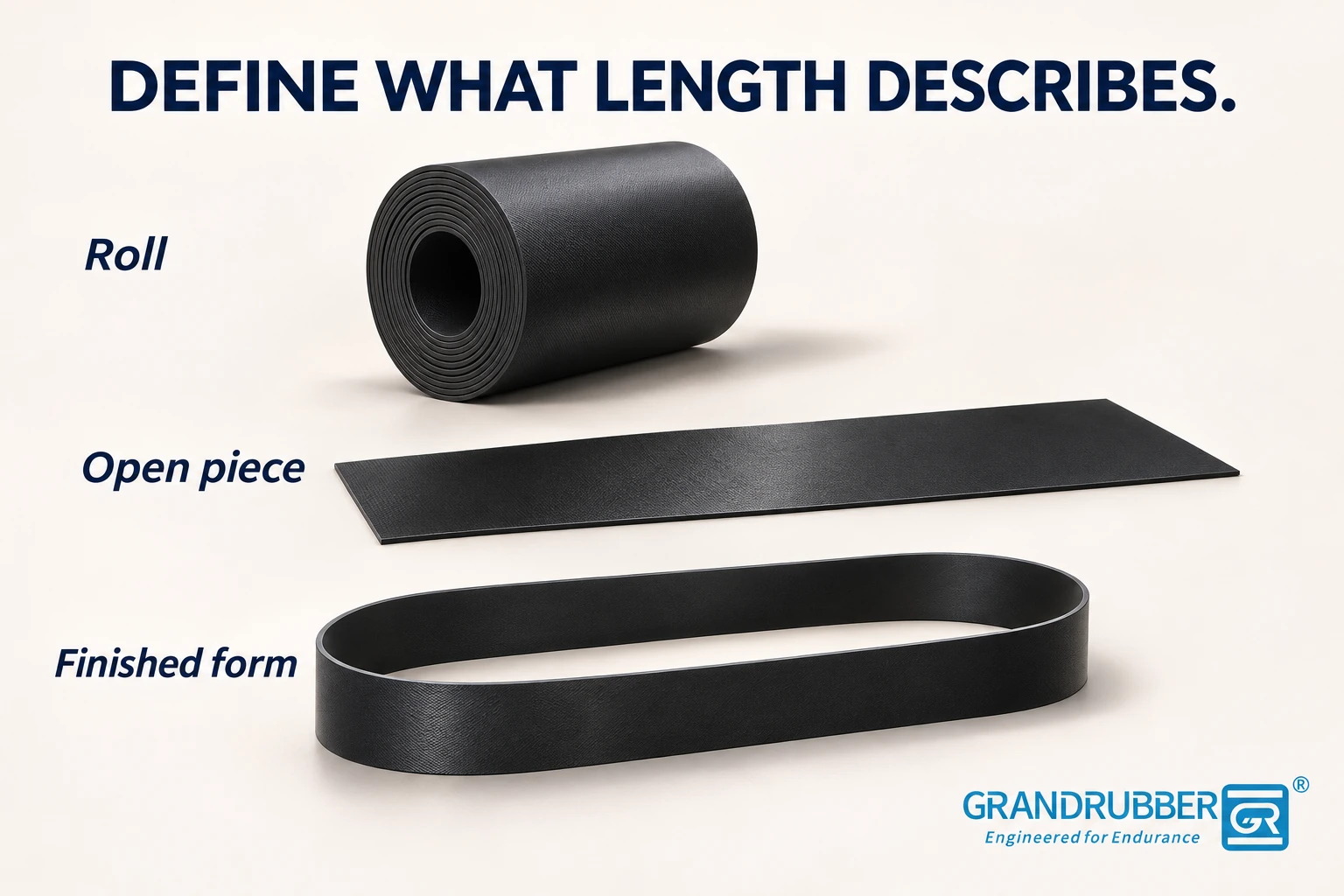
A belt purchase can refer to a roll, an open cut length or a finished endless item. The word length should identify which actual form and reference the order means. Repeating a nominal number in an enquiry and quotation does not settle that relationship by itself.
ISO 251:2024’s public abstract concerns widths, lengths and corresponding tolerances of textile-carcass belts, excludes light conveyor belts and notes that belt lengths themselves are not standardized. The official lifecycle records publication in December 2024. This guide has not accessed the full tolerance tables or measurement method and does not reproduce them.
The practical action is to establish the actual required dimensions and acceptance basis for the offered form. A standards title can identify the relevant topic without supplying every contractual value or approving an assumed splice allowance.
Reconcile required, offered and finished references
Identify the actual belt construction, supplied form and dimension references in the purchase request. Keep width and length distinct and ask how each is defined in the applicable actual specification. If the buyer needs a finished component, identify that subject rather than assuming the supplier will infer it from the conveyor name.
For a jointed or converted item, ask the responsible belt/splice parties to define their actual dimensional scope and interfaces. This article does not calculate cut length, splice allowance or installed belt length. Those inputs must come from the actual accepted arrangement and responsible technical response.
The first table separates required dimensions, supply form and final acceptance. It is not a measuring or cutting procedure. The purpose is to reveal the missing reference before a purchase record or work instruction is treated as complete.

| Line | Actual reference needed | Do not assume |
|---|---|---|
| Construction | Actual textile-carcass belt and applicable scope | Every belt category uses one basis |
| Supplied form | Roll, open piece or identified finished item | All length entries describe the same subject |
| Dimensions | Required width/length and reference | Nominal values specify every allowance |
| Tolerance/method | Actual agreed specification and edition | A public abstract supplies the contract values |
| Acceptance | Required real record and responsible party | Another material test proves dimensions |
Agree the tolerance and measurement basis without inventing it
Ask which actual tolerance requirement and method apply to the item. Preserve the specification/edition reference and any agreed contractual detail. A nominal dimension is not automatically an unlimited tolerance, but this guide supplies no numerical permitted deviation.
Keep the actual measurement subject and conditions with the acceptance record as required by the applicable method and order. Do not treat a rough site reading or a catalogue value as the specified measurement evidence unless the actual agreed basis establishes that role.
Where the purchase does not yet define the basis, request clarification rather than selecting a favourable tolerance from an unrelated belt category. Light and other construction categories can have different applicable scope. The responsible parties need the actual item and specification, not an assumed universal table.
Worked delivery review: roll length and finished length are confused
Consider a hypothetical fabric-belt purchase that lists a nominal length but does not say whether it means supplied roll, cut piece or finished endless belt. The buyer and supplier later compare measurements of different subjects. No actual order dimensions, GR delivery or discrepancy is represented.
Reconcile the original requirement, quotation and intended supplied form before declaring a dimensional pass or failure. Ask the responsible parties to identify what was actually agreed and which relevant records show it. Do not retroactively alter the original document or invent an allowance to make the numbers align.
A second issue may involve a stated width with no identified tolerance basis. Keep that as a separate clarification rather than assuming the length discussion resolves it. Each actual dimensional requirement needs its own defined subject and acceptance basis.
The second table organizes these questions. It avoids giving a cutting instruction or advising irreversible processing of an item whose acceptance relationship has not been established.
| Record | Issue | Clarification |
|---|---|---|
| Nominal length without form | Subject ambiguous | Reconcile actual supplied/finished requirement |
| Roll and endless dimensions compared | Different subjects | Identify actual agreed references and joint scope |
| Width without tolerance basis | Acceptance criterion incomplete | Obtain applicable actual specification |
| Form changed after order review | Earlier dimensional basis may differ | Retain reconciled final revision |
Preserve the accepted dimensions through changes and handover
If supplied form, belt construction, joint arrangement or dimensional requirement changes, issue and retain the appropriate reconciled revision. Ask which earlier evidence remains applicable to the final item. An old nominal line should not silently govern a differently finished product.
Keep dimensional acceptance distinct from material-property and installed-equipment acceptance. Correct width and length alone do not establish the entire belt’s suitability, while an unrelated material test cannot prove actual delivered dimensions. Use each record for its actual purpose.
GR’s fabric-belt category does not establish every cut size, tolerance, endless form or converting service. Ask for the actual offered scope and relevant documentation. No delivered dimensional result or technical approval is created by this educational guide.
Send a supplied-form dimensional enquiry
Provide the actual construction, intended supply/finished form, required width and length references and the applicable specification or unresolved tolerance question. Ask GRAND RUBBER to state the offered scope and available evidence, with joint/processing responsibilities clearly assigned.
Use the specification checklist for broader belt inputs and the truly-endless guide for the separate construction/supply-form distinction. Here the specific decision is whether the dimensional subject and acceptance basis have been agreed before cutting, splicing or treating a delivery as conforming.
The next action is one reconciled dimensional line for each actual required subject, linked to its applicable tolerance/method and responsible acceptance record. Keep unknowns explicit and preserve original documents until the actual requirement is resolved.
Buyer FAQ
Does nominal belt length define every finished dimension?
No. Identify whether it describes a roll, cut piece or actual finished item and its applicable reference.
Does this guide provide ISO tolerance values?
No. Only the public scope/lifecycle was reviewed, not the full tables or procedure.
Can a splice allowance be guessed to reconcile an order?
No allowance is supplied here. Obtain the actual responsible joint and dimensional scope.
Does the public abstract standardize all belt lengths?
It explicitly notes that belt lengths are not standardized. The purchase must identify its actual required length and basis.
Can a light-belt tolerance be assumed for a textile heavy-duty belt?
Do not assume construction-scope equivalence. Identify the actual applicable specification and item.
Does a material test prove delivered width and length?
No dimensional result follows from another property test alone. Obtain the required actual dimensional record.
What should the next enquiry include?
Actual belt construction and supplied form, dimension references, tolerance/method basis and the separately assigned acceptance/processing scope.
Sources
Related technical resources
Related products
 Multi-ply Fabric Conveyor Belts
Document and page references
- ISO 251:2024 — Public Abstract and Lifecycle: Public scope: textile-carcass widths/lengths/tolerances; light-belt exclusion; length not standardized. Abstract only. No tolerance values, measurement procedure, nominal width mandate, splice allowance or GR dimensional result.
- Editor-derived evergreen purchasing analysis; hypothetical examples are not real cases, field results or approved operating procedures.
Download the reference tables
Source-labelled review extract. Historical references remain historical; this is not a formal TDS, certificate or current availability confirmation.
Download guide tables CSV