
EP or NN: what must a buyer compare?
EP and NN names do not establish interchangeable conveyor belts. Compare the declared textile carcass, complete construction and response required by the equipment before accepting a change, even when nominal strength or ply count appears to match.
On this page
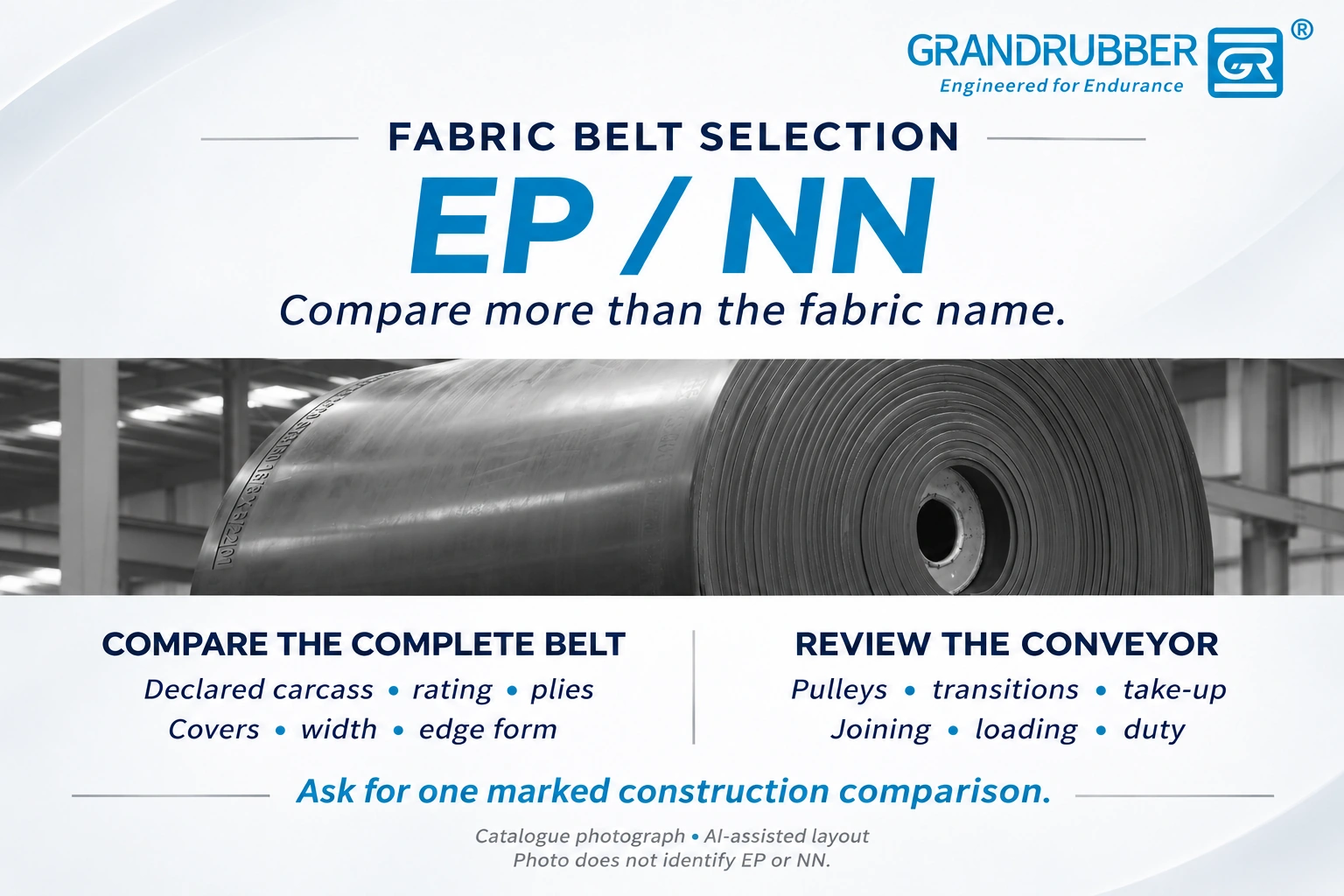 Open full-size image ↗
Do not accept an EP-to-NN or NN-to-EP replacement from the reinforcement name, nominal strength or ply count alone. Identify the existing and offered complete constructions, then have the responsible reviewer check the change against the conveyor and its duty. The buyer’s decision is whether the proposed substitution is supported, not which two-letter label is universally better.
This guide concerns rubber-covered textile belts. It does not prescribe a fabric, calculate an allowable load or approve a belt conversion for a particular conveyor.
1. What do EP and NN identify, and what do they leave open?
EP and NN identify different fabric-belt categories. Reinforcement and rubber covers are separate elements. A category name helps locate a construction discussion; it does not identify the exact weave, ply design, covers or ordered dimensions.
A June 2025 manufacturer-hosted engineering article by Leslie David discusses conventional EP as a polyester/nylon combination and explains that fabric type and weave affect carcass behaviour beyond a tensile-strength label. This is general engineering context, not a statement that a particular GRAND RUBBER belt has the author’s proprietary construction or performance.
Ask the supplier to declare the actual reinforcement rather than relying on the abbreviation alone. If the original record is incomplete, distinguish confirmed identity from a proposed identification. A photograph of a rubber roll generally cannot establish the concealed fabric construction.
2. Why are matching plies or nominal strength insufficient?
The carcass is the load-carrying reinforcement within the belt. Ply count describes a count, while a whole-belt strength designation describes a different property. Neither states all the belt’s longitudinal and transverse characteristics, the rubber between and over the plies, or the construction needed by the conveyor.
The first table asks for a complete comparison against the existing reference. Keep the two covers, width and edge form visible alongside the reinforcement. If a supplier changes more than the fabric category, list each departure separately. Calling the proposal EP instead of NN should not hide a changed cover or supply form.
ISO 14890:2026’s public abstract identifies a general surface-use category for covered textile belting. It does not provide a substitution approval or an equipment-specific decision in the public scope text reviewed here. The full standard was not examined for this guide.
| Comparison area | Record for existing and proposed belt | Why it cannot be omitted |
|---|---|---|
| Reinforcement identity | Fabric category and declared carcass construction | A name or ply count is incomplete identity |
| Whole belt | Rating basis, plies, width, covers and edge form | Same rating can accompany other departures |
| Mechanical behaviour | Applicable offered data and method for relevant behaviour | One elongation description does not cover every property |
| Equipment interfaces | Drawing, pulley/transition/take-up and joining references | Product data need an equipment review |
| Duty and history | Material, loading, special exposure and reason for change | A fabric change is not an automatic diagnosis |
3. Which equipment questions make the comparison meaningful?
Give the reviewer the available conveyor layout, pulley arrangement, transitions, take-up information, joining requirement and operating duty. Transitions are the portions where the supported belt changes its shape; take-up is the arrangement that accommodates belt length and tension requirements. Provide actual drawings and settings where recorded, rather than deriving them from the belt’s appearance.
The engineering article distinguishes elastic, permanent and break-related elongation and links carcass behaviour to conveyor geometry. Those are different properties; a single low-stretch description does not define every response the equipment needs. Ask which offered-belt data and review method address the actual machine.
Discuss loading, material and observed history with the same reference pack. A previous belt problem may justify investigating a change, but it does not establish that a different fabric label will fix it. Any identified equipment or joining change requires its own responsible review; this article gives no adjustment values.
4. Worked substitution example: the same rating is only the start
Assume a hypothetical buyer has a documented NN construction and receives an EP alternative with the same nominal whole-belt rating. The seller describes it as a replacement, but its response does not identify the complete carcass, joining basis or equipment review. No particular rating, ply count, price or expected life is assigned in this example.
The buyer should first identify the actual offered construction and all departures. Matching the rating means only that the stated rating matches; it does not answer the rest of the substitution question. Ask the seller to identify which data support its proposal and what equipment information remains necessary.
If the supplier offers fewer plies or a different cover, record those as additional changes rather than accepting a vague same-strength explanation. The responsible reviewer must assess the complete proposal. If the original construction is itself uncertain, resolve the baseline or explicitly keep the proposed comparison preliminary.
The second table turns that process into a disposition record. A defensible outcome may be that the option is not yet comparable, or that it can proceed to a defined technical review. Neither outcome is the same as approving the replacement for ordering.
| Question | Evidence or response needed | Do not conclude |
|---|---|---|
| Is the original NN construction identified? | Baseline document and unresolved identity fields | A remembered label establishes the complete belt |
| What exactly does the EP offer change? | Declared construction and separate departures | Matching rating proves interchangeability |
| What machine review is needed? | Applicable equipment documents and responsible reviewer | A catalogue table supplies all machine settings |
| What supports any claimed advantage? | Evidence for the actual offered construction and duty | A general fabric discussion guarantees improvement |
| Can the buyer release the change? | Explicit recorded disposition and agreed item revision | A preliminary comparison is an order approval |
5. What evidence should support the offered construction?
Request a product-specific construction statement and the applicable supporting documents. Identify which properties were tested, the specimen or product covered, the method and conditions. Keep a required specification, an offered value and an actual test result distinguishable; ask for clarification when the documents do not identify the proposed item.
Do not turn a manufacturer’s general discussion of fabric behaviour into a promised improvement for your belt. This guide makes no comparative life, impact, elongation or downtime guarantee. A proposed advantage needs evidence matching the actual offered construction and operating requirement.
If the review accepts a departure, retain the accepted construction and the basis of that decision with the enquiry or order revision. Do not reduce the result back to substitute EP or substitute NN and lose the details the reviewer needed.
6. Send a substitution review, not a label-only order
Use the related Multi-ply Fabric Conveyor Belts enquiry to send the existing specification, the proposed construction, equipment references and the reasons for the change. Ask for a marked comparison and a list of unresolved review items. A fabric-belt category entry does not approve every combination or a specific machine conversion.
Retain the original belt identification, drawing revisions and the reviewer’s disposition. If the discussion is actually about cover thickness or heat duty, include those as separate requirements and use the corresponding guide for that decision. The reinforcement name should not absorb unrelated changes into an apparently simple substitution.
The next step is one written answer against the comparison record, showing what is established and what still needs assessment before the buyer can release a changed construction.
Buyer FAQ
What if only one section is being replaced and the remaining belt has another carcass?
Identify the proposed section, the remaining belt and the joining interfaces as one review. Ask the responsible engineer and suppliers what compatibility evidence and controlled joining basis are required. Do not assume that matching a rating permits a mixed construction or that this guide authorizes the repair.
Does lower elongation always make a replacement better?
No universal ranking follows from that phrase. Identify which elongation property, test conditions and offered product are meant, then review the response required by the actual conveyor. This article does not assign an acceptable elongation or calculate a take-up setting.
Can a thick rubber cover tell me which carcass is inside?
Not reliably. Covers and reinforcement are separate elements. Obtain the product identity and construction evidence from the supplier; do not infer the hidden fabric category, ply design or strength from the outside of a roll.
Can the previous splice specification stay unchanged after a carcass substitution?
Ask the responsible reviewer and joining-system supplier to identify the procedure applicable to the actual offered construction and equipment. Record whether the earlier specification remains applicable or needs revision. A prior procedure should not be silently reused as approval for a changed carcass.
Can an EP label alone establish suitability for hot material?
No. Heat duty requires the offered belt’s cover, reinforcement, joining and exposure requirements to be considered together. Supply the actual duty record and ask for a construction-specific assessment rather than interpreting EP as a temperature grade.
What if the original drawing is missing and the old belt is badly worn?
Record the identity and dimensions that are documented and label the rest unknown. Ask the responsible technical parties to establish a usable baseline or define a fresh requirement. A worn specimen can inform inspection without proving its original nominal construction.
Sources
- Leslie David, June 2025: general conveyor carcass and elongation concepts; manufacturer-hosted article
- ISO 14890:2026 official public scope: general surface textile belting, not substitution approval
Related technical resources
Related products
 Multi-ply Fabric Conveyor Belts
Document and page references
- Catalogue_GRAND_RUBBER.pdf, PDF pp6–7: EP/NN category and separate covers/plies/whole-belt fields; not an interchangeability approval.
- GRAND_RUBBER_Conveyor_Belts.pdf, PDF p27: fabric reinforcement and rubber covers are separate construction elements.
- Leslie David, Out of sight, out of mind, Mining & Quarry World June 2025, manufacturer-hosted PDF pp1,3: general carcass/weave and elongation concepts only. No competitor prices, proprietary performance or allegations reproduced.
- ISO 14890:2026 official public abstract only. No full standard, certified conformity or specific substitution approval claimed.
Download the reference tables
Source-labelled review extract. Historical references remain historical; this is not a formal TDS, certificate or current availability confirmation.
Download guide tables CSV