GRAND RUBBER — Engineered for Endurance
HomeAbout UsBuyer SupportFAQWorksheetSearchMarkets / EN

GRAND RUBBER / INDUSTRY OVERVIEW

Cement & Clinker Handling

Separate hot-clinker transport, elevation and ordinary raw-material duties.

Operating scenarios
2
Candidate product routes
5
Related buying guides
13
Hot material on an industrial conveyor in the GR catalogue.
Heat-resistant Conveyor Belts · Catalogue application or exposure illustration; confirm the actual product specification and duty.

01 / PROCESS & APPLICATION

Separate the operating duties

Hot material on an industrial conveyor in the GR catalogue.
Heat-resistant Conveyor Belts · Catalogue application or exposure illustration; confirm the actual product specification and duty.
OPERATING STAGE 01

Cement clinker & hot-material conveying

Record the three temperature measures separately before reviewing a heat-resistant grade.

Check: Record normal and peak material temperature, peak duration, measured belt-surface temperature, particle size, contact time, belt speed and cooling. Keep source editions separate.

Open this duty and its product routes →
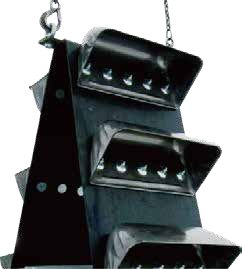
Buckets fastened to a vertical elevator belt section.
Bucket Elevator Belts · ; confirm the selected dimensions and configuration.
OPERATING STAGE 02

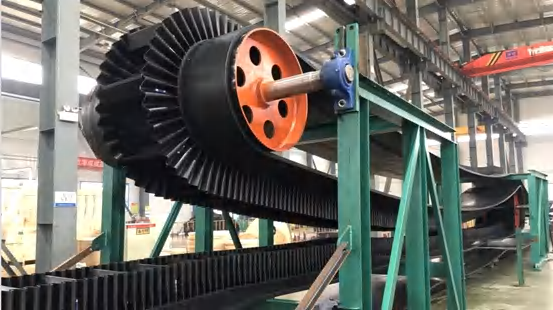
Cement elevation & sidewall layouts

Review the lifting layout and equipment interfaces, rather than choosing by belt width alone.

Check: Record lift, incline, capacity, material size/density, bucket or cleat arrangement, hole/pitch drawing, pulley arrangement and loading/discharge points.

Open this duty and its product routes →

02 / DUTY-TO-PRODUCT MAP

Match the product role to the operating problem

Operating stage → candidate products → information needed for review
Operating dutyCandidate productsWhat the buyer needs to establish
Cement clinker & hot-material conveyingRecord normal and peak material temperature, peak duration, measured belt-surface temperature, particle size, contact time, belt speed and cooling. Keep source editions separate.
Cement elevation & sidewall layoutsRecord lift, incline, capacity, material size/density, bucket or cleat arrangement, hole/pitch drawing, pulley arrangement and loading/discharge points.

These are catalogue-based review routes. Confirm the complete duty and evidence; an industry listing is not an engineering approval.

03 / CONSTRUCTION & INTERFACES

Review the candidate product range

Hot material on an industrial conveyor in the GR catalogue.
Heat-resistant Conveyor Belts · Catalogue application or exposure illustration; confirm the actual product specification and duty.
Conveyor Belts

Heat-resistant Conveyor Belts

Heat-resistant conveyor belts for hot bulk materials in cement, steel and related processes. Separate continuous, peak and belt-surface temperatures before choosing the construction and cover grade.

T1
≤100°C (Continuous temperature) / 150°C (Peak temperature) / ≤75°C (Belt-surface temperature)
T2
≤125°C (Continuous temperature) / 170°C (Peak temperature) / ≤100°C (Belt-surface temperature)
T3
≤150°C (Continuous temperature) / 200°C (Peak temperature) / ≤125°C (Belt-surface temperature)
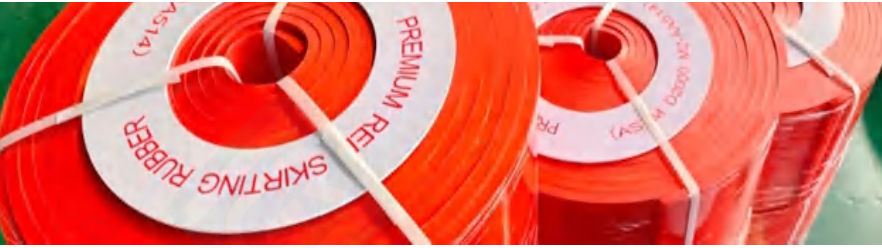
Rubber Skirtboard Sheet · original GRAND RUBBER catalogue product photograph
Rubber Skirtboard Sheet
Conveyor Components & Maintenance Materials

Rubber Skirtboard Sheet

Rubber skirtboard sheet for conveyor transfer-point interfaces. Specify sheet dimensions, holder and contact conditions, then confirm the actual grade and property combination.

Hardness Shore A
55 / 60 / 65 ±5
Density g/cm³
1.5 / 1.45 / 1.35 / 1.3 / 1.25
Tensile strength MPa
4 / 6 / 8 / 10 / 15

04 / ENGINEERING HANDOFF

Prepare the industry-specific project inputs

Cement & Clinker Handling · review checklist

  • Continuous/peak material temperature
  • belt-surface temperature
  • particle size
  • loading
  • cooling
  • lift and inspection scope
01

Identify the operating stage and existing product

02

Share known conditions and the controlled drawing

03

Confirm the selected construction and document scope

Share what you know. Leave unknowns for review.

Send the existing reference, drawing or operating conditions. Confirm the offered construction and document scope before ordering.

Prepare a requirement

05 / BUYER SUPPORT

Read the guidance for your next decision

BUYING GUIDE

How to specify a belt for hot clinker or sinter

For hot clinker or sinter, review the exposure record with the complete belt construction and conveyor conditions. Keep continuous material, temporary peaks and belt-surface temperatures distinct, then ask which offered compound, carcass and joining basis match that duty.

BUYING GUIDE

Datasheet, test report or certificate: what does each prove?

Match each document to the specific claim it supports: a product description, a result for an identified specimen, or certification of a stated scope. More files do not close an evidence gap if they concern a different item or question.

BUYING GUIDE

What is needed to specify a new sidewall conveyor?

For a new sidewall conveyor, define the material, required duty and route together before choosing belt geometry. Separate fixed project constraints from proposed dimensions and ask the responsible design team to resolve missing inputs.

BUYING GUIDE

How do you identify an existing sidewall belt?

Identify the existing sidewall belt with a complete, revision-controlled geometry record. Match the drawing’s own symbols to basebelt, cleats, sidewalls and inset; photographs and two overall dimensions do not establish replacement equivalence.

All technical resources

Questions buyers ask before choosing

How can I specify a heat-resistant conveyor belt correctly?

Record the material, continuous and peak temperature, how temperature was measured, contact time, belt speed and cooling conditions. Material temperature and belt-surface temperature describe different conditions.

Continue to the related product or guide

06 / PROCUREMENT DOCUMENTS

Product-specific files & evidence

Catalogue extracts contain the listed specifications, source and purchasing conditions. Controlled TDS, batch reports and certification originals require confirmation for the selected product and order.

Catalogue reference

Source-labelled data and actual extract downloads are available above.

Order-specific evidence

Confirm file revision, applicable product, required tests and acceptance conditions.

Document control

Manufacturing & quality

Review company and quality information separately from the source catalogue values.

Review the evidence routes

Catalogue PDF references

These are complete catalogues. Use the product and physical-page references below. They are not single-model datasheets, approved drawings, batch test reports or certification originals. Different catalogue schedules and versions must not be combined.

Conveyor belts & rubber sheets — full catalogue

Full source catalogue for reference only. Check the physical pages and the selected construction. Catalogue claims do not replace order-specific technical approval, test results or certification evidence.

File version: 4abe41343ea1 · 22 PDF pages. Issue date: not confirmed.

Applicable product / model and physical PDF pages

Download full catalogue PDF (22 pages · 18.2 MB)

Conveyor belts — full product manual

Full source catalogue for reference only. Check the physical pages and the selected construction. Catalogue claims do not replace order-specific technical approval, test results or certification evidence.

File version: 46905d537347 · 41 PDF pages. Issue date: not confirmed.

Applicable product / model and physical PDF pages

Download full catalogue PDF (41 pages · 8.6 MB)

Conveyor components — full product manual

Full source catalogue for reference only. Check the physical pages and the selected construction. Catalogue claims do not replace order-specific technical approval, test results or certification evidence.

File version: 90e4dfe160e9 · 42 PDF pages. Issue date: not confirmed.

Applicable product / model and physical PDF pages

Download full catalogue PDF (42 pages · 10.1 MB)

Request matching technical files

Catalogue basis and project evidence

; p34–35. These are catalogue application scenarios, not a representation of an authorised GR project at a named customer. Request the applicable drawing, offered specification and evidence.

Review manufacturing and quality information