
Conveyor Belt Troughability: What Should Buyers Check Before Ordering a Replacement?
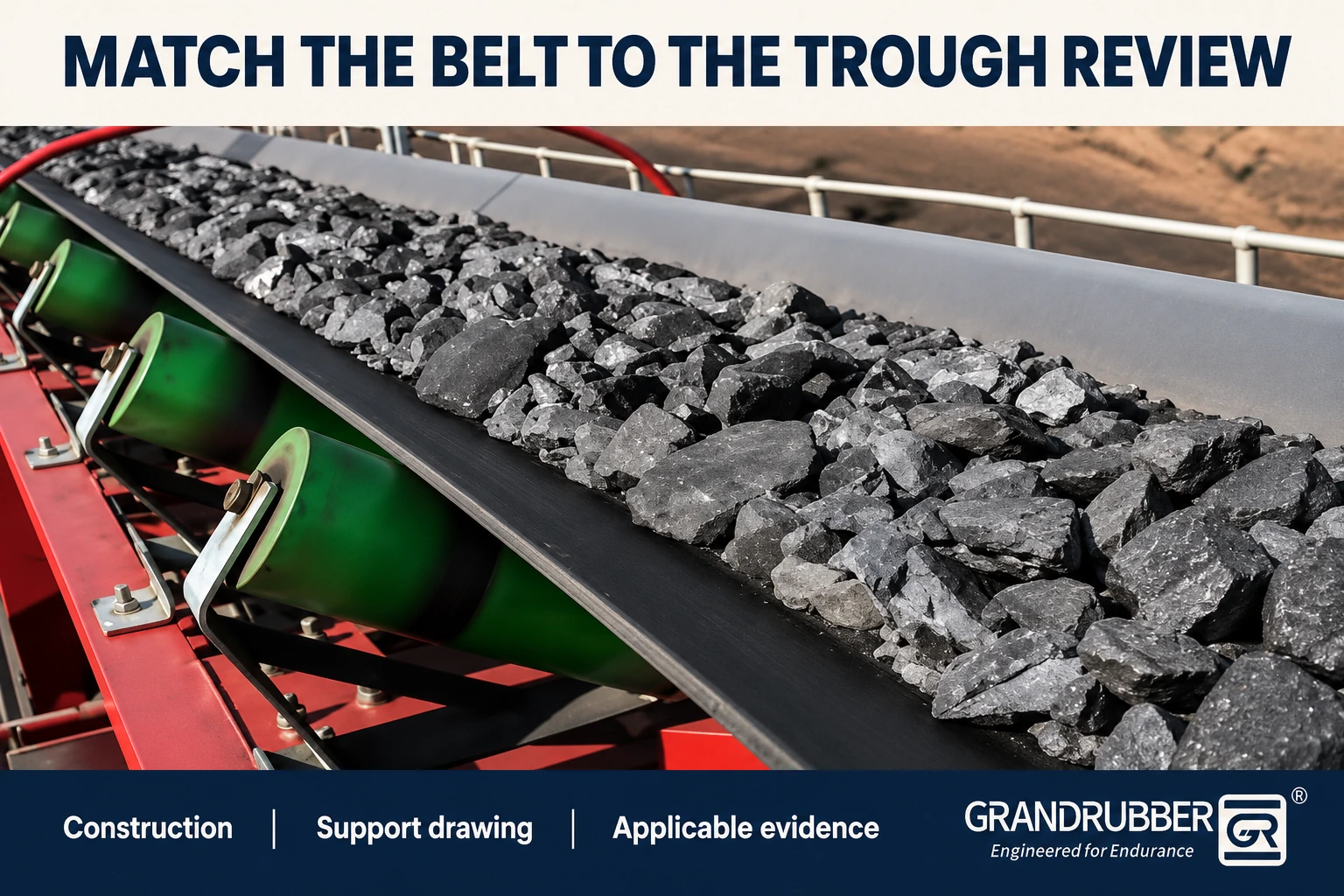
Troughability concerns transverse flexibility: how the belt bends across its width. Check the proposed construction and relevant evidence against the conveyor’s trough arrangement; matching width or nominal strength alone does not establish that fit. Keep the equipment review separate from a laboratory result.
On this page
 Open full-size image ↗
Troughability concerns transverse flexibility: how the belt bends across its width. Check the proposed construction and relevant evidence against the conveyor’s trough arrangement; matching width or nominal strength alone does not establish that fit. Keep the equipment review separate from a laboratory result.
Distinguish bending across the width from bending around a pulley
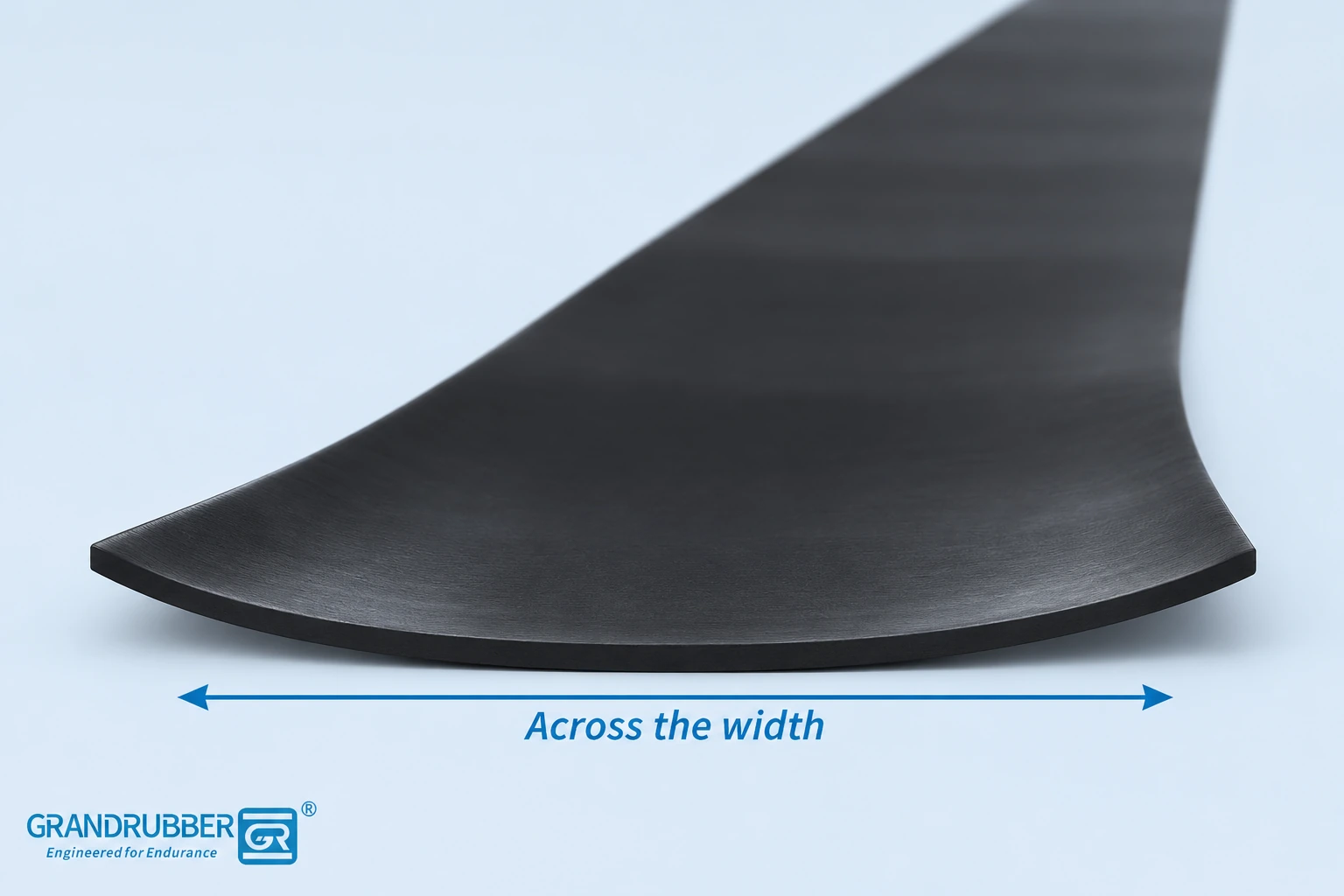
A troughed belt has a cross-sectional shape established by its support arrangement. Transverse flexibility describes bending across the belt’s width; the bend around a pulley is a different geometric question. Describing a belt as flexible without naming the direction can therefore leave the replacement decision unresolved.
ISO 703:2025’s public abstract identifies a method for transverse flexibility, also called troughability, expressed as an F/L ratio. It states that the method is not suitable or valid for the light-belt category it identifies. The public scope describes what the method assesses, not an acceptable ratio for every conveyor. No full test procedure or GR result is presented here.
For procurement, the important consequence is that a longitudinal strength designation does not itself answer a transverse-fit question. Likewise, a minimum-pulley statement should not be silently treated as a troughability result. Ask which evidence addresses each interface rather than searching for one general flexibility rating.
Describe the support geometry that the offered belt must fit
Give the reviewer the actual carrying-idler arrangement, the belt width and the relevant conveyor drawing. Include the transition regions between flat and troughed portions, and identify whether the proposed replacement changes construction, covers or reinforcement. Use the drawing’s own references and units; do not infer a missing angle or roller arrangement from a product photograph.
Keep the condition being discussed visible. A photograph of a loaded belt and a photograph of an empty belt do not document the same loading state. Where existing observations are available, identify their location and operating context so the equipment reviewer can interpret them. This is an observation-record request, not an instruction to approach moving equipment or conduct a trial.
The first table organizes the physical interfaces. It does not choose roller positions, transition lengths or operating limits. If the equipment details are unavailable, flag the proposal as awaiting that information rather than filling the gaps with another supplier’s catalogue dimensions. The offered belt and the machine must be identified in the same review.
| Input | What to identify | Why it matters to the review |
|---|---|---|
| Belt proposal | Width, construction, covers and any declared changes | The strength label alone is not transverse-flexibility evidence |
| Carrying supports | Actual idler arrangement and drawing revision | The required supported shape belongs to this machine |
| Transitions | Identified flat-to-troughed regions and applicable drawings | A trough section is not the entire route |
| Observations | Location and documented empty/loaded context | Different states should not be treated as the same observation |
| Evidence | Method/edition, tested item and supplier applicability statement | A report needs a connection to the proposed belt |
Ask what the troughability evidence actually represents
A useful response identifies the tested construction, the stated method and edition, the result as reported and its relation to the proposed belt. If the report concerns a different width or construction, ask the supplier to state the basis on which it is being used. An unexplained test reference should not become a claim that every belt in the catalogue fits the same trough.
The public ISO 703 scope includes a technical note distinguishing this method’s transverse-flexibility concept from other bending-property measures. For a buyer, that is a reason to keep unlike measurements in separate fields. Do not rank a result from one method against a different bending quantity just because both are described as stiffness.
The equipment reviewer still needs to assess the actual arrangement. A laboratory descriptor and a machine disposition serve different purposes. Ask for the response that connects the proposed belt evidence to the identified conveyor, with any remaining conditions or information gaps stated. This guide supplies no universal F/L threshold, maximum trough angle or cross-brand equivalence.
Worked replacement: width matches, but the offered construction changes
Assume a hypothetical replacement request preserves the nominal belt width and strength label. The new offer changes the construction, while the comparison contains no transverse-flexibility evidence and no reference to the carrying-idler drawing. No dimension, test result or actual field outcome is invented here.
A width match answers only the width entry. The buyer should ask the supplier to identify the offered construction and explain which evidence and equipment information support its use in the actual trough arrangement. If the proposal changes additional elements, retain each departure explicitly instead of hiding them under equivalent replacement.
A second hypothetical offer may supply a troughability report but omit the proposed belt identity. That has an evidence-applicability gap even though the laboratory category is correct. The buyer needs a traceable connection, not another generic statement that the belt is flexible.
The second table turns these distinctions into review outcomes. An appropriate interim result can be that the width is documented but the trough-fit review remains open. Neither the purchase team nor this article should convert that incomplete state into an equipment approval.
| What the offer provides | What it answers | What remains open |
|---|---|---|
| Matching nominal width | One dimensional entry | Construction-specific trough fit |
| Matching strength designation | A stated longitudinal rating basis | The relevant transverse-flexibility response |
| Troughability report for another item | A result for its named subject | Applicability to the offered construction |
| Belt data without conveyor references | Product information for review | The equipment-specific disposition |
Keep an observed trough problem separate from its assumed cause
If an existing belt appears not to sit as expected on its supports, record the observed location, belt identity and the circumstances already documented. Do not conclude from a photograph alone that the new belt is too stiff or that changing the carcass will solve the problem. Equipment condition and the whole operating context still need the responsible reviewer’s assessment.
This distinction matters when a replacement enquiry begins as a maintenance complaint. The buyer can ask for both a product proposal and a review of the reported condition, but they are separate answers. A proposed belt is not a completed diagnosis, and a test result is not an instruction to adjust the conveyor.
If the issue concerns transition geometry, a pipe-belt system or a sidewall installation, use the applicable equipment records rather than applying this troughed-belt discussion as a universal design method. The article’s scope is the purchasing evidence needed for the identified replacement, not troubleshooting steps or design calculations.
Request a construction-and-trough review before releasing the order
Send the identified belt construction, carrying-idler drawing, available transition references and relevant observations with the fabric- or steel-cord-belt enquiry. Ask GRAND RUBBER for an item-specific proposal that identifies the evidence offered for transverse flexibility and the equipment information still needed. No particular GR construction or tested troughability is asserted by this guide.
Keep the accepted response with the drawing revision and the final construction schedule. If negotiation later changes the reinforcement, width or covers, ask whether the prior review still applies. A final purchase order should preserve the decision basis, not reduce the outcome to the same nominal strength and width.
Use the EP/NN guide for a reinforcement substitution comparison and the pulley-schedule guide for that separate interface. Here the next step is a written disposition connecting the actual proposed belt to the identified trough arrangement, with unresolved conditions visible.
Buyer FAQ
Can ply count alone show whether the belt will trough correctly?
No single ply count establishes the complete transverse response or the actual machine fit. Identify the offered construction and request the evidence and equipment assessment relevant to the conveyor.
Does a minimum pulley diameter also specify the trough arrangement?
It addresses a different interface. Keep pulley bending and transverse trough fit separate and obtain the appropriate response for each rather than substituting one entry for the other.
Can I compare two F/L values without checking the reports?
First identify the method, edition, tested constructions and reporting context. Ask the reviewer whether the values are comparable and how they relate to the actual equipment; this guide supplies no universal ranking or threshold.
What if the supplier quotes ISO 703:2017?
Retain the actual reference. ISO lists the 2025 edition as published and the 2017 edition as withdrawn. Ask for a review against the enquiry requirement rather than rewriting the year on an older report.
Can a photograph establish the trough angle?
Use the actual equipment drawing or a responsible documented measurement. A photograph can locate an observation without reliably defining all support geometry or approving a new construction.
Should I run a trial if the belt does not sit on the centre support?
This article provides no trial or adjustment instruction. Send the documented condition to the responsible equipment and belt reviewers and use their applicable safety and technical process.
Does this guide cover light conveyor belts?
Do not apply the stated ISO 703 scope indiscriminately. Its public abstract excludes the light-belt category it identifies; obtain the appropriate product and test basis for that equipment.
Sources
Related technical resources
Related products
 Multi-ply Fabric Conveyor BeltsEP/NN multi-ply rubber conveyor belts for mining, cement and bulk handling. Match whole-belt strength, plies and cover grade to your material and conveyor before ordering.
 Steel Cord Conveyor BeltsSteel-cord conveyor belts for high-tension, long-distance bulk conveying. Compare ST, STE and STH constructions against belt width, cord layout, pulley and splice requirements.
Document and page references
- ISO 703:2025 — official published scope: transverse flexibility/troughability: Abstract including F/L ratio and light-belt exclusion; lifecycle. Public scope only; no test setup or universal acceptable ratio/trough angle; no GR test result.
- Evergreen editor-derived buyer decision; hypothetical comparisons and tables are original purchasing aids, not measured results or actual customer cases.
Download the reference tables
Source-labelled review extract. Historical references remain historical; this is not a formal TDS, certificate or current availability confirmation.
Download guide tables CSV