
Belt Elongation and Take-Up Travel: Which Data Can a Buyer Actually Use?
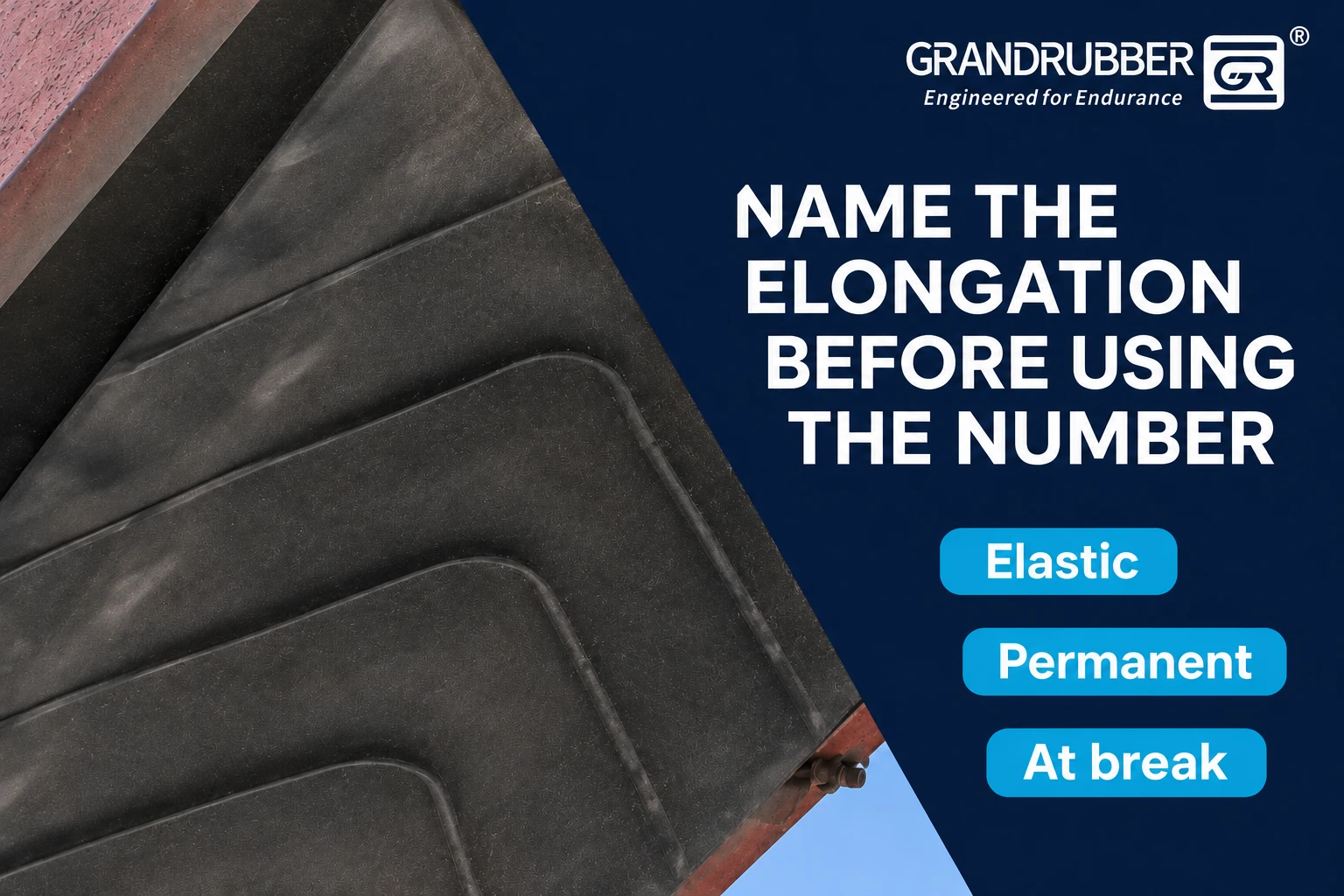
Elongation at break is not a take-up travel allowance. Identify the elastic and permanent behaviour relevant to the offered belt and the conveyor’s operating basis, then have the responsible equipment reviewer assess the take-up arrangement. A percentage from a laboratory report does not by itself specify a machine setting.
On this page
 Open full-size image ↗
Elongation at break is not a take-up travel allowance. Identify the elastic and permanent behaviour relevant to the offered belt and the conveyor’s operating basis, then have the responsible equipment reviewer assess the take-up arrangement. A percentage from a laboratory report does not by itself specify a machine setting.
Name the elongation quantity before comparing a percentage
Elongation describes a change in length relative to a stated starting length, but its meaning depends on the test or operating condition. Elastic elongation is the part associated with recovery when the load is relieved. Permanent elongation is the length change that remains under the defined assessment. Elongation at break concerns the breaking event. A quotation column labelled stretch can conceal these different quantities.
Fenner Dunlop’s engineering article distinguishes these three meanings. That distinction is useful background, not a promise about the elongation, life or geometry of a particular GRAND RUBBER belt. This guide does not import the article’s test-load percentages, cycle counts or proprietary belt comparisons.
For a buyer, the first task is to attach a name and basis to each value. Ask whether a percentage is nominal product data, a reported specimen result or a project calculation input. If those roles are mixed, two offers can look comparable while answering different questions. A smaller number is not automatically a better answer for the actual conveyor.
Read the test scope without turning it into an equipment setting
ISO 9856:2016’s public scope concerns elastic and permanent elongation and calculation of elastic modulus. ISO 283:2023’s public scope concerns textile-belt tensile properties and elongation at a reference force and at break. Their scopes identify different assessment subjects; neither public abstract supplies a take-up setting for the buyer’s machine. The stated exclusions for light conveyor belts also matter to applicability.
Ask the supplier to identify the offered construction and the actual report or declared data being submitted. Preserve the test method and edition, the named elongation quantity, and the report’s relevant condition references. Where only an excerpt is supplied, request the missing reporting context rather than guessing it from a familiar standard number.
The first table separates the data questions. It does not prescribe laboratory testing or say that every order requires every listed document. Select the evidence needed for the actual replacement review and make unresolved applicability visible. In particular, a break-related result should not be silently copied into a field intended for length change in operation.
| Entry | What to identify | Do not substitute it for |
|---|---|---|
| Elastic elongation | Defined recoverable response and its stated assessment basis | Permanent length change or take-up setting |
| Permanent elongation | Remaining change under the identified assessment | A universal running-in allowance |
| Elongation at break | The reported breaking-related quantity and specimen | Length change at the project operating condition |
| Equipment movement | Actual take-up geometry and available-condition record | A material test percentage |
| Review outcome | Identified proposal and responsible disposition | A supplier adjective such as low stretch |
Understand why belt length change and take-up stroke are different entries
A take-up is part of the conveyor arrangement used to accommodate length and tension requirements. Belt length change is a material-and-duty question; usable equipment movement is a geometry-and-condition question. The reviewer must connect them for the actual machine. The terms should therefore appear as separate entries, not as two labels for the same percentage.
A simple dimensional example illustrates the distinction without designing a conveyor. If a hypothetical record states a 100 metre reference length and a 0.5 percent length change under its explicitly defined condition, the arithmetic length change is 0.5 metre. That is only a length-change calculation. It does not establish an acceptable take-up stroke, movement direction, starting position, counterweight, operating tension or remaining service allowance.
The actual equipment arrangement determines how a length change relates to component movement, and the review may have to address more than one operating state. Send the equipment drawing and available current-condition records to the responsible reviewer. Do not select a generic conversion factor from another conveyor and treat it as a setting for yours. The numerical example contains no GR test value or installation recommendation.
Worked replacement: the low-stretch offer leaves the equipment question unanswered
Assume a hypothetical buyer wants to replace a belt while retaining the conveyor’s take-up equipment. One offer advertises low stretch and supplies elongation at break; another supplies a stated elastic/permanent assessment but does not identify the offered construction. No real customer or measured result is represented in this example.
The first offer has not answered the operating length-change question merely by supplying a break result. The second offers a more relevant category of information, but its applicability is still unresolved. Neither response yet establishes that the existing take-up arrangement is suitable for the proposed replacement.
The useful clarification asks each supplier to identify the actual construction, the quantity and basis of its data, and the equipment information needed for a responsible review. Preserve the existing drawing and the relevant known take-up condition; label missing information as unknown instead of inventing available travel.
If a reviewer identifies an equipment change or another construction as necessary, keep that outcome separate from the product price comparison. The second table records what each answer establishes and what remains open. It prevents a purchasing team from reducing a machine-compatibility decision to a ranking of percentage values.
| Available response | What remains unresolved | Next evidence question |
|---|---|---|
| Low-stretch wording and a break result | Relevant operating elongation | Which quantity and assessment basis address the proposed duty? |
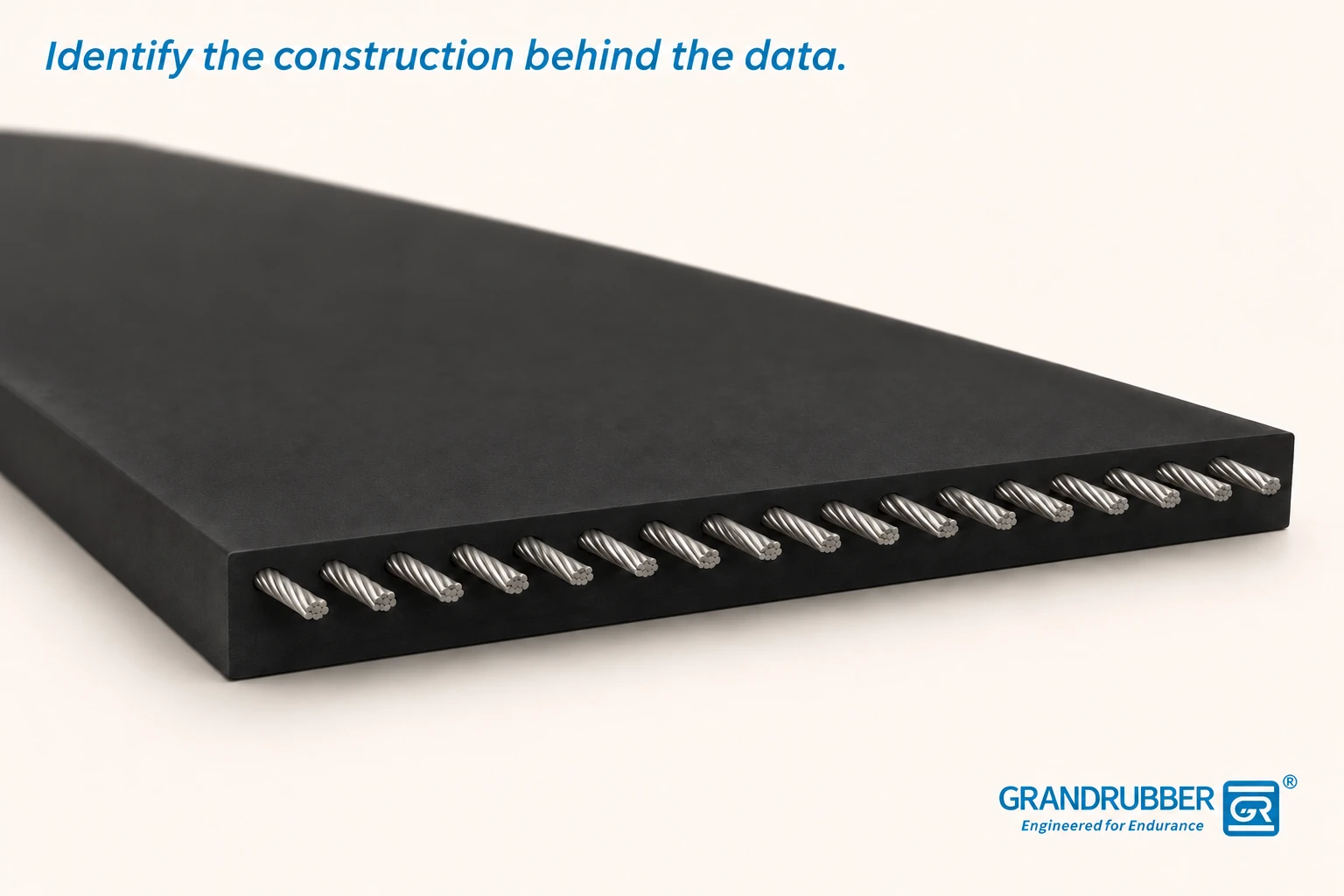
| Elastic/permanent result for unnamed construction | Offered-item applicability | What identifies the construction represented by the data? |
| Belt data without take-up drawing | Equipment relationship | Which machine geometry and condition must the reviewer assess? |
| Revised belt after technical comparison | Whether the earlier review still applies | Does the disposition cover the final offered construction? |
Compare the operating basis and the data’s stated limits
A value obtained under one identified condition should not be silently presented as the response under every duty. Ask which operating basis the supplier’s statement addresses and what relevant limitations are recorded. Where startup, loading variation, temperature or a changed route is part of the enquiry, provide the actual known information so the reviewer can decide what matters.
Do not combine unlike percentages into an assumed allowance without an applicable engineering basis. Similarly, an old data sheet may identify a previous construction rather than the revised offer. Keep document revisions and the final item identity linked so a negotiation change does not leave the take-up review attached to a superseded belt.
The required outcome is a written assessment of the identified proposal against the actual equipment requirement, including outstanding inputs. This article supplies no acceptable elongation limit, installation tension, adjustment procedure or predicted running-in time. Those cannot be recovered from an unqualified low-stretch label.
Send one elongation-and-equipment review pack
Include the existing belt identity, the proposed construction, the reason for replacement, the relevant conveyor/take-up drawings and the elongation data actually offered. Ask GRAND RUBBER to identify what its proposal states and which supporting documents and further equipment information are needed. Its supply categories do not approve an unreviewed conversion or establish a particular elongation result.
If the discussion includes an EP/NN substitution, use the related construction guide to retain all departures rather than treating this article as a substitute for that wider comparison. If the concern is an observed fault, attach the existing documented observations without turning them into a diagnosis.
The next step is one reconciled response showing the meaning and applicability of each offered value, the equipment reviewer’s disposition and any open input. Keep that response with the accepted construction so the technical decision survives into the purchase order.
Buyer FAQ
Can elongation at break be used as allowable operating stretch?
No direct substitution follows. It describes a different assessment point. Ask for the relevant belt behaviour and the equipment review appropriate to the actual operating requirement.
Is lower elastic elongation always preferable?
Do not rank it without the conveyor’s requirements. Identify the quantity, basis and construction, then obtain the equipment-specific assessment. This guide gives no universal best value.
Does a permanent-elongation figure predict how long running-in will take?
It does not establish a universal time forecast. Retain the test or declared-data scope and ask the responsible parties for the information applicable to the proposed belt and actual duty.
Can I calculate travel by multiplying belt length by a catalogue percentage?
That multiplication can describe a length change only when the percentage and reference length are appropriate. Equipment stroke and settings still require the actual arrangement and a responsible engineering assessment.
What if the take-up drawing or available-travel record is missing?
Keep the missing input explicit and ask the equipment owner or responsible reviewer to establish it. Do not turn the conveyor centre distance or an outside photograph into an assumed usable travel.
Does ISO 9856 apply to every light conveyor belt?
Its public scope excludes the light-belt category it identifies. Obtain the method and product basis appropriate to the actual belt rather than applying the reference indiscriminately.
Should the same data remain valid when cover or carcass changes?
Ask the supplier and reviewer to confirm the applicability to the revised construction. Keep any changed item and document revision visible; this article does not approve carrying forward earlier data.
Sources
- ISO 9856:2016 — official published scope: elastic and permanent elongation
- ISO 283:2023 — official published scope: textile-belt tensile and elongation testing
- Fenner Dunlop / Rob van Oijen — Stretching the limits, April2024
Related technical resources
Related products
 Multi-ply Fabric Conveyor BeltsEP/NN multi-ply rubber conveyor belts for mining, cement and bulk handling. Match whole-belt strength, plies and cover grade to your material and conveyor before ordering.
 Steel Cord Conveyor BeltsSteel-cord conveyor belts for high-tension, long-distance bulk conveying. Compare ST, STE and STH constructions against belt width, cord layout, pulley and splice requirements.
Document and page references
- ISO 9856:2016 — official published scope: elastic and permanent elongation: Abstract;2022confirmation/current status. Public scope only; no cycle loads, universal elongation or equipment setting.; ISO 283:2023 — official published scope: textile-belt tensile and elongation testing: Abstract; general information. Public scope only; no laboratory result or acceptable working tension inferred.; Fenner Dunlop / Rob van Oijen — Stretching the limits, April2024: p1, distinction between elastic, permanent and breaking elongation; geometry discussion. Manufacturer engineering explanation only; no proprietary construction, test figures, life or EP/NN promise transferred.
- Evergreen editor-derived buyer decision; hypothetical comparisons and tables are original purchasing aids, not measured results or actual customer cases.
Download the reference tables
Source-labelled review extract. Historical references remain historical; this is not a formal TDS, certificate or current availability confirmation.
Download guide tables CSV