
Does a Troughability Result Approve the Conveyor Transition Distance?
A transverse troughability result does not by itself approve the longitudinal transition arrangement between pulley and troughed supports. Identify the actual belt and transition drawing, then obtain the applicable equipment assessment. Keep belt-flexibility evidence and transition-distance design as related but separate questions.
On this page
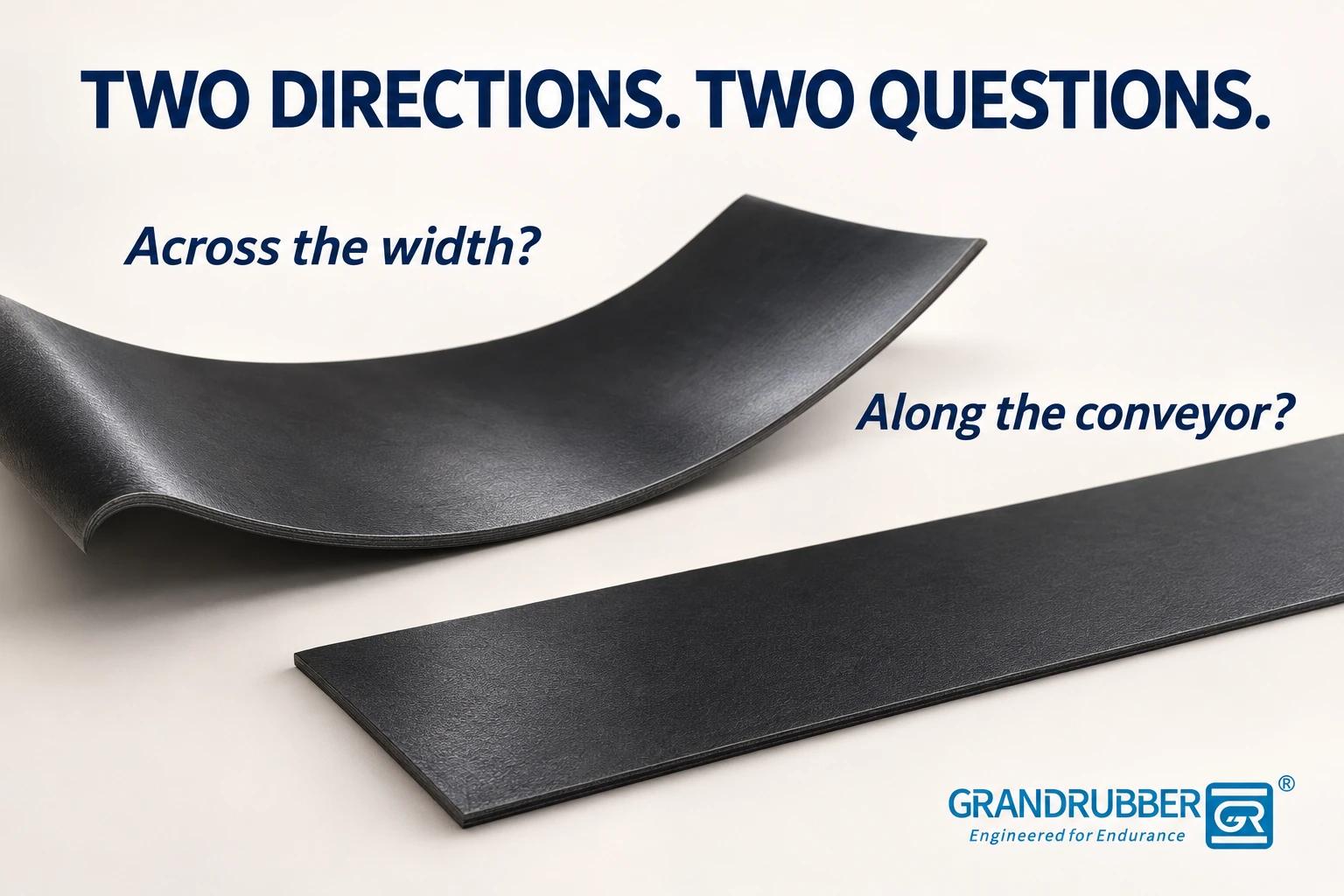 Open full-size image ↗
A transverse troughability result does not by itself approve the longitudinal transition arrangement between pulley and troughed supports. Identify the actual belt and transition drawing, then obtain the applicable equipment assessment. Keep belt-flexibility evidence and transition-distance design as related but separate questions.
Across-width bending and along-conveyor transition have different subjects
Troughability concerns a belt’s transverse response. A transition concerns the actual region along the conveyor where the belt changes between a flat pulley arrangement and troughed support. Evidence about one should not be treated as a completed design check of the other.
ISO 5293:2004’s public scope addresses calculation of transition distances on three idler rollers and excludes light conveyor belts. The official page shows the 2004 edition confirmed in 2025 with revision work under development. This guide has read the public abstract/lifecycle, not the full calculation method, and does not present a replacement edition as published.
The practical consequence is to request a separate transition assessment for the actual belt and equipment. A favourable flexibility description or a reproduced support angle is not the actual longitudinal layout and does not identify the applicable design inputs.
Obtain the actual transition drawing and proposed belt identity
Identify the pulley and supporting-idler arrangement with the actual drawing revision, including the region the responsible designer regards as the transition. Ask the equipment owner for the actual references rather than measuring an assumed distance from a catalogue illustration.
Provide the proposed belt construction and relevant dimensions/documents to the responsible reviewer. If a replacement changes the construction or other specified inputs, identify that change explicitly. Matching belt width alone does not establish that every earlier equipment assessment remains applicable.
The first table separates the input records. It does not provide an installation distance, transition formula or instruction to move supports. The competent equipment/belt parties must determine the actual applicable assessment and requirements for their particular conveyor.
| Review | Actual subject | Do not substitute |
|---|---|---|
| Transverse flexibility | Belt response across its width | Conveyor-specific transition design |
| Transition geometry | Actual pulley/support region and drawing | A generic trough angle |
| Belt proposal | Final construction and relevant inputs | Width alone |
| Applicable basis | Real method/edition and responsible assessment | A public abstract as the full calculation |
| Disposition | Identified final belt/drawing relationship | An old accepted checkbox |
Ask what the submitted response actually assesses
A useful transition response identifies its subject: actual belt, equipment geometry, governing basis and responsible assessment. Ask which drawing and proposal it covers and what remains outside its scope. A general technical-data page cannot identify a conveyor-specific disposition unless the relationship is established.
Keep any calculation or design document with its actual assumptions and revision. If the supplier submits only a troughability result, retain it for its own property and ask who provides the separate transition review. Do not relabel one report to close the other requirement.
Where the project cites a standard, preserve its actual edition and scope. The public title/abstract can identify the topic without supplying the complete procedure or every applicable construction limit. This article gives no transition-distance number and does not determine compliance with the full standard.
Worked replacement: a flexibility attachment closes a layout line
Assume a hypothetical replacement-belt tender contains an actual pulley-to-idler transition requirement. A bidder supplies transverse flexibility information, and the comparison marks the equipment transition accepted. No actual distance, test value or GR design result is represented.
The attachment may be relevant to the belt but does not establish assessment of the actual transition layout. Ask the responsible party to identify the applicable design response for the proposed belt and drawing. Preserve the flexibility record without extending its subject.
A second submission may include a transition calculation for an earlier construction. That is a revision-applicability question, not an automatic pass or automatic failure. Identify the actual changes and obtain the responsible disposition.
The second table organizes those different gaps. It prevents the buyer from choosing an unsupported installation distance while still allowing the relevant technical parties to use the real evidence and geometry for their assessment.
| Evidence received | Remaining question | Request |
|---|---|---|
| Transverse flexibility only | Actual transition layout unassessed | Obtain the separate applicable equipment response |
| Old-construction calculation | Revised belt relationship unclear | Reconcile actual changes and assessment |
| Diagram without dimensions/reference | Actual layout unidentified | Provide the responsible drawing basis |
| Draft edition called published | Document status misstated | Retain real current/draft identities |
Treat geometry and belt changes as actual review inputs
If a pulley location, support arrangement or proposed belt construction changes, ask whether the earlier transition response still applies. Retain the final drawing and proposal identifiers with the actual responsible assessment. Do not keep an accepted checkbox detached from the configuration it originally described.
Keep observations on an existing conveyor factual and located. Edge, centre or other condition findings should not be diagnosed as a transition problem solely from this guide. The competent review needs the actual context and any relevant inspection records.
A material supplier’s role should also be explicit. GR’s belt category does not establish complete conveyor design, installed-layout approval or authority to alter equipment. The purchase needs the actual belt evidence and separately assigned equipment responsibility.
Send a transition-specific replacement request
Provide the actual belt proposal, pulley/support drawing and the defined transition requirement with the enquiry. Ask GRAND RUBBER which belt construction documents are available, and obtain the applicable layout assessment from the responsible equipment and belt parties.
Use the troughability guide for the distinct transverse-fit question and the specification checklist for the wider input record. Here the decision is whether an actual longitudinal transition review has been replaced by a different belt-property attachment.
The next action is one identified transition response linked to the actual final belt and drawing. Keep missing geometry, assumptions or responsible disposition visible before treating a flexibility result as permission to accept or modify the installation.
Buyer FAQ
Does a troughability result approve a transition distance?
Not by itself. The actual longitudinal equipment arrangement requires its applicable review.
Can an installation distance be taken from this article?
No formula or distance is supplied. Obtain the competent response for the actual belt and conveyor.
Is the developing ISO 5293 revision already a published replacement?
The reviewed official page identifies a developing draft while the 2004 edition remains current. Preserve the actual status rather than inventing an edition.
Does matching belt width preserve every earlier layout assessment?
Not automatically. Identify the actual construction and other changes for the responsible applicability review.
Can a condition photo diagnose an incorrect transition?
No cause is established here. Provide actual located observations and equipment references for competent assessment.
Does GR belt supply include complete conveyor design?
That service scope is not established by this guide. Assign belt and equipment responsibilities explicitly.
What belongs in the next request?
Actual final belt identity, transition drawing/revision, governing requirement and the responsible assessment scope.
Sources
Related technical resources
Related products
 Multi-ply Fabric Conveyor BeltsEP/NN multi-ply rubber conveyor belts for mining, cement and bulk handling. Match whole-belt strength, plies and cover grade to your material and conveyor before ordering.
 Steel Cord Conveyor BeltsSteel-cord conveyor belts for high-tension, long-distance bulk conveying. Compare ST, STE and STH constructions against belt width, cord layout, pulley and splice requirements.
Document and page references
- ISO 5293:2004 — Public Abstract and Lifecycle: Public title/abstract: transition distance on three idler rollers, light-belt exclusion; current and draft status. Public scope only; full standard not accessed. No formula, installation distance, numeric input factors or approval of conveyor geometry; no2026replacement falsely claimed.
- Editor-derived evergreen purchasing analysis; hypothetical examples are not real cases, field results or approved operating procedures.
Download the reference tables
Source-labelled review extract. Historical references remain historical; this is not a formal TDS, certificate or current availability confirmation.
Download guide tables CSV