
Antistatic and Flame-Retardant Conveyor Belts: Do the Same Tests Prove Both?
No. Electrical conductivity and reaction to an ignition flame are different properties. A buyer requiring both needs evidence for each requirement on the identified offered belt. Keep product-test evidence separate from the installation’s wider safety assessment and destination requirements.
On this page
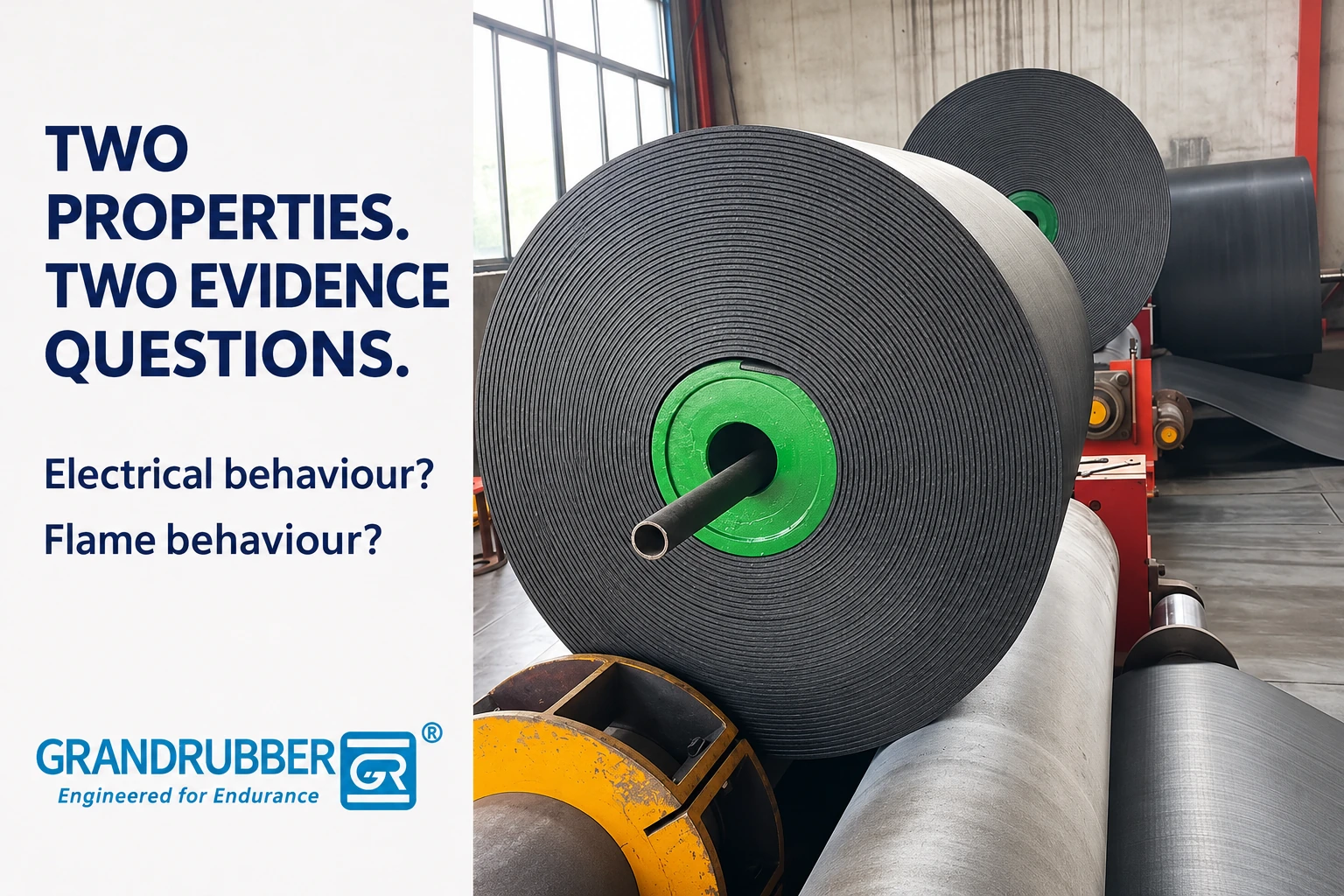 Open full-size image ↗
No. Electrical conductivity and reaction to an ignition flame are different properties. A buyer requiring both needs evidence for each requirement on the identified offered belt. Keep product-test evidence separate from the installation’s wider safety assessment and destination requirements.
Start by separating the two physical questions
A belt can be described with several safety-related words, but the words do not name one combined property. An electrical-conductivity requirement concerns the belt’s electrical behaviour. A flame-related requirement concerns its response to an ignition source under the stated assessment. A purchasing comparison loses information when both become one column labelled safety.
ISO’s public scope for ISO 284:2025 addresses conveyor-belt electrical resistance and a corresponding test, aimed at avoiding static-charge accumulation. Its public scope excludes the light conveyor belts it identifies separately. ISO 340:2022 addresses a small-scale reaction to an ignition flame and covers textile-carcass and steel-cord belts. These scope statements explain why the evidence questions differ; they are not GRAND RUBBER test results.
Ask which property each offered document actually addresses. The answer may be two separate reports, or one document containing clearly identified results for two methods. Counting attachments is less useful than checking whether both technical questions have an applicable answer. This guide supplies no resistance limit, exposure duration or acceptance threshold.
Build separate evidence lines for the actual offered construction
Put the requested belt identity above the evidence schedule: construction, relevant covers, width and the item or revision being quoted. Then give electrical and flame requirements their own lines. Each line needs an agreed method and edition, the required scope, the document offered and the responsible review status. If the buyer has not established the requirement, record that as an unresolved purchasing input.
An antistatic statement in a brochure is not automatically evidence of a flame result. The reverse substitution is equally weak. Where one report is offered for a family of products, request the documented basis connecting the offered construction to that report. Do not extend a report simply because another belt carries the same trade name or nominal strength.
The first table is an editorial comparison tool. It helps the buyer see what is missing without choosing a numerical pass criterion. Whether a submitted document meets a particular contract remains a decision against that contract and the applicable technical basis. A supplier response should identify exceptions instead of compressing everything into meets requirements.
| Requirement | Evidence question | Boundary to retain |
|---|---|---|
| Electrical conductivity | Which method/edition and belt identity does the evidence cover? | Do not read it as a flame result |
| Laboratory-scale flame behaviour | Which flame assessment and stated belt construction are documented? | Do not read it as an electrical result |
| Installation suitability | Which project/equipment review applies? | Belt test evidence alone does not assess the complete installation |
| Destination or contract | Which actual requirement has the buyer specified? | Do not infer universal approval from a category name |
Keep belt testing distinct from the conveyor’s safety review
A belt report describes the subject and scope recorded in that report. It does not, by itself, examine every part of the installed conveyor, the actual material handled, all ignition sources or every operating condition. Therefore a buyer should not turn a belt-test statement into an unqualified declaration that the complete conveyor is safe.
The purchasing task is to preserve the boundary. Ask the responsible equipment or project reviewer which belt evidence is needed for the installation and which wider assessments or approvals are separate. If the enquiry is for a specific mine, process or destination, send that requirement explicitly. A general product-category description should not be treated as a universal approval for that location.
This distinction also protects the comparison between suppliers. One supplier may be quoting material supply against two stated laboratory requirements; another may be referring to an equipment assessment with additional conditions. Those are different response scopes. Establish the requirement and responsibility before comparing their claims as equivalent. This article does not select a hazard classification, design an electrical system or prescribe an operational test.
Worked tender review: a combined label hides a missing answer
Consider a hypothetical tender requiring evidence for electrical conductivity and laboratory-scale flame behaviour. An offer says antistatic/flame-retardant and supplies one document whose stated method concerns only electrical behaviour. No test result, approval or real customer experience is invented in this example.
The buyer should retain the electrical document with its actual scope and leave the flame-evidence line open. The useful clarification is specific: identify the offered belt, state whether flame evidence is available for it, name the method and edition, and explain any limitations. Asking for a new covering letter saying compliant does not resolve the absence of the underlying evidence.
A second offer might include both method references but identify a different construction. It has a different gap: the test questions are named, yet applicability to the quoted item remains unestablished. The second table separates these outcomes so a document deficiency is not confused with a failed test.
If the missing evidence affects tender acceptance, retain the proposed document timing and obtain the purchasing authority’s disposition. This example does not authorize a waiver, delayed submission or shipment. It shows how to present the open decision clearly enough for the responsible person to act.
| Offer situation | What is established | Clarification still needed |
|---|---|---|
| Only electrical evidence supplied | One stated property has a document for review | Applicable flame evidence or an explicit departure |
| Both methods named, another construction identified | The intended test categories are listed | Basis connecting evidence to the offered belt |
| Method edition differs from the enquiry | Two edition references exist | Responsible assessment against the actual requirement |
| Final item revised after comparison | A changed offer exists | Updated mapping of evidence to the accepted construction |
Control method editions and substitutions without rewriting evidence
A report’s method edition and the edition specified by a buyer can differ. Keep both references visible. As checked for this guide, ISO lists ISO 284:2025 as published, replacing ISO 284:2012, and lists ISO 340:2022 as published. That does not establish that every older report is unacceptable or that a date can be edited to make it current.
Ask the responsible parties to determine whether the submitted evidence addresses the actual requirement and what additional explanation or work is needed. Preserve the original report; record the review separately. A translation, a quotation revision or a new cover page must not silently change its method, subject or result.
If the offered construction changes during negotiation, recheck the evidence mapping for that revised item. A price or delivery discussion can otherwise leave a final order referring to a different belt from the one used in the technical comparison. Close the loop by keeping the accepted item revision and each requirement’s disposition together.
Send a two-property evidence request with the enquiry
Use the flame-retardant conveyor-belt product enquiry with the actual belt requirement, destination or project reference, and separate electrical and flame evidence lines. Ask GRAND RUBBER to identify the offered construction, available applicable documents and unresolved items. Its product listing is a route for an enquiry; this guide does not establish certification or conformity for an unquoted item.
If the wider document pack is incomplete, use the inspection-document guide to organize identity, document timing and review ownership. The present guide answers a narrower decision: whether evidence for one of these two properties can close the other requirement. It cannot do so merely by changing the label.
The buyer’s next action is one consolidated clarification request, with each property linked to the required evidence and the same offered item. Keep the resulting answers with the accepted quotation so the distinction survives beyond the first email.
Buyer FAQ
Is a single report always insufficient?
No. One report may contain separate results for both properties. Check the methods, scope and item identity for each result; the number of files does not determine completeness.
Does a flame-test reference also establish antistatic performance?
It does not establish that separate property merely by association. Request the electrical evidence required for the actual offered belt, with its applicable method and subject.
Can I use these method references for a lightweight belt?
Do not assume that. ISO 284’s public scope expressly excludes the light-belt category it identifies. Ask the supplier and responsible reviewer for the method appropriate to the actual belt category.
Should an older report be relabelled with the latest standard year?
No. Preserve the report as issued and record the edition difference. Obtain a responsible review of applicability or additional evidence rather than changing its original reference.
Can a compliant belt report approve the entire conveyor?
A belt report addresses its stated subject and assessment. Installation review and any project or destination approval need their own applicable basis; they are not created by a product report.
What if a tender just says fireproof and antistatic?
Ask the purchasing authority to define the intended properties, methods, evidence and acceptance basis. Do not choose a hidden interpretation or promise an absolute fireproof outcome.
Does GRAND RUBBER’s flame-retardant product listing prove my requested belt passes?
No. It identifies an enquiry category. Ask for the actual offered construction and applicable evidence; no product-specific passing result is asserted here.
Sources
- ISO 284:2025 — official published scope: conveyor-belt electrical conductivity
- ISO 340:2022 — official published scope: laboratory-scale flammability
Related technical resources
Related products
 Multi-ply Fabric Conveyor BeltsEP/NN multi-ply rubber conveyor belts for mining, cement and bulk handling. Match whole-belt strength, plies and cover grade to your material and conveyor before ordering.
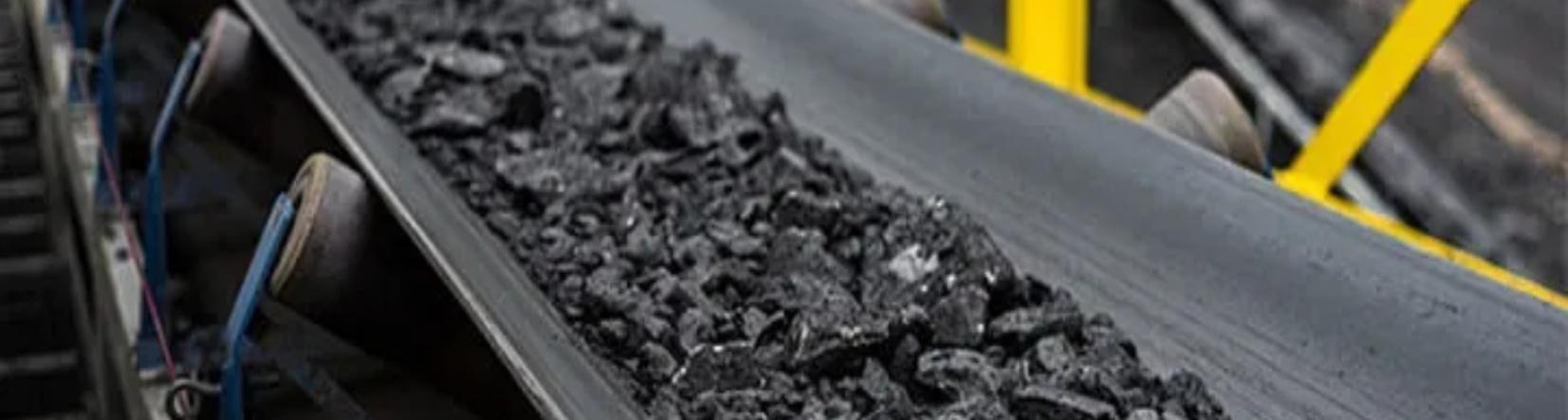 Flame-retardant Conveyor BeltsFabric and steel-cord conveyor belts with flame-retardant catalogue options. Specify the operating location, flame and antistatic requirements, then request evidence applicable to the selected belt.
Document and page references
- ISO 284:2025 — official published scope: conveyor-belt electrical conductivity: Abstract; general information; lifecycle replacing2012. Public abstract only; no resistance limits or test procedure copied; not GR conformity evidence.; ISO 340:2022 — official published scope: laboratory-scale flammability: Abstract; general information. Public abstract only; no exposure durations, results or pass threshold; no installation fire-safety approval.
- Evergreen editor-derived buyer decision; hypothetical comparisons and tables are original purchasing aids, not measured results or actual customer cases.
Download the reference tables
Source-labelled review extract. Historical references remain historical; this is not a formal TDS, certificate or current availability confirmation.
Download guide tables CSV