
Is a Thicker Conveyor Belt Cover Always Better?
Review a proposed conveyor belt cover-thickness change by separating cover dimensions, compound and carcass, then confirming the reason for the change and the complete replacement specification.
On this page
 Open full-size image ↗
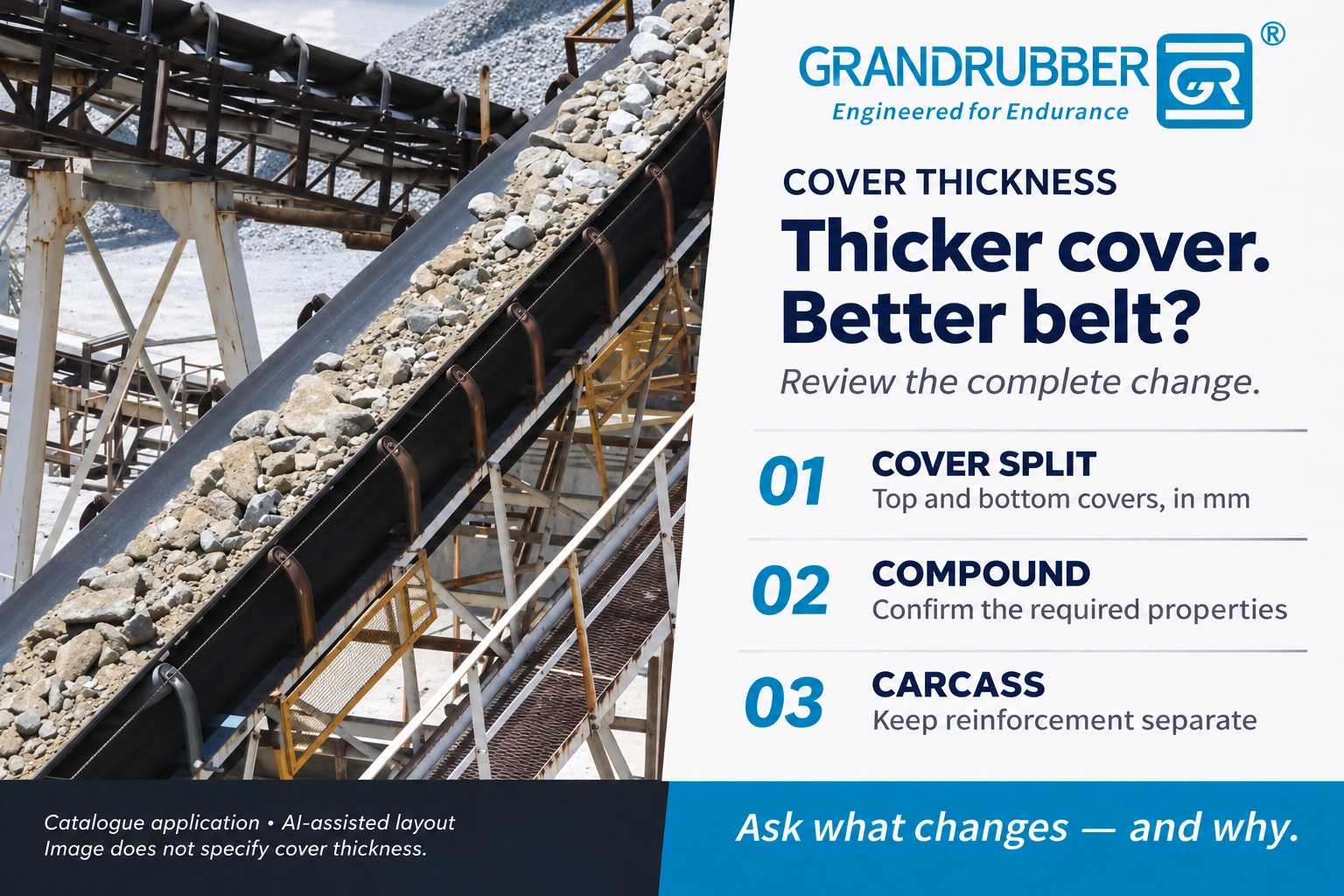
A thicker conveyor belt cover is not automatically a better replacement. Review the proposed thickness together with the rubber compound, fabric carcass and conveyor requirements. Thickness alone does not establish tensile strength, resistance to a particular exposure or expected service life.
This guide is for buyers reviewing a proposed cover-thickness change on a multi-ply fabric belt. It does not recommend a universal thickness or approve a replacement construction.
What exactly is the supplier proposing to change?
Ask for a before-and-after construction statement: top rubber cover, fabric carcass and bottom rubber cover. Use millimetres for the two covers and identify the carcass separately. Do not compare a cover measurement in one offer with total belt thickness in another.
Cover thickness, fabric plies and whole-belt strength are separate specification items. The rubber cover is separate from the reinforcement. These distinctions explain the specification structure; they do not show that a particular change suits your conveyor.
Give each value a label, a unit and a reference revision. The top cover is the rubber on the carrying face; the bottom cover is the rubber on the other face. The carcass is the reinforcement between them. A statement such as “thicker belt” leaves the buyer unable to tell which of these parts changes.
Keep the existing specified dimensions separate from observations on a used belt. A worn measurement is evidence of its present condition, not automatically the original nominal construction. Where the original document is missing, record that gap before treating a measurement as the replacement baseline.
Does extra thickness address the actual requirement?
First name the requirement behind the change. Is the buyer asking for a different cover dimension, a particular resistance property, or a response to an observed wear problem? Keep these requests separate so that the supplier can state which one its proposal addresses.
Different cover-property options require separate verification. A thicker general-purpose cover does not establish oil resistance, heat resistance or flame performance. Ask for the proposed compound and its applicable verification basis. A catalogue option is not evidence that every listed property applies to the offered belt.
If the concern is early wear, record where it occurs and provide the operating history and photographs. Ask the technical reviewer whether a thickness change addresses the observed issue or whether other construction or operating factors require investigation. This is a review question, not a diagnosis from photographs.
Separate an observed condition from the reason proposed by the seller. “A local area of cover is damaged” describes evidence; “the whole top cover needs to be thicker” is a proposal that needs a supporting explanation. Ask why the proposed change addresses the documented condition, what remains unchanged, and what other issues the reviewer has not resolved.
Set the acceptance question before comparing a price. Is the request to supply an identified dimension, to meet a separately defined property, or to review an unexplained failure? These are different tasks. A dimensional quotation cannot stand in for a fault assessment, and a general compound label cannot stand in for evidence applicable to the offered material.
Worked example: two thickness proposals that need different clarifications
Consider a hypothetical procurement review, not a customer case or a recommended belt specification. Assume the buyer has an identified existing multi-ply fabric-belt specification, a drawing revision and a report of localized cover wear. The cause of that wear has not been established. The request is to review a possible increase in the top-cover dimension while keeping the rest of the requirement visible. No dimensions, price or predicted life are assigned in this example.
Offer A states a higher top-cover dimension and declares the bottom cover, compound and carcass unchanged. That is a clearer description of the proposed departure. It does not establish that the departure is appropriate: the buyer still needs the reason for it, an identified complete construction and the responsible technical disposition. A statement of unchanged items should be tied to the baseline document, not left as an unreferenced phrase.
Offer B describes its belt only as thicker and quotes an overall thickness. Its cover split and reinforcement are not stated. The buyer cannot tell whether it is the same proposal as A, or even which requirement has changed. The next action is to request the missing construction breakdown, not to rank B as better or worse from its overall dimension.
If B later identifies a different compound or carcass, record a separate departure for each. Do not keep calling it a thickness-only substitution. Ask for the evidence and equipment review needed for that revised construction; keep any price comparison preliminary until the technical basis is clear.
The comparison table immediately after this example records what the buyer can conclude at each point. Neither offer is approved by the example. Its useful outcome is a short list of unanswered decisions: what changed, why it was proposed, which evidence applies, and who must close the review before release.
| Stage or proposal | What is actually established | Buyer action before release |
|---|---|---|
| Documented baseline | Existing construction and revision identified; wear cause still unknown | Keep the dimensional baseline separate from the unresolved wear assessment. |
| Offer A: higher top cover; other items declared unchanged | A stated departure against the baseline, not proof of suitability | Request its reason, applicable documents and responsible technical disposition. |
| Offer B: thicker overall dimension only | No top/bottom cover split or complete reinforcement identified | Request the missing breakdown; do not treat it as equivalent to A. |
| B later reveals another compound or carcass | The proposal changes more than cover thickness | List each departure and revisit the applicable evidence and comparison basis. |
What needs checking before accepting the change?
Request the proposed complete belt construction and a list of departures from the existing specification. Have the responsible technical team review the change against the conveyor drawings, pulley arrangement and joining requirements. Matching nominal strength alone does not establish replacement equivalence.
Give the reviewer the conveyed material and exposure conditions. For hot duty, distinguish continuous material temperature, temporary peaks and any measured belt-surface temperature. For oily duty, identify the substance and contact conditions. These inputs describe the review scope; this article does not assign a compound, temperature rating or approved thickness.
Ask the supplier to distinguish three answers in the marked specification: unchanged against an identified baseline; changed with a stated reason; and not yet established. “Same as existing” is not a complete answer when the existing document itself is missing. Equally, silence in an offer does not confirm that a component remains unchanged.
Use the review table after this section to collect those answers. Its construction rows are a comparison aid, not a universal approval checklist. Ask the responsible reviewer to identify the applicable equipment and joining documents and the checks still required for the offered construction. Do not select a pulley requirement, splice procedure or acceptance tolerance from this article.
Treat supporting documents according to their scope. A drawing may identify the requested dimensions; a product sheet may describe an offered construction; a test report must be checked for the material, sample, method and conditions it covers. None should silently become approval of a different construction. ISO 14890:2026 is cited here only through its official public abstract for general surface-use textile belting. The full standard was not reviewed, and its title is not evidence that this replacement or a thickness departure has been approved.
| Item | Current specification | Proposed replacement: what to confirm |
|---|---|---|
| Cover dimensions | Identify top and bottom covers separately, in mm | State both new values and mark which one changes. |
| Compound and carcass | Identify the cover grade and complete reinforcement | Mark whether either changes with the thickness proposal. |
| Reason for change | Record the requirement or observed issue | Explain which requirement the change addresses and what remains unresolved. |
| Technical disposition | Provide existing drawings and applicable specification | List compatibility checks, supporting documents and any deviation awaiting agreement. |
How should the buyer record the decision and unresolved items?
Close the review with a statement that a second person can understand without reconstructing the quotation conversation. Identify the baseline, the proposed construction, the listed departures and the party responsible for the technical disposition. Keep the purchasing decision distinct from the record of what the technical reviewer has actually accepted.
A useful reply may be that the description is complete enough for further review but not yet accepted for release. State the open question, the required input and its owner. For example, where the existing cover dimensions are unknown, the unresolved task is to establish a usable baseline through the responsible technical team; it is not to guess a pair of values so that the order form can be completed.
If the review changes the compound, reinforcement or supply form as well as the covers, revise the comparison and ask which supporting documents must be reconsidered. Carry the agreed revision into the material enquiry and the subsequent order description. This prevents an earlier shorthand thickness request from remaining the only recorded specification.
Do not turn this process into a promise about the proposed belt’s service life. The decision record can establish what was reviewed, what remains open and what is ordered. It does not create missing test results or a verified operating outcome.
What should the buyer send next?
Send one existing belt specification together with the proposed change. Ask the supplier to return a marked comparison identifying what remains the same, what changes, the reason for each change and which points need technical confirmation. Use the two chapter tables to keep the response focused on the cover-thickness decision.
Send the existing specification and proposed thickness change through the related Multi-ply Fabric Conveyor Belts product enquiry for review. The construction and required supporting documents remain subject to confirmation.
Buyer FAQ
The old belt marking gives no cover dimensions. What should I do?
Send the marking, available drawings and photographs, and identify the cover dimensions as unknown. Ask the technical reviewer what inspection or controlled measurement is needed. Do not invent nominal cover values from an incomplete marking.
The quotation only states total belt thickness. Is that enough for this comparison?
No. Ask for the top cover, bottom cover and carcass construction separately. The total alone does not identify which part of the replacement specification changes.
The supplier gives a thickness range instead of one proposed nominal value. What should I ask?
Ask which nominal top and bottom cover dimensions are offered, what dimensional acceptance basis applies, and which document records it. A catalogue production range is not the nominal value or agreed tolerance for your order. Do not choose a point within the range on the supplier’s behalf.
The top cover is unchanged but the bottom cover differs. Is that the same replacement?
Record the bottom-cover difference as a departure even if the carrying face is unchanged. Ask the responsible technical reviewer to consider the complete offered construction and relevant equipment and joining interfaces. The phrase same top cover does not close the replacement review.
Our drawing and the offer name different editions of a standard. Can I ignore that?
Keep both document references visible and ask the responsible parties to resolve the required edition and its application to the offer. Do not silently replace the drawing’s requirement or infer equivalence from a newer date. This guide has not compared the full standard editions or their acceptance provisions.
Can a report supplied with the previous belt approve the changed construction?
Check what product, material, sample, method and conditions that report identifies. Ask which statements still apply to the new offer and which need additional evidence or review. A previous document can be a reference, but it should not be relabelled as a report or approval for an untested replacement.
Sources
- ISO 14890:2026 official scope - textile conveyor belt category only, not a GR compliance certificate
Related products
 Multi-ply Fabric Conveyor Belts
Document and page references
- Catalogue_GRAND_RUBBER.pdf, PDF page 6 (printed pages 8-9), Multi-ply Fabric (EP/NN) Conveyor Belt: rubber-cover/fabric structure and separately listed cover-property categories. Catalogue reference, not approval of a replacement.
- Catalogue_GRAND_RUBBER.pdf, PDF page 7, left half (printed page 10), Production Range and Main Technical Parameters: cover thickness, fabric plies and whole-belt strength listed separately. No numerical range or test result reproduced.
- GRAND_RUBBER_Conveyor_Belts.pdf, PDF page 27 (printed 27/41), Fabric Conveyor Belt: rubber-cover/reinforcement illustration and rubber-quality options. Options are not cumulative properties.
- ISO 14890:2026 official public scope page, checked 18 November 2026: product-category context only. Full standard not reviewed; this reference does not approve a cover-thickness change or establish GRAND RUBBER conformity/certification.
- Worked offers, comparison table and follow-up questions are hypothetical editorial procurement aids, not catalogue specifications, customer quotations, test results or technical approval.
Download the reference tables
Source-labelled review extract. Historical references remain historical; this is not a formal TDS, certificate or current availability confirmation.
Download guide tables CSV