
How to compare conveyor belt quotations
Compare conveyor belt offers against one requirement revision, identify technical departures first, and align quantity and supply boundaries before comparing price. An unpriced or unconfirmed difference remains an open decision, not an assumed saving.
On this page
 Open full-size image ↗
Conveyor belt quotations are comparable only after the buyer identifies what each offer supplies against the same requirement. Put departures, omissions and evidence gaps beside the quoted item before ranking the prices. A lower total for a different construction, quantity basis or supply scope is not yet a like-for-like offer.
This guide is for reviewing received belt quotations. It does not set an acceptable price, approve a substitution or assign installation responsibilities for a particular contract.
1. Freeze the comparison baseline before reading the totals
Identify one requirement revision for the comparison and link each supplier’s response to it. If an enquiry changed after one offer was issued, ask for that offer to be updated or show the difference explicitly. Comparing the latest offer from one bidder with an earlier requirement from another produces a misleading ranking.
Separate a buyer requirement, a supplier statement and a purchaser’s assumption. For each construction field, record the actual offered entry or “not stated”. Do not fill a blank by borrowing a catalogue value or copying the other offer. The first table establishes this comparison discipline.
The resulting sheet should answer a simple question: if the price column were hidden, would the technical reviewer be looking at the same supply requirement? If not, list the unresolved differences before presenting a price recommendation.
| Comparison entry | Record for each offer | Disposition to identify |
|---|---|---|
| Requirement revision | The exact enquiry/drawing cited by the supplier | Same basis or clarification required |
| Complete construction | Offered reinforcement, rating, plies/cord and covers | Stated match, declared departure or not stated |
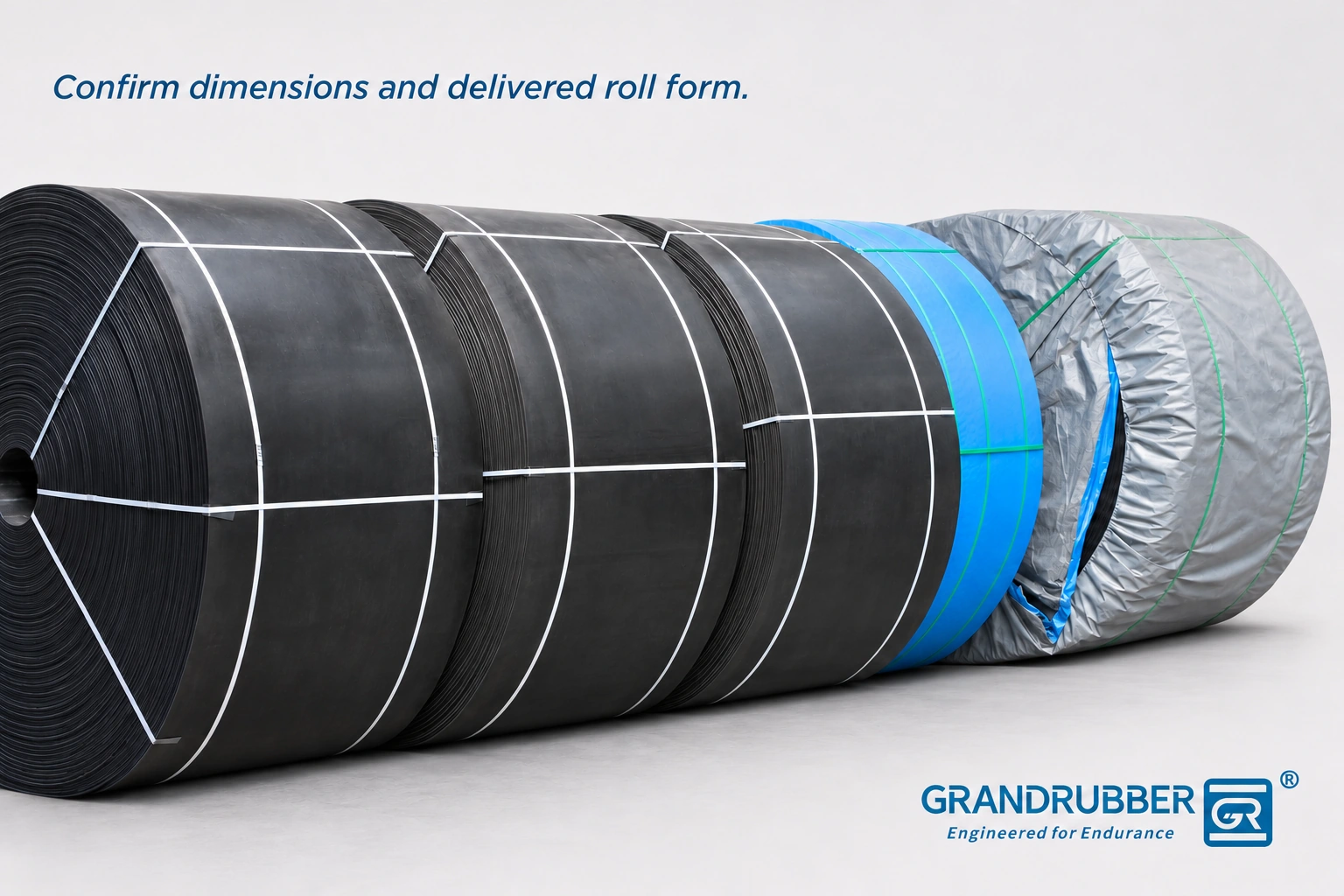
| Dimensions and supply form | Width, quantity basis, roll/piece lengths and joining form | Difference to clarify before price ranking |
| Supporting documents | Offered product reference and applicable evidence | Reviewed scope or evidence gap |
| Proposed alternative | Actual replacement statement and supplier reason | Technical acceptance pending or recorded |
2. Distinguish a stated match from a proposed alternative
Check reinforcement, whole-belt rating, width, plies or cord arrangement, top/bottom covers, edge form and the stated specification basis where applicable. A repeated grade name or rating is a retrieval key, not a complete identity. GRAND RUBBER’s fabric schedules list covers and reinforcement separately; its steel cord manual places different source schedules together. Values from adjacent tables should not be blended into an offer that no supplier actually made.
Classify a response as matching the stated requirement, declaring a departure, or leaving a field unresolved. These statuses are different. “Supplier says equivalent” needs an identified proposed construction and an explanation for the departure; it should not be re-entered as a confirmed match by purchasing.
Request the applicable product and evidence references for any alternative. Keep a product description, a result for an identified sample and a required acceptance condition distinct. A document title alone does not close the technical question. The buyer’s reviewer determines whether a departure is acceptable for the actual equipment and duty.
3. Align the commercial basis without guessing missing costs
After the technical comparison, check what the price measures: the quoted quantity, unit, roll or piece schedule, supply form and scope of accessories. A per-metre entry and a total entry cannot be compared until their stated quantities and units are understood. A roll supply and a finished-loop supply may also describe different work.
Record the offered currency, delivery basis, named delivery point, packing, payment conditions and validity exactly as stated. If a normalized purchasing comparison is needed, identify who provides the currency or cost basis and when it applies; do not invent conversion rates, freight or handling allowances in the comparison sheet.
Use the second table to expose scope gaps. Mark the gap as unresolved until the responsible party supplies a supported basis. An empty cost cell does not mean an activity is free, included or unnecessary. Keep requested project timing separate from a delivery commitment actually stated and confirmed by the supplier.
| Area | Compare the stated basis | Do not assume |
|---|---|---|
| Price and quantity | Currency, unit, total and item schedule | A lower total covers the same quantity |
| Delivery and packing | Named boundary, offered packing and handling scope | Freight, unloading or every package requirement is included |
| Joining/accessories | Precisely included work and consumables | A belt price includes a completed joint or site fitting |
| Timing and validity | Offer conditions and confirmed delivery basis | The requested shutdown date is a commitment |
| Outstanding work | Responsible party and verified cost/scope if relevant | A missing line costs nothing |
4. Worked example: the cheaper line is not yet the same offer
Assume a hypothetical buyer receives Offer A and Offer B for the same referenced enquiry. A describes the requested construction and states its roll supply boundary. B has a lower stated total but omits the bottom-cover entry and describes joining differently. No prices, rates or service outcomes are invented in this example.
The buyer cannot yet conclude that B saves money on the same item. The technical clarification is the missing cover entry and whether any construction departure exists. The scope clarification is what B includes for joining and what each offer expects another party to do. Both belong in the clarification record before a purchasing ranking is finalized.
If B later confirms the required construction and the joining scope is deliberately different, compare that scope against the buyer’s actual arrangement. If the missing work is provided elsewhere, document that fact and its verified basis; if it is still unassigned, leave the comparison open. Neither offer becomes preferred solely because it is more detailed or lower in price.
The useful outcome is a decision with reasons: comparable on the stated basis, alternative awaiting acceptance, or incomplete pending clarification. This prevents a procurement spreadsheet from silently becoming a technical approval.
5. Ask for one consolidated clarification and revised offer
Send each supplier the entries it needs to answer, tied to the offer and enquiry revisions. Ask for a revised specification and price basis where the answer changes the proposal. A chain of separate messages can otherwise leave a correction in correspondence while the purchase file still contains the old offer.
Retain the supplier’s actual wording for unresolved or excluded items. Ask who can resolve a technical departure and which information that reviewer still needs. Purchasing can coordinate the questions, but should not accept a changed construction merely to make two columns look complete.
When a comparison is ready to recommend, record which differences were accepted, which scopes were intentionally excluded and which documents support that outcome. Quote validity or production timing may need reconfirmation after a material change; this article does not promise that the original terms survive a revised requirement.
6. Make the next purchasing action explicit
Return the clarified comparison for the buyer’s technical and purchasing decision, then ensure the selected offer and order refer to the same agreed revision. Do not let a broad phrase such as equivalent belt replace the actual accepted construction or leave another supplier’s assumptions in the order.
For a GRAND RUBBER offer review, use the related fabric or steel cord product enquiry to send the baseline and the specific departures to be answered. Those families identify relevant routes for discussion, not automatic substitutes for each other. Ask for a written reply against the comparison entries.
This page evaluates received offers; the specification-checklist guide helps assemble the initial enquiry, and the maintenance-scope guide treats material and site-service handovers in greater detail. Keeping those decisions separate makes the comparison concise enough to use.
Buyer FAQ
Can the cheapest technically incomplete offer stay on the shortlist?
It can remain under clarification, but label it incomplete and state what prevents a like-for-like ranking. Do not report its unqualified total as the confirmed saving against a complete offer. The buyer decides whether to continue the enquiry or exclude it under the actual procurement rules.
Must every declared departure lead to rejection of an offer?
Do not assume either acceptance or rejection. Identify which requirements are mandatory for the buyer and which alternatives may be reviewed, then obtain the responsible decision against that basis. A clearly declared departure is easier to evaluate, but declaration alone does not make it acceptable.
Should I add an estimated cost to an excluded activity?
Use an estimate only with an identified basis, source and clearly stated uncertainty for the purchasing exercise. Do not treat a guessed amount as another supplier’s binding price. Where the comparison requires a firm scope and price, obtain that confirmation from the responsible party.
Does an attached certificate settle a construction deviation?
No. First identify what the document actually covers and whether it addresses the requirement in question. A certificate or report for another subject cannot turn an unspecified cover, carcass or joint into the accepted proposed construction.
What if a supplier corrects the specification by message but not the quotation?
Ask for a consolidated revised offer or an explicit cross-reference that the parties can review. Preserve the old version as history and make clear which revision is current. Do not rely on a private spreadsheet correction that the supplier has not confirmed.
Can I compare a supply-only offer with one including joining?
Yes, if the different scopes are intentional, separately identified and reconciled with the buyer’s arrangement. Keep them visibly different until the missing work, responsibility and cost basis are established. A single headline total should not hide the distinction.
Related technical resources
Related products
 Multi-ply Fabric Conveyor BeltsEP/NN multi-ply rubber conveyor belts for mining, cement and bulk handling. Match whole-belt strength, plies and cover grade to your material and conveyor before ordering.
 Steel Cord Conveyor BeltsSteel-cord conveyor belts for high-tension, long-distance bulk conveying. Compare ST, STE and STH constructions against belt width, cord layout, pulley and splice requirements.
Related buyer question
How do I compare two belt quotations with different technical specifications?
Place belt width, length, carcass, strength, ply count, top and bottom covers, edge type and stated standard in one comparison table. List deviations rather than assuming two offers describe the same product.
Document and page references
- Catalogue_GRAND_RUBBER.pdf, PDF pp6–7: distinct construction fields; no pricing or technical equivalence approval.
- GRAND_RUBBER_Conveyor_Belts.pdf, PDF p22: GB/DIN source-specific steel cord schedules shown separately; no dimensional table values mixed or reproduced.
- Comparison statuses, commercial entries and hypothetical offers are editorial purchasing methods, not prices, exchange rates, contract interpretation or approved alternatives.
Download the reference tables
Source-labelled review extract. Historical references remain historical; this is not a formal TDS, certificate or current availability confirmation.
Download guide tables CSV