
Tail Pulley Debris: Why Cleaners Alone Do Not Protect the Inner Belt Cover
Investigate debris on the pulley-contact face separately from carryback on the carrying face. Identify where objects enter, how the existing protection contacts the belt, and who will review the protection arrangement before ordering another belt or cover change.
On this page
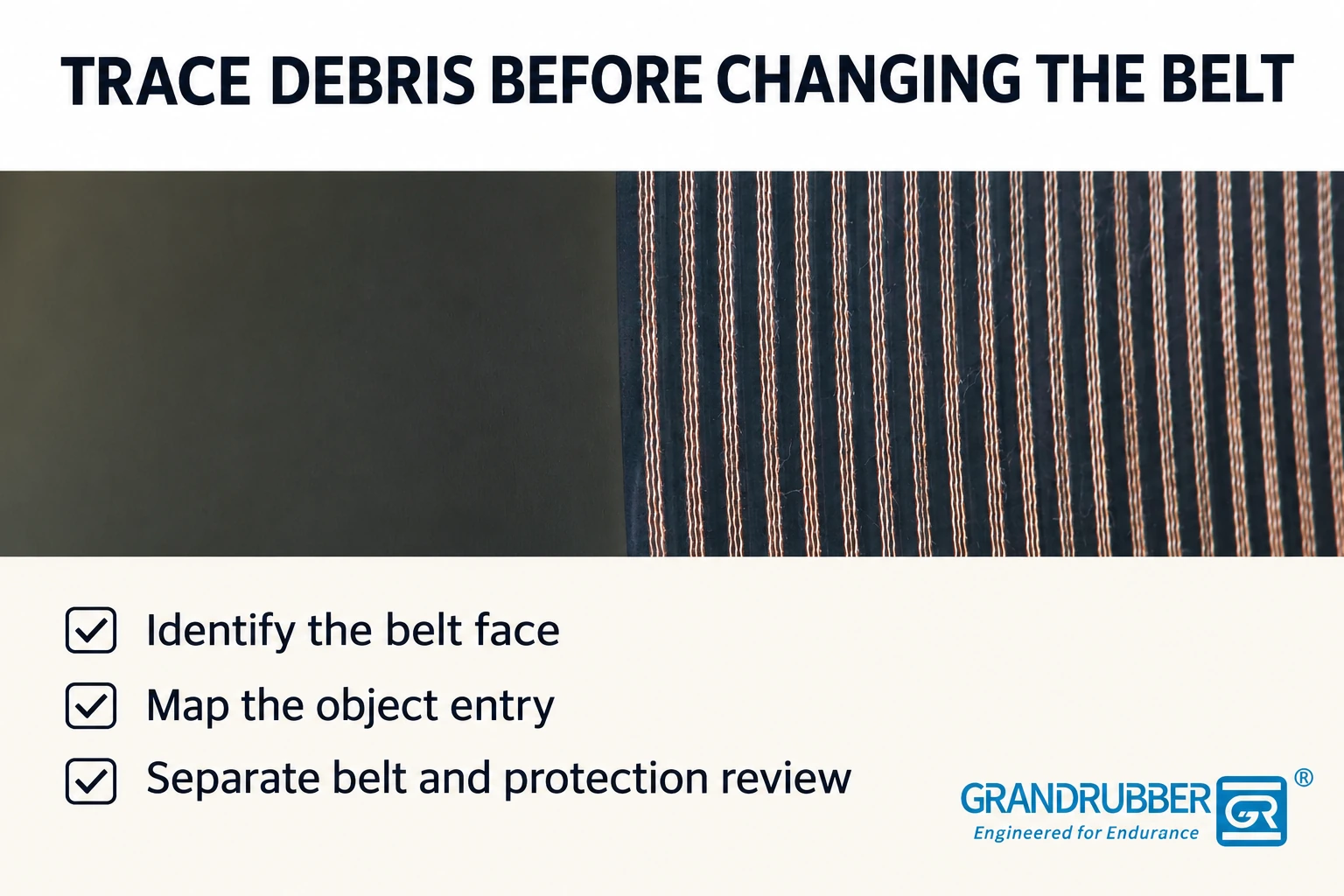 Open full-size image ↗
When objects repeatedly reach a tail pulley, the purchasing question is not simply whether a tougher belt is available. Establish which belt face is affected, where the objects enter and whether the existing protection arrangement is itself contributing to contact damage. A replacement belt and a corrected protection arrangement are separate deliverables. This guide organizes the evidence for that decision; it does not set plow pressure, clearances or service procedures.
Name the belt face and the entry path
The carrying face transports material through the loaded run. The opposite, pulley-contact face is the face relevant to objects trapped as the belt meets a pulley. On a return run, labels such as top side can confuse an observer; identify the face by function and mark the direction on the equipment drawing.
Carryback is material remaining on the carrying face after discharge. Spillage onto the other face is a different observation, even if both eventually accumulate near the tail. A pile beside the pulley is a collection location, not proof of where the material entered. Separate these possibilities before selecting a cleaner, protection device or belt change.
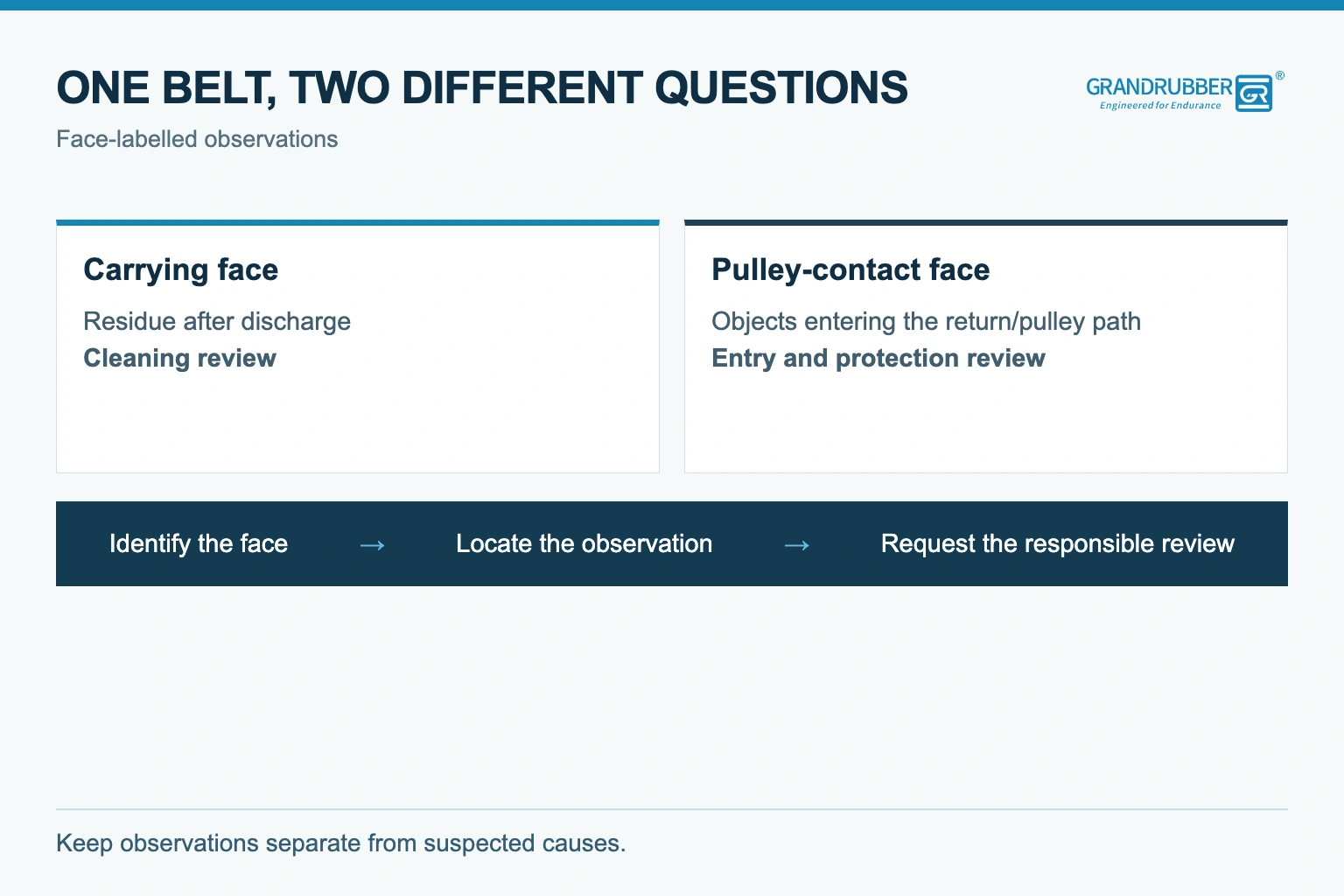
Use the manufacturer case as a question, not a recipe
Martin Engineering reports a Peruvian installation where an existing tail-protection device failed to prevent object entrapment and also contributed to wear on the belt’s inner cover. That is a manufacturer-specific case, not a diagnosis of another conveyor or a GRAND RUBBER installation.
The procurement lesson is narrower than the case’s claimed outcomes: ask what the present device actually protects and how its contact with the belt has been assessed. The fact that protection is installed does not demonstrate that its arrangement is appropriate. No pressure value, standards-compliance claim, energy saving or service-life result from that case is adopted here.
Build a location record that separates observation from cause
Ask the responsible site team for authorized inspection records showing the affected face, damage locations, pulley location and existing protection identity. Link overview and detail images to the same drawing position. Record whether the observed objects, marks or accumulation change with loading, cleaning or another operating condition, where that history is known.
The first table is a record structure. It does not instruct anyone to approach moving equipment. Use the site’s controlled inspection and isolation arrangements; missing access is a limitation to resolve with the responsible team, not a reason to obtain a risky photograph. A visible groove can guide an inspection request without proving the original cause or remaining structural capability.
| Observation | Identify | Still not established |
|---|---|---|
| Debris on belt | Carrying or pulley-contact face and location | Original entry point |
| Damage | Face, position and authorized assessment | Cause or structural disposition |
| Protection device | Actual identity, task and contact area | Suitability from presence alone |
| Material history | Known event and operating context | A universal repeating mechanism |
Worked example: a cleaner count conceals a second problem
Assume a hypothetical buyer reports several cleaners and asks for a thicker belt because stones still reach the tail. The information does not identify which face each cleaner contacts or where the stones enter. No particular conveyor, thickness, quantity or failure result is assigned.
First split the review: what remains on the carrying face, and what reaches the pulley-contact face? Ask the cleaning/protection supplier to identify the task and applicable equipment for each. Ask the belt reviewer to assess the documented damage separately. Increasing cover thickness cannot establish that an unidentified object path or an unsuitable contact device has been corrected.
The second table records the proposal boundaries. The useful response may be two coordinated reviews rather than an immediate new-belt order. If the protection supplier proposes a change, keep its interfaces and acceptance basis with the belt-condition assessment.
| Proposal | Responsible question | Do not infer |
|---|---|---|
| Replacement belt | What condition and construction are supported? | Object entry is corrected |
| Protection change | What path and equipment interface are addressed? | Existing damage is acceptable |
| Site work | Who installs and accepts the arrangement? | Parts price includes all tasks |
| Review outcome | What remains unresolved before release? | A photograph grants approval |
Compare the belt proposal and protection proposal without mixing responsibility
A belt supplier needs the complete construction, duty and actual assessed damage to review a replacement. The equipment party needs the object path, device identity, layout and applicable maintenance information to assess protection. Give both parties the same location references, but do not assume that one supplier has accepted the other party’s design.
Record who confirms measurements, who supplies the device, who performs site work and who accepts the completed arrangement. If the belt proposal changes covers or reinforcement, list those departures explicitly. A material quotation does not approve the protection design; a new protection device does not certify an already damaged belt. Keep any claimed reduction in cleanup, wear or downtime separate from measured site history.
Send one tail-pulley review pack
Use the related conveyor-belt enquiry to submit the existing specification, a face-labelled location record, the damage assessment and the protection proposal. Ask for a written reply identifying established facts, unresolved evidence and the supply boundary. Include the equipment/protection party where its interface remains open.
GRAND RUBBER’s belt and repair product categories provide routes for a material discussion. This article does not establish supply of a V-plow, local inspection or a complete protection installation. Retain the accepted revision and responsibility record with any subsequent order.
Buyer FAQ
Is debris near the tail always carryback?
No. Identify the face and route. Residue on the carrying face and material spilled onto the pulley-contact face are different observations that may need different reviews.
Does an installed V-plow prove the tail is protected?
Its identity and presence do not establish performance in the actual arrangement. Ask its responsible supplier to assess the applicable equipment, contact and material path.
Can a thicker cover solve the problem by itself?
Thickness does not identify or remove an object path. Review the damage and protection arrangement before treating a cover change as the complete remedy.
Can I copy a pressure value from the published case?
No. It belongs to that supplier’s described system and conditions. Obtain the applicable controlled equipment guidance for the actual installation.
Do photographs prove which component caused a groove?
They can locate observations but may leave several causes open. Request the responsible assessment rather than assigning liability from appearance.
What if the required inspection point is inaccessible?
Record the evidence gap and ask the site team to plan an authorized assessment. This article does not authorize access near moving or stored-energy equipment.
Sources
Related technical resources
Related products
 Multi-ply Fabric Conveyor BeltsEP/NN multi-ply rubber conveyor belts for mining, cement and bulk handling. Match whole-belt strength, plies and cover grade to your material and conveyor before ordering.
 Belt Repair Strips & PatchesRepair strips and patches in catalogue formats for conveyor belt maintenance. Match dimensions and bonding materials to the damage, including any exposed or affected reinforcement.
Document and page references
- Martin Engineering: manufacturer-specific tail-protection case: Manufacturer case Problem/Solution paragraphs; no exact publication or event date established.
- New comparison/checklist entries and worked examples are editorial review aids, not measured results, approved specifications or real customer cases.
Download the reference tables
Source-labelled review extract. Historical references remain historical; this is not a formal TDS, certificate or current availability confirmation.
Download guide tables CSV