GRAND RUBBER — Engineered for Endurance
HomeAbout UsBuyer SupportFAQWorksheetSearchMarkets / EN

GRAND RUBBER / INDUSTRY OVERVIEW

Steel & Metallurgy

Define sinter/coke conveying and wear protection as separate requirements.

Operating scenarios
2
Candidate product routes
5
Related buying guides
20
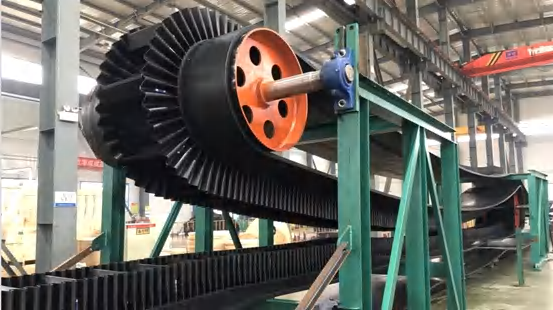
Hot material on an industrial conveyor in the GR catalogue.
Heat-resistant Conveyor Belts · Catalogue application or exposure illustration; confirm the actual product specification and duty.

01 / PROCESS & APPLICATION

Separate the operating duties

Hot material on an industrial conveyor in the GR catalogue.
Heat-resistant Conveyor Belts · Catalogue application or exposure illustration; confirm the actual product specification and duty.
OPERATING STAGE 01

Steelworks hot-bulk handling

Review heat exposure and conveying duty before comparing offered constructions.

Check: Record material, normal/peak/surface temperatures, loading, working tension, conveyor geometry, cover requirements and source edition.

Open this duty and its product routes →
02 / DUTY-TO-PRODUCT MAP

Match the product role to the operating problem

Operating stage → candidate products → information needed for review
Operating dutyCandidate productsWhat the buyer needs to establish
Steelworks hot-bulk handlingRecord material, normal/peak/surface temperatures, loading, working tension, conveyor geometry, cover requirements and source edition.
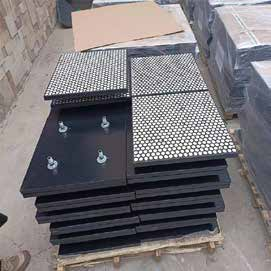
Steelworks chutes & composite linersRecord wear mechanism, material, particle size, temperature, substrate, fixing method, shape and maintenance access.

These are catalogue-based review routes. Confirm the complete duty and evidence; an industry listing is not an engineering approval.

03 / CONSTRUCTION & INTERFACES

Review the candidate product range

Hot material on an industrial conveyor in the GR catalogue.
Heat-resistant Conveyor Belts · Catalogue application or exposure illustration; confirm the actual product specification and duty.
Conveyor Belts

Heat-resistant Conveyor Belts

Heat-resistant conveyor belts for hot bulk materials in cement, steel and related processes. Separate continuous, peak and belt-surface temperatures before choosing the construction and cover grade.

T1
≤100°C (Continuous temperature) / 150°C (Peak temperature) / ≤75°C (Belt-surface temperature)
T2
≤125°C (Continuous temperature) / 170°C (Peak temperature) / ≤100°C (Belt-surface temperature)
T3
≤150°C (Continuous temperature) / 200°C (Peak temperature) / ≤125°C (Belt-surface temperature)

04 / ENGINEERING HANDOFF

Prepare the industry-specific project inputs

Steel & Metallurgy · review checklist

  • Thermal cycle
  • impact
  • sharp material
  • route
  • cover selection
  • chute geometry and required acceptance documents
01

Identify the operating stage and existing product

02

Share known conditions and the controlled drawing

03

Confirm the selected construction and document scope

Share what you know. Leave unknowns for review.

Send the existing reference, drawing or operating conditions. Confirm the offered construction and document scope before ordering.

Prepare a requirement

05 / BUYER SUPPORT

Read the guidance for your next decision

BUYING GUIDE

How to specify a belt for hot clinker or sinter

For hot clinker or sinter, review the exposure record with the complete belt construction and conveyor conditions. Keep continuous material, temporary peaks and belt-surface temperatures distinct, then ask which offered compound, carcass and joining basis match that duty.

BUYING GUIDE

How to compare conveyor belt quotations

Compare conveyor belt offers against one requirement revision, identify technical departures first, and align quantity and supply boundaries before comparing price. An unpriced or unconfirmed difference remains an open decision, not an assumed saving.

BUYING GUIDE

What information belongs in a conveyor belt quotation request?

A useful conveyor belt quotation request separates documented requirements, observations and missing inputs. Identify the belt and duty, assign each uncertainty to the right reviewer, and state whether you need preliminary guidance or a defined quotation.

BUYING GUIDE

Datasheet, test report or certificate: what does each prove?

Match each document to the specific claim it supports: a product description, a result for an identified specimen, or certification of a stated scope. More files do not close an evidence gap if they concern a different item or question.

BUYING GUIDE

Hardness alone does not select a wear lining

Hardness is one material property, not a wear-lining selection rule. Compare the actual damage and mounting duty with identified material evidence measured on a compatible basis before choosing a lining.

BUYING GUIDE

What is needed to specify a new sidewall conveyor?

For a new sidewall conveyor, define the material, required duty and route together before choosing belt geometry. Separate fixed project constraints from proposed dimensions and ask the responsible design team to resolve missing inputs.

All technical resources

Questions buyers ask before choosing

How can I specify a heat-resistant conveyor belt correctly?

Record the material, continuous and peak temperature, how temperature was measured, contact time, belt speed and cooling conditions. Material temperature and belt-surface temperature describe different conditions.

Continue to the related product or guide
What is the difference between supplied specifications and batch test results?

A datasheet describes the identified product and specification. A batch test report records the tests and results for its stated sample or batch. A management-system certificate describes a named organisation and certified scope; it does not establish every product performance claim.

Continue to the related product or guide
What is the difference between a test report and a certificate?

A datasheet describes the identified product and specification. A batch test report records the tests and results for its stated sample or batch. A management-system certificate describes a named organisation and certified scope; it does not establish every product performance claim.

Continue to the related product or guide
How do I compare two belt quotations with different technical specifications?

Place belt width, length, carcass, strength, ply count, top and bottom covers, edge type and stated standard in one comparison table. List deviations rather than assuming two offers describe the same product.

Continue to the related product or guide
What information is needed to request a conveyor belt quote?

Include product type, existing designation, width, quantity, belt length or roll lengths, carcass, strength, covers and the required standard where known. State what is unknown instead of guessing.

Continue to the related product or guide

06 / PROCUREMENT DOCUMENTS

Product-specific files & evidence

Catalogue extracts contain the listed specifications, source and purchasing conditions. Controlled TDS, batch reports and certification originals require confirmation for the selected product and order.

Catalogue reference

Source-labelled data and actual extract downloads are available above.

Order-specific evidence

Confirm file revision, applicable product, required tests and acceptance conditions.

Document control

Manufacturing & quality

Review company and quality information separately from the source catalogue values.

Review the evidence routes

Catalogue PDF references

These are complete catalogues. Use the product and physical-page references below. They are not single-model datasheets, approved drawings, batch test reports or certification originals. Different catalogue schedules and versions must not be combined.

Conveyor belts & rubber sheets — full catalogue

Full source catalogue for reference only. Check the physical pages and the selected construction. Catalogue claims do not replace order-specific technical approval, test results or certification evidence.

File version: 4abe41343ea1 · 22 PDF pages. Issue date: not confirmed.

Applicable product / model and physical PDF pages

Download full catalogue PDF (22 pages · 18.2 MB)

Conveyor belts — full product manual

Full source catalogue for reference only. Check the physical pages and the selected construction. Catalogue claims do not replace order-specific technical approval, test results or certification evidence.

File version: 46905d537347 · 41 PDF pages. Issue date: not confirmed.

Applicable product / model and physical PDF pages

Download full catalogue PDF (41 pages · 8.6 MB)

Conveyor components — full product manual

Full source catalogue for reference only. Check the physical pages and the selected construction. Catalogue claims do not replace order-specific technical approval, test results or certification evidence.

File version: 90e4dfe160e9 · 42 PDF pages. Issue date: not confirmed.

Applicable product / model and physical PDF pages

Download full catalogue PDF (42 pages · 10.1 MB)

Request matching technical files

Catalogue basis and project evidence

; p35. These are catalogue application scenarios, not a representation of an authorised GR project at a named customer. Request the applicable drawing, offered specification and evidence.

Review manufacturing and quality information