
Surface Cracks With Little Wear: What Should a Belt Buyer Review?
Light wear does not rule out other deterioration, but a photograph of cracks does not prove their cause. Record the crack pattern, affected locations, exposure and belt history, then request a responsible review of material and operating evidence. Keep ozone/UV resistance distinct from abrasion performance.
On this page
 Open full-size image ↗
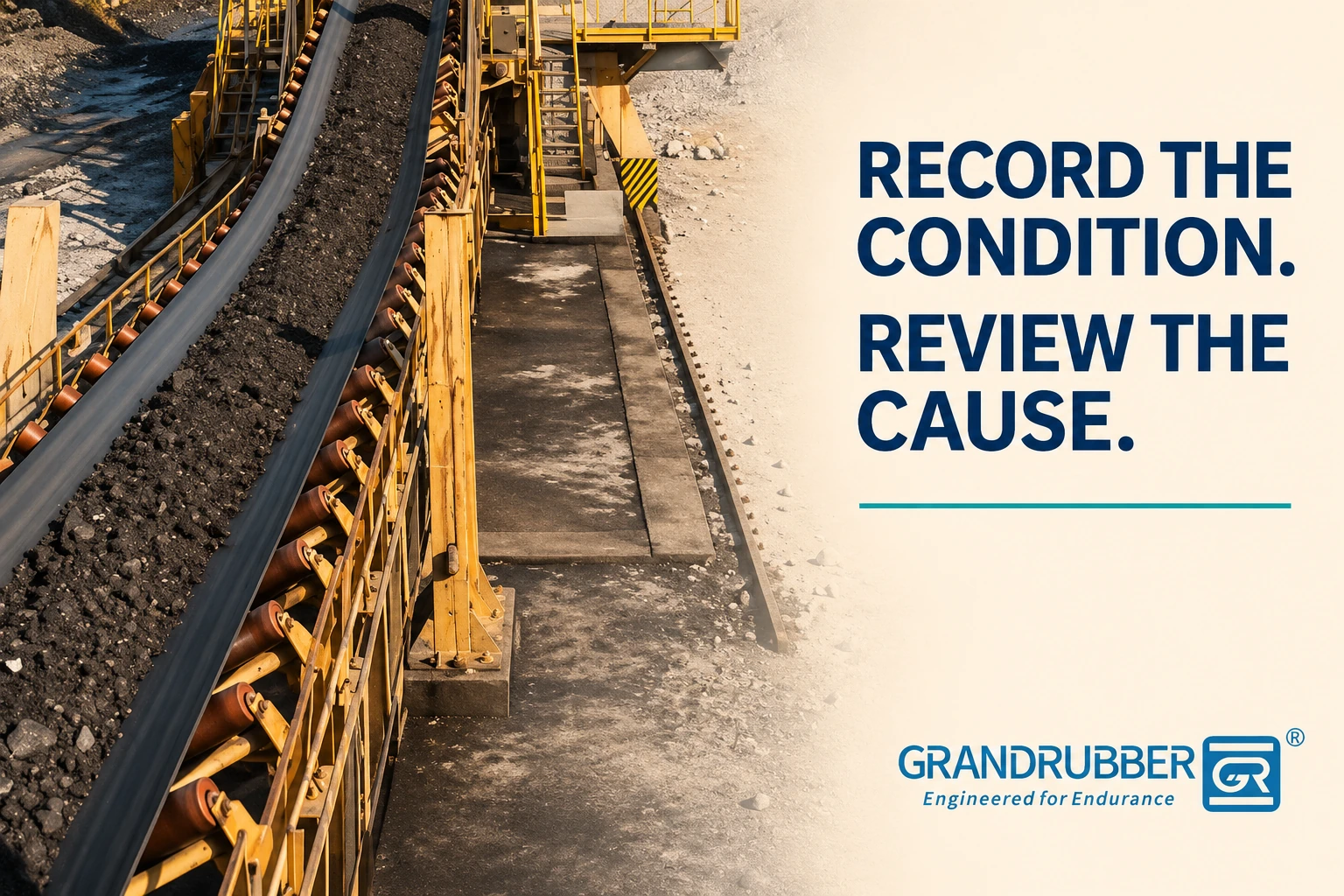
Light wear does not rule out other deterioration, but a photograph of cracks does not prove their cause. Record the crack pattern, affected locations, exposure and belt history, then request a responsible review of material and operating evidence. Keep ozone/UV resistance distinct from abrasion performance.
Separate material loss from a change in surface condition
Wear and cracking are different observations. A belt can have little obvious material loss yet show a surface condition that needs investigation. Conversely, the presence of cracks does not establish a single cause. The buyer should preserve both the physical observation and the uncertainty about its explanation.
Fenner Dunlop’s discussion describes ozone- and ultraviolet-related rubber deterioration and surface cracking. It provides background for asking about exposure and relevant material evidence, not a diagnosis of a photograph or a guarantee about another supplier’s belt. Its proprietary resistance claims and time-to-life comparisons are not adopted here.
A procurement enquiry should therefore avoid two shortcuts: selecting only an abrasion figure because the belt is a wear product, or declaring ozone damage because cracking is visible. Ask which review and evidence address the actual condition and proposed replacement.
Map the observed cracks and the exposure history
Identify the belt, affected face, locations and the condition already documented. Use an equipment map or labelled records to distinguish local damage from observations across other areas. State when the condition was first observed and what is known about prior storage, exposure or changes in use; do not turn an unknown installation date into an estimated material life.
Describe relevant outdoor or sheltered exposure and the actual process/cleaning conditions where recorded. If a history is incomplete, preserve that limitation. A geography label alone does not quantify ozone or UV exposure, and a photograph does not measure either.
The first table separates the observation record from the causal hypothesis. It is an information request, not an instruction to inspect a moving belt or conduct a chemical or exposure test. The responsible equipment and material reviewers determine the applicable investigation and safety process.
| Record | Useful input | Do not infer |
|---|---|---|
| Condition | Actual crack pattern, face and affected locations | A photograph proves ozone or another single cause |
| Material history | Identified belt, documented age/changes or unknown | Appearance establishes original formulation |
| Exposure | Actual storage/outdoor/process/cleaning history | Country or climate label measures exposure |
| Property evidence | Abrasion and ageing results in separate scopes | One property report proves every response |
| Disposition | Responsible material/equipment assessment | An adjective supplies a diagnosis or service-life forecast |
Ask for ageing evidence as its own property question
An abrasion report addresses its stated test; it should not silently become an ozone- or UV-resistance result. Ask which material and method the offered ageing evidence covers, the conditions identified in the report and how the supplier connects it to the proposed belt. If only a general weather-resistant description is available, request its documented meaning.
Keep unlike assessment categories separate. An ozone-related report, a UV exposure result and a field history each has its own subject and conditions. They are not automatically interchangeable or a universal service-life forecast. Do not derive years in operation from hours in a manufacturer’s laboratory exposure without an applicable validated basis.
The relevant purchasing outcome is an identified property response against the actual requirement. This guide does not give an exposure concentration, strain, duration or pass threshold, and does not claim that a GR belt has completed any specific ageing test.
Worked replacement enquiry: a better abrasion figure leaves the crack question open
Assume a hypothetical buyer reports surface cracks while noting that little cover has visibly worn away. A replacement offer emphasizes a different abrasion value but does not identify any ageing evidence or address the recorded exposure. No actual material result or customer case is being represented.
The offer has answered one property question, not necessarily the reason the buyer raised the enquiry. Ask for a responsible review of the observed condition and the property evidence applicable to the proposed replacement. Preserve abrasion data within its own scope instead of treating it as irrelevant or all-inclusive.
A second response may attribute the cracks to ozone from a single photograph. That explanation also needs support. The buyer should ask what evidence and limitations underlie the conclusion and which other material or operating information remains necessary. Do not replace the missing review with a stronger headline claim.
The second table keeps those gaps distinct. It allows a buyer to request a more useful answer without diagnosing the belt or prescribing a particular compound. A proposal can remain open while the relevant condition and evidence are reconciled.
| Response | What it addresses | What remains open |
|---|---|---|
| Abrasion value emphasized | One wear-test property | Recorded cracking and ageing requirement |
| Ozone cause asserted from photo | A hypothesis is proposed | Supporting investigation and its limitations |
| General weather-resistant label | A claimed product characteristic | Defined evidence for the offered item |
| Changed cover recommended | A material departure is proposed | Which requirement and evidence justify the change? |
Keep any proposed material change and claimed benefit traceable
If the supplier recommends a different cover or construction, record exactly what changes and which stated requirement the change addresses. A general promise of longer life does not identify the technical basis or prove the cause of the existing condition. Ask for applicable offered-item evidence and explicit limitations.
Do not turn a manufacturer’s advice about its own formulation into a claim that all belts of a polymer category have the same ageing response. Similarly, colour or a familiar grade name does not establish which additives or test performance the actual offered item has. The proposal needs its own identity and evidence.
Retain the accepted exposure requirement and the final material revision with the order. Where the project’s service or storage assumptions change later, ask whether the earlier response remains applicable. That is more useful than carrying forward one unqualified weather-resistant phrase.
Send an observation-and-ageing evidence request
Use the fabric-belt enquiry with the documented crack/location record, actual exposure history, belt identity and proposed replacement requirement. Ask GRAND RUBBER for the material response and supporting documents within the actual offer. No GR ozone/UV test result, resistance percentage or guaranteed life is established here.
The troubleshooting guide helps organize an observed condition without assuming its cause, while the cover-evidence guide addresses a different comparison of wear duty. Here the specific decision is whether the reported cracking and relevant ageing property have actually been addressed.
The next action is one written response distinguishing observation, proposed explanation, applicable evidence and remaining investigation. Keep those categories in the purchasing record so a replacement proposal does not become an undocumented diagnosis.
Buyer FAQ
Can a belt crack before much cover is worn away?
These are different observations; limited visible wear does not close the condition review. Record the actual findings and seek an applicable assessment.
Do cracks in a photograph prove ozone damage?
No single cause is established by the picture alone. Keep the pattern and exposure record separate from the responsible causal assessment.
Does a lower abrasion-loss result establish better UV resistance?
Not by itself. Abrasion and ageing evidence need their own identified subject, conditions and applicability to the offered belt.
Can laboratory exposure hours be converted directly to years of service?
No universal conversion is used here. A life prediction needs its own applicable validated basis, not an assumed ratio.
Does outdoor use require one universal compound?
This guide does not select a compound from the word outdoor. Identify the actual duty and requested evidence and obtain a construction-specific proposal.
Can colour establish the protective formulation?
No. Obtain the actual product identity and applicable evidence rather than inferring formulation or ageing response from colour.
What is the useful next action?
Send the documented condition, location and exposure history with the belt identity, then ask for the responsible assessment and relevant offered-item evidence.
Sources
Related technical resources
Related products
 Multi-ply Fabric Conveyor Belts
Document and page references
- Fenner Dunlop — Effects of ozone and ultraviolet on rubber conveyor belts: Ozone/ultraviolet deterioration and observed surface cracking sections. Background failure-review questions only; no diagnosis from a photo,100percent resistance, life conversion or proprietary test threshold transferred. Research PDF URL could not be retrieved here; verified primaryHTML used.
- Editor-derived evergreen purchasing analysis; hypothetical examples are not real cases, field results or approved operating procedures.
Download the reference tables
Source-labelled review extract. Historical references remain historical; this is not a formal TDS, certificate or current availability confirmation.
Download guide tables CSV