
Conveyor Carryback With Cleaners Installed: What Should Buyers Check Before Replacing the Belt?
When carryback persists, compare the residue pattern with cover condition and the installed cleaning system. Use a matched inspection and quotation record before choosing cleaning work, cover repair or a replacement belt.
On this page
 Open full-size image ↗
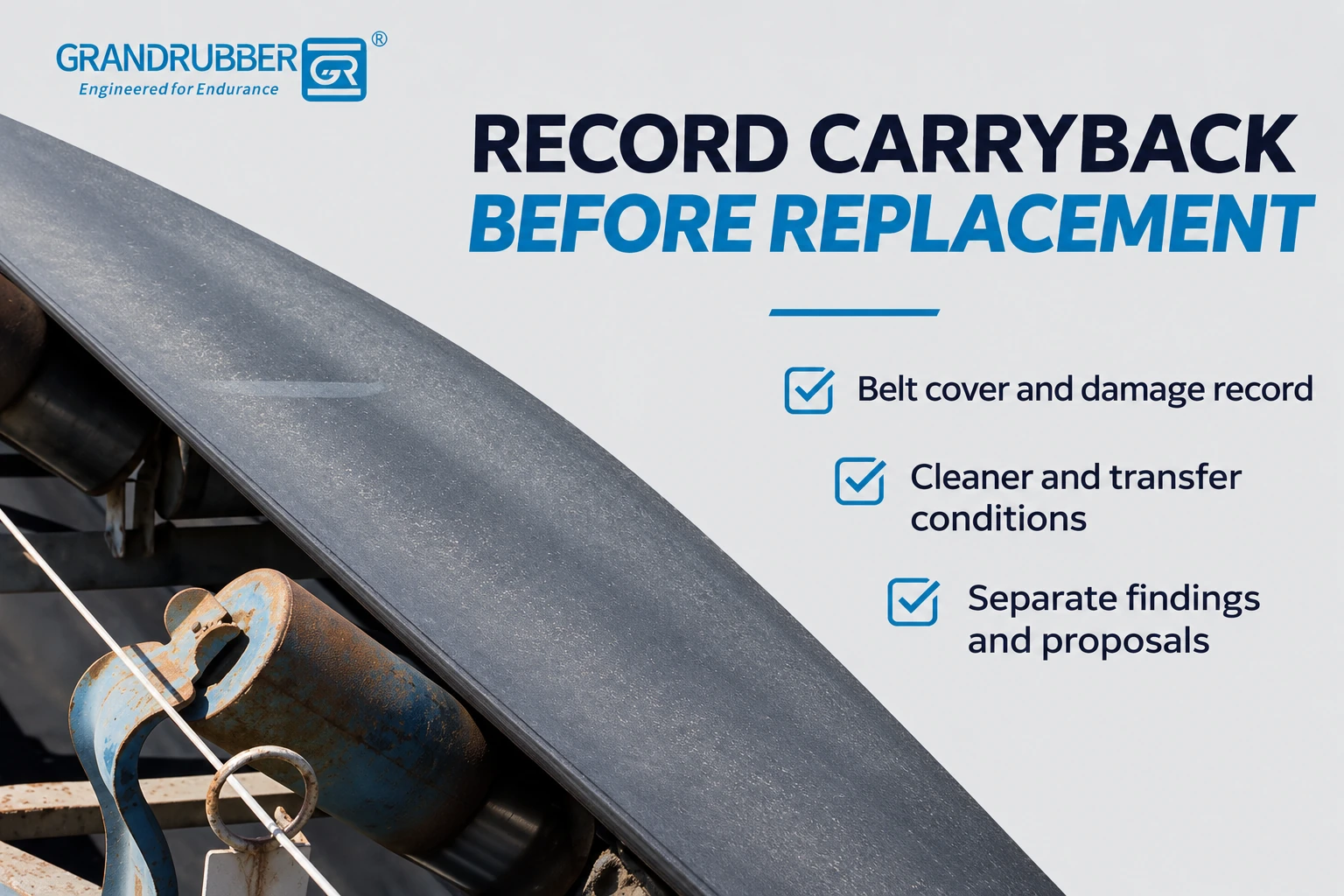
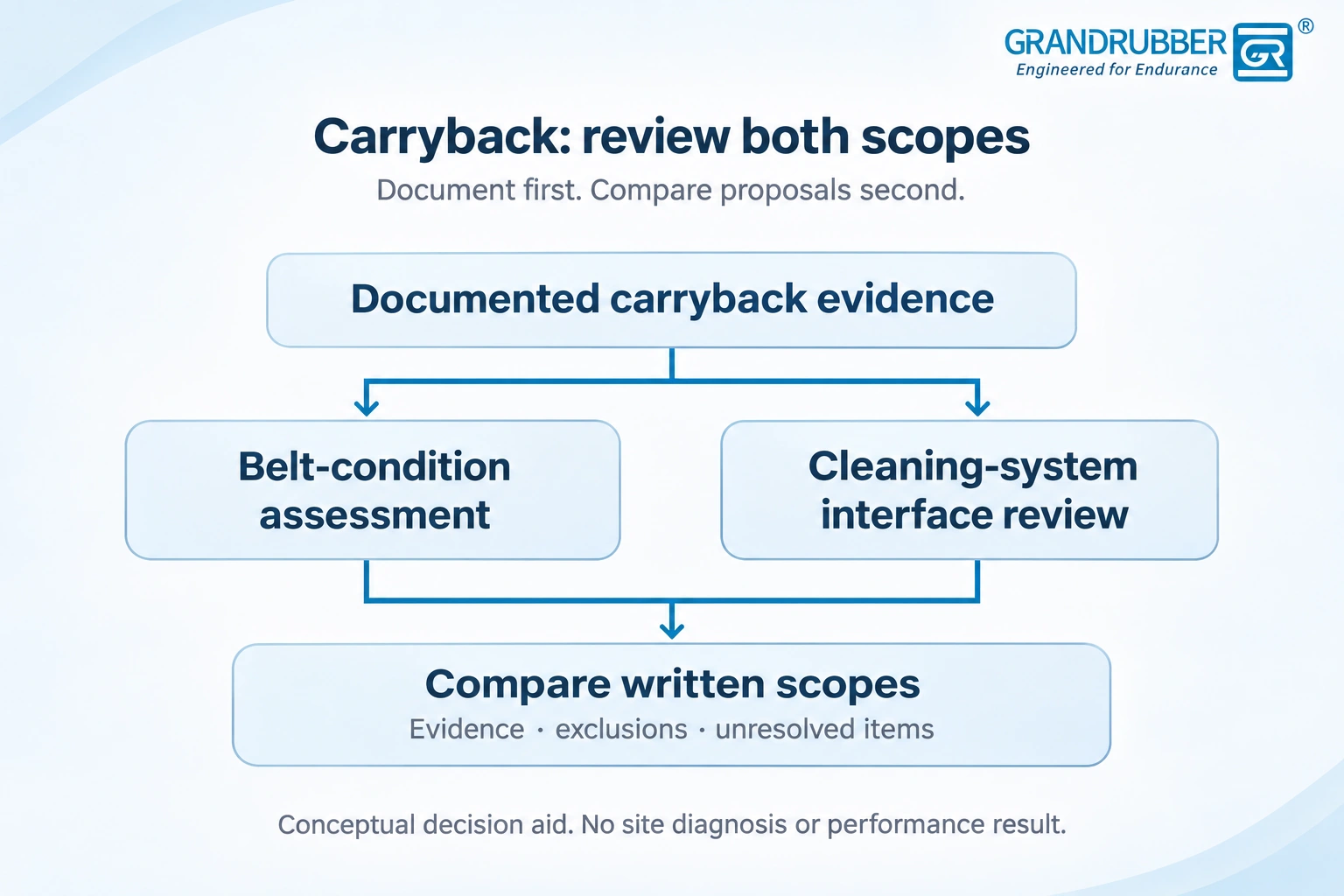
Cleaners being installed does not prove that the remaining carryback requires a new belt. Before buying another cleaner or replacing the belt, document where material remains, whether it follows damaged cover areas, and what the cleaning-system supplier has verified. A replacement decision needs both a belt-condition assessment and an explanation of the unresolved cleaning problem.
Carryback means material that stays on the belt after discharge and travels along the return route. This guide helps maintenance and procurement teams prepare an evidence-based review for conventional rubber conveyor belts handling bulk material. It does not set cleaning adjustments, repair limits or approval criteria for an underground installation.
Why can carryback remain when cleaners are already installed?
An installed cleaner is an equipment fact; an effective cleaning arrangement is a condition that must be checked. Record the actual make, model, position, blade or brush type, maintenance history and the belt surface it contacts. A list saying “three cleaners fitted” does not explain which material each unit removes or what remains after it.
Martin Engineering’s 2021 article explains that residual fines and moisture can leave material lodged in belt-surface imperfections even after primary cleaning. Flexco’s W457 bulletin also identifies worn top covers as harder to clean. These are reasons to investigate the cover and cleaning interface together, not proof that either caused a particular site’s problem.
A public underground-limestone discussion illustrates the information gap. Its author reported existing cleaners and fine material caught in cuts and dimples. Commenters proposed different remedies, but the discussion supplies no verified inspection, approved selection or final result. It is a question source, not a GRAND RUBBER case study.
What does the residue pattern tell the reviewer?
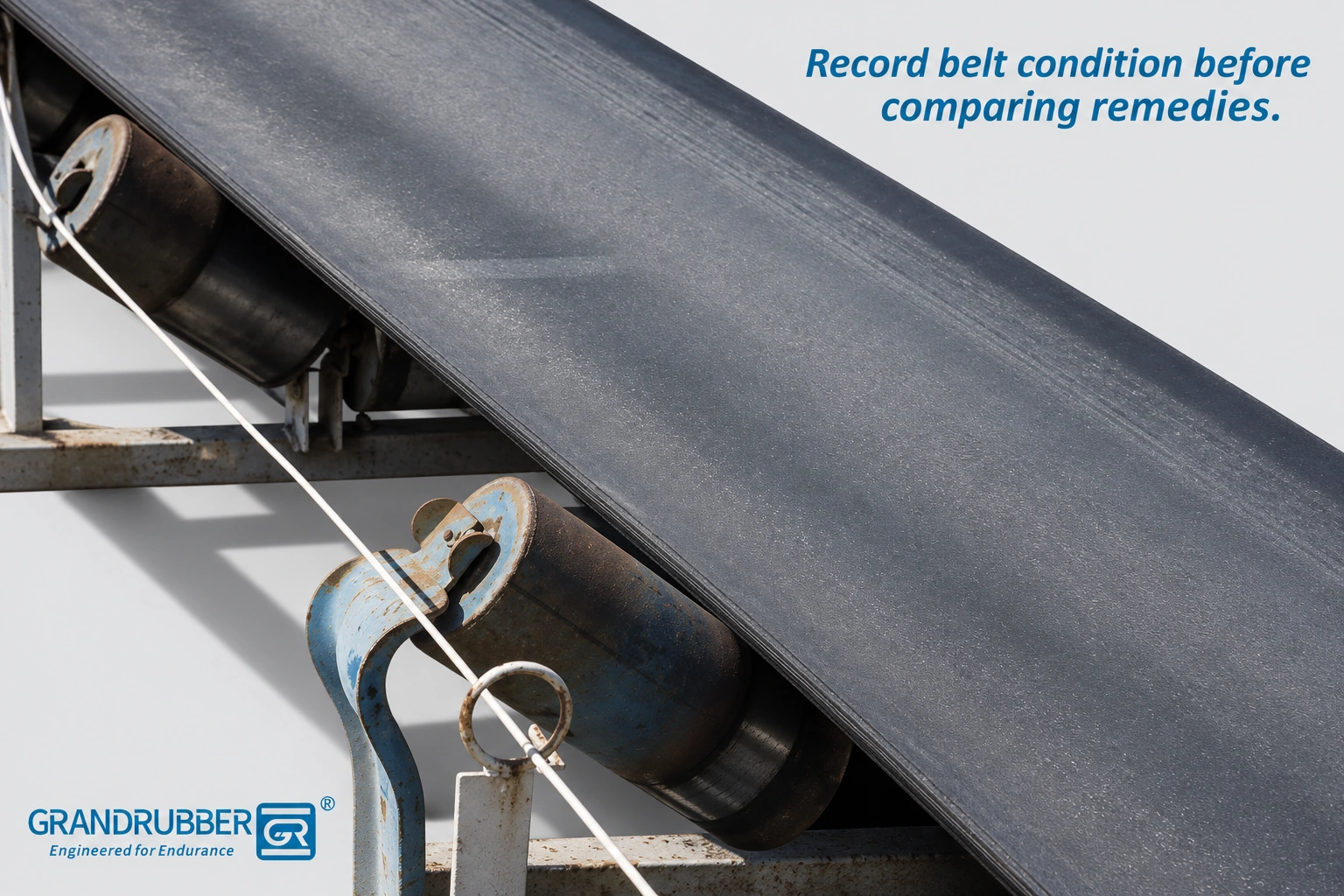
Prepare a location record that connects the dirty belt surface with the accumulation below it. Distinguish residue visible after discharge from material spilled onto the return strand elsewhere. A pile near the tail identifies a collection point; it does not by itself locate the source.
Ask the responsible inspection team to distinguish a continuous dirty band, isolated pockets in damaged areas, and residue associated with a splice or a previous repair. Record whether the pattern is persistent or changes with the material condition. Provide dated photographs from an authorized inspection, with a scale where safely available and a clear label identifying the belt face.
The first table turns those observations into separate review questions. Its entries are an editorial recording aid, not a diagnostic chart. For example, material in surface depressions warrants a cover-condition assessment, but the same photographs may leave the cleaner’s condition, contact and compatibility unresolved. Do not turn a plausible explanation into a purchase specification.
| Record from an authorized inspection | Question for the responsible reviewer | What the observation does not prove |
|---|---|---|
| Residue concentrated in cover cuts or depressions | Assess cover condition alongside the installed cleaning interface | That a new belt alone will resolve carryback |
| A persistent dirty strip across otherwise different belt areas | Review cleaning coverage and equipment condition | That higher pressure or an extra cleaner is appropriate |
| Residue near a splice or previous repair | Verify the joint/repair and cleaner compatibility | That a particular fastener or repair system is suitable |
| Material accumulates near the tail | Trace where it enters and leaves the return route | That the tail is where the carryback originates |
| Residue changes with wet or different feed | Compare conditions using dated records | A fixed improvement percentage under all duties |
What must the cleaning-system supplier verify?
Give the supplier the installed equipment identity and the operating envelope, including belt width, speed, direction of travel, material path and splice details. Ask which supplied document covers that exact cleaner and application. Include access and discharge constraints: where can removed material go, and how can the selected equipment be maintained under the site’s approved procedure?
Flexco’s Quick Fixes guide identifies mounting, belt shape at the cleaner, blade wear and material-path matching as relevant cleaning issues. Those checks support a model-specific review; they do not justify copying a generic installation change onto an unidentified conveyor.
More blade pressure is not a purchasing shortcut. Flexco W457 warns that excessive tension can reduce cleaning performance and damage equipment or belt surfaces. Request the applicable manufacturer’s assessment rather than an improvised tension value. Any physical inspection, cleaning or service requires the actual equipment’s isolation and stored-energy procedure; this article is not a maintenance instruction.
If a brush is proposed, request its application limits, space and drive requirements, compatibility with the existing belt and joints, servicing access, and the route for removed material. A brush suggestion from a discussion is not an approved design, and this article does not establish GRAND RUBBER as its supplier.
When should cover repair or belt replacement enter the comparison?
Bring the belt supplier into the review when an authorized condition assessment identifies damage requiring a belt disposition. Keep that assessment separate from the cleaning-system assessment. A surface defect can matter to cleanability without a photograph establishing the belt’s remaining structural capability. Conversely, reducing visible carryback would not establish that damaged reinforcement is acceptable.
Ask for a written disposition describing the assessed areas, the applicable repair or replacement basis, the remaining uncertainties and who is responsible for acceptance. If the proposal concerns only a cover treatment, ask what it is intended to restore and what it does not establish. If it concerns replacement, ask why cleaning-system work alone would leave the documented requirement unmet.
Do not request an identical-looking belt as the whole solution. Record how the observed damage developed and what will be checked before the new belt enters service. Otherwise, a quote may replace the component without addressing the cause of the original condition. This is the central buying distinction: purchasing a belt and resolving a cleaning problem are related scopes, but neither scope automatically completes the other.
How can buyers compare proposals without inventing a payback figure?
Use one defined review period and compare the same boundaries. List the supply price, installation scope, planned outage, ongoing maintenance, cleanup work and material-handling arrangements separately. Record actual site hours and costs where available; leave unknown figures visibly unresolved. A forum author’s budget estimate is not a replacement quotation for your conveyor.
The second table is a proposal-comparison template. It deliberately asks what evidence would make each option acceptable rather than ranking a brush, repair or new belt in advance. Keep any estimated cleanup saving separate from recorded history and identify who produced the estimate.
Require each bidder to identify exclusions. Who confirms belt integrity? Who confirms cleaner compatibility? Who manages collected fines? Who accepts the completed work? A lower equipment price is not a meaningful comparison when one proposal includes installation and verification and another supplies parts only.
| Proposal | Evidence to request | Scope to price separately |
|---|---|---|
| Service or change cleaning equipment | Exact model/application review and an agreed verification plan | Equipment, installation, access, maintenance and fines collection |
| Repair an assessed cover area | Belt-condition disposition and an applicable controlled repair basis | Preparation, repair, outage and responsibility for acceptance |
| Replace the belt | Complete construction and compatibility review; reason replacement is needed | Belt, joining, installation, outage and cleaning-interface review |
| Defer a buying decision pending inspection | Named evidence gap, responsible party and completion date | Investigation scope; no assumed permission to continue operating |
What should be sent with the next enquiry?
Send one carryback review pack: an annotated location record, authorized belt-condition evidence, cleaner identification and service records, material and duty details, and the proposed options with unresolved questions. Ask for a written response separating observations, assumptions, additional inspection required and supply scope.
If a replacement fabric belt is being considered, use the related Multi-ply Fabric Conveyor Belts page to submit the existing construction and the condition-review pack together. GRAND RUBBER lists fabric conveyor belts; the offered construction and any supporting documents still require application-specific confirmation. The present guide does not promise cleaner supply, on-site service or underground approval.
Use the two tables below to organize that single pack. They are decision aids built for this article, with no claimed field trial, measured performance improvement or universal replacement threshold.
Buyer FAQ
Does carryback prove that the belt cover is worn out?
No. Material remaining after discharge is an observation. Its cause and the belt’s condition require separate assessment. Document surface defects and the installed cleaning arrangement before asking for a repair or replacement disposition.
Can I specify a thicker cover to stop fines sticking?
Not from this evidence. Cover thickness is a construction dimension, not proof of cleanability. Explain the residue pattern and duty to the belt supplier; ask what basis supports any proposed construction change.
Should a brush be added after the existing scrapers?
Only after the equipment supplier checks the actual application and interfaces. Request a model-specific proposal with limitations, access, collection and maintenance scope. The source discussion did not establish an approved brush or a successful result.
What if the belt specification or cleaner model is missing?
List the item as unknown and provide available markings, purchase records and authorized photographs. Ask the appropriate supplier to identify what further evidence is required. Do not substitute a visually similar model or a remembered specification.
Can cleanup labour alone justify replacing the belt?
It can inform the business comparison, but it does not establish the technically appropriate remedy. Use site records over a defined period and compare complete scopes. Keep predicted savings distinct from verified costs and from the condition assessment.
Does an anti-stick product name establish that it suits this problem?
No. Ask for the offered belt construction, applicable material and cleaning-interface evidence. A product category does not demonstrate performance with your fines, cover condition or cleaning arrangement.
Is this guidance an underground belt approval?
No. The discussion that prompted the question concerned underground limestone, but its regulatory and equipment requirements were not verified. Establish the applicable site requirements and product evidence separately before specifying an underground replacement.
What if one supplier only quotes the belt?
Mark the quotation as belt supply only and assign joining, installation, cleaning-system review and acceptance elsewhere. Ask the project owner to confirm the remaining responsibilities before comparing it with a turnkey proposal.
Sources
- Martin Engineering, Seth Mercer, 12 March 2021: residual fines and belt-surface imperfections
- Flexco W457, 17 January 2017, p1: cleaner tension and worn-cover cleanability
- Flexco Quick Fixes, issues 9–10: cleaning-system interfaces
- Public question context: underground-limestone carryback discussion; self-report, no verified outcome
Related products
 Multi-ply Fabric Conveyor Belts
Document and page references
- Catalogue_GRAND_RUBBER.pdf, PDF pp6–7: multi-ply belt structure and specification categories; not application approval.
- Editorial decision tables and comparison method; no site test data, replacement threshold or quantified saving.
Download the reference tables
Source-labelled review extract. Historical references remain historical; this is not a formal TDS, certificate or current availability confirmation.
Download guide tables CSV