
Moulded, Sealed or Raw Cut Belt Edges: What Should the Order Specify?
Specify the actual edge construction and the belt reinforcement it belongs to. Moulded, cut-and-sealed and raw cut edges describe different manufacturing outcomes; a quotation should state the offered form rather than treating the names as interchangeable. Confirm any proposed departure before ordering.
On this page
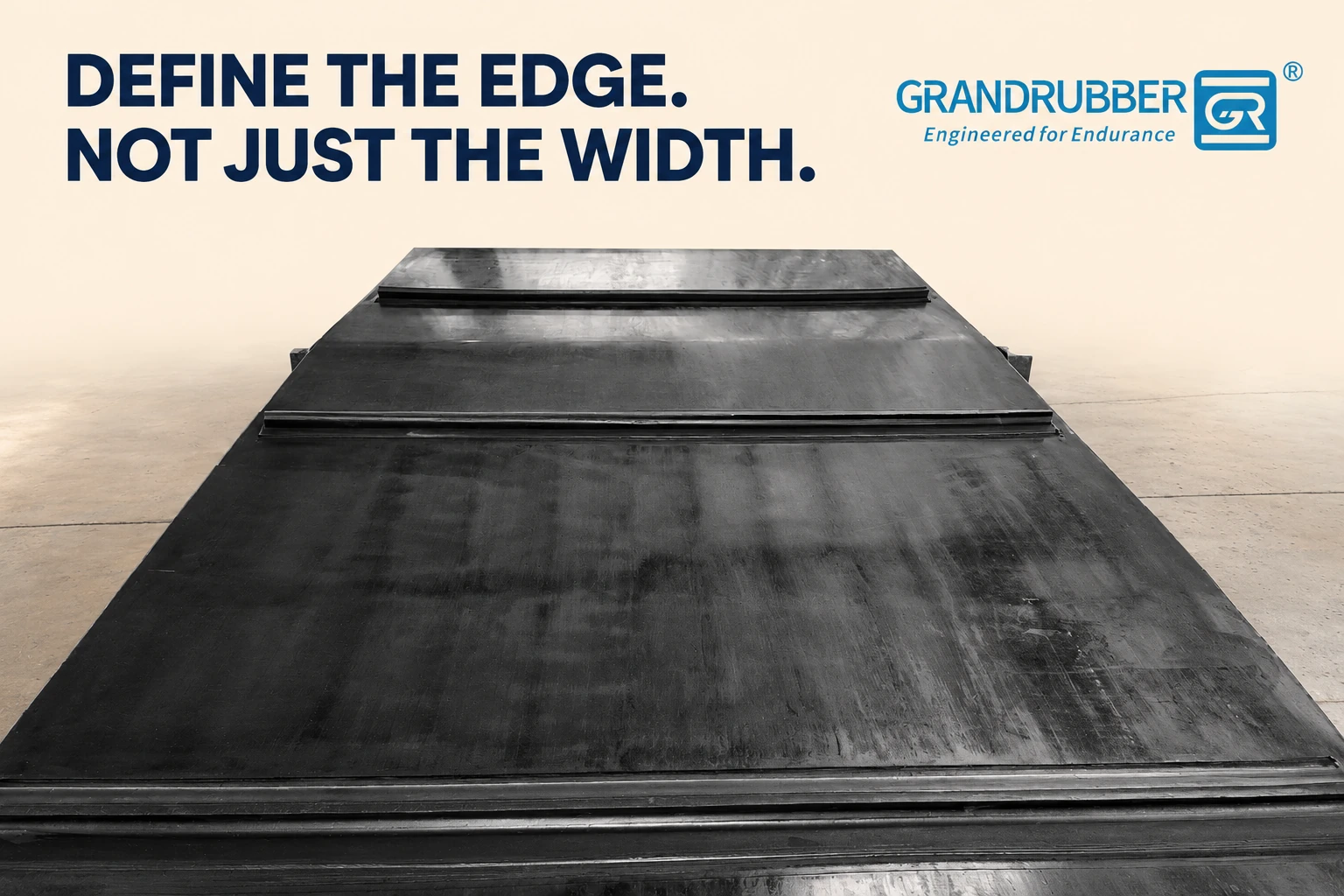 Open full-size image ↗
Specify the actual edge construction and the belt reinforcement it belongs to. Moulded, cut-and-sealed and raw cut edges describe different manufacturing outcomes; a quotation should state the offered form rather than treating the names as interchangeable. Confirm any proposed departure before ordering.
An edge name describes how the belt boundary is supplied
The edge is part of the supplied belt construction, not just the line visible at the side of a drawing. Two offers can name the same width and strength while leaving a different edge outcome. A purchasing comparison should identify that difference explicitly.
Fenner Dunlop’s published explanation distinguishes moulded edges formed with the manufactured belt, cut-and-sealed edges produced during a slitting route, and unsealed cut edges. Its steel-reinforced discussion treats protection of the steel at the boundary as a separate concern. These are useful distinctions from that manufacturer’s explanation; they do not establish GRAND RUBBER’s manufacturing route or availability.
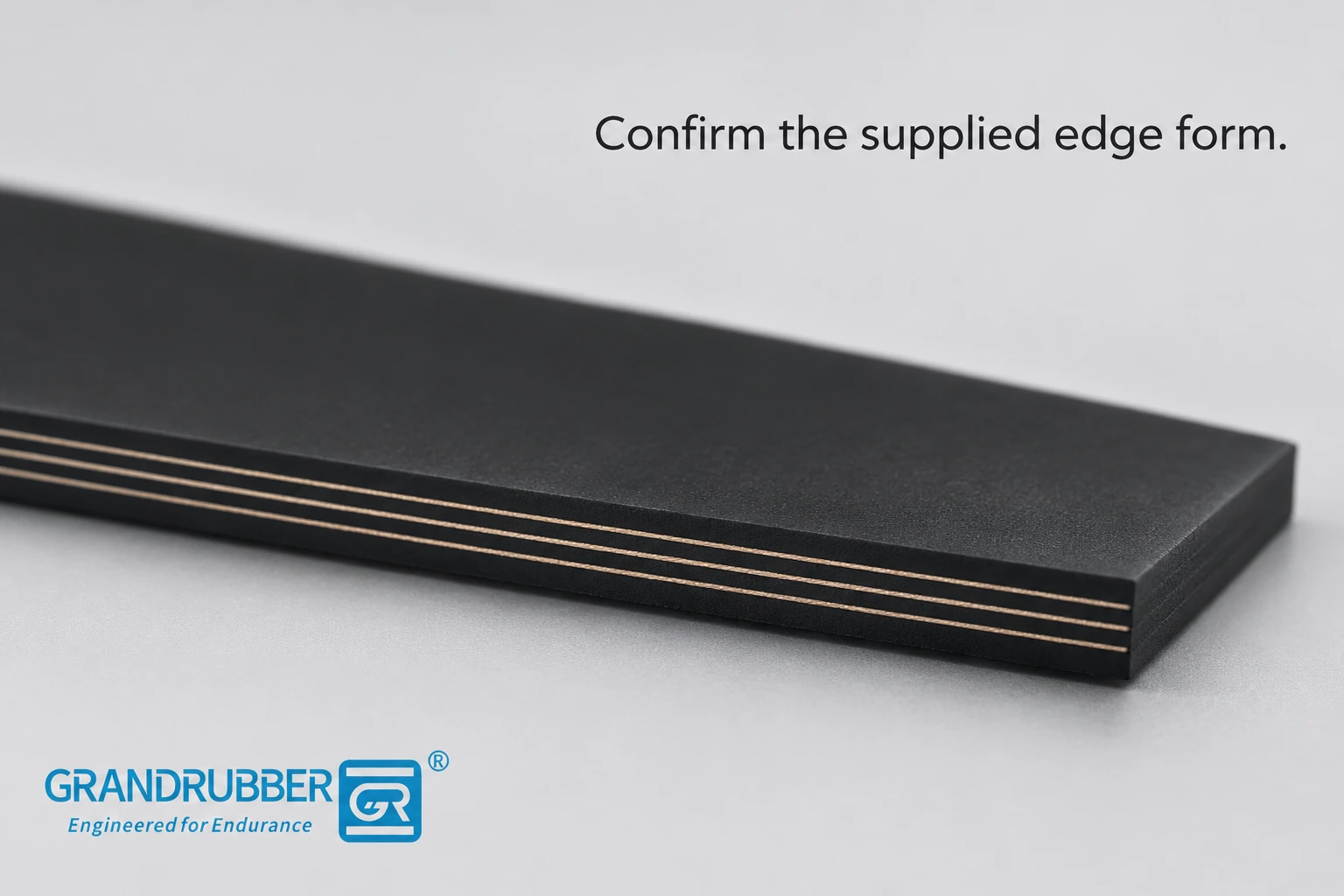
The buying question is therefore more precise than whether an edge looks neat. What edge form is requested, what is offered, and how does it relate to the actual reinforcement? Do not use a photograph of one belt edge to identify a hidden carcass or to establish that every other belt in a product category has the same construction.
Write the edge, width and reinforcement on the same item schedule
Place the requested finished width and edge form beside the declared reinforcement and construction. Identify the relevant drawing or specification revision. If edge terminology comes from an old order or another manufacturer’s catalogue, ask the supplier to state what the proposed term means for this item. A shared word is not a substitute for a construction description.
Where an offer involves slitting a wider belt, ask what finished edge is produced and whether it satisfies the requirement. Do not infer the route from a low price or a short delivery statement. Conversely, do not assume every non-standard width must follow one particular manufacturing route. Those are supplier-specific commercial and production questions.
The first table preserves the distinction between requested form and proposed form. This makes it possible to identify a departure before comparing the rest of the offer. It also prevents a width change during negotiation from silently carrying forward an edge assumption that no longer matches the revised item.
| Item field | What to record | What remains a separate question |
|---|---|---|
| Reinforcement | Declared fabric, steel cord or other actual construction | Do not infer it from the outside edge |
| Edge requirement | Moulded, cut-and-sealed or another explicitly defined form | A name alone may need a construction explanation |
| Finished width | Drawing reference and applicable dimensional basis | A width match does not establish an edge match |
| Proposed route | Supplier explanation of the finished result where relevant | No assumed stock, slitting or delivery capability |
| Departure | Required versus offered form and disposition | No silent replacement by an equivalent label |
Do not turn another manufacturer’s edge explanation into a universal ranking
An application discussion can explain why reinforcement and exposure matter without proving that one edge name is always better. The source’s statements about its own production, stock and edge treatment belong to that supplier. They cannot be imported as GRAND RUBBER capability, a delivery promise or a cross-brand equivalence.
For the actual enquiry, describe relevant wet exposure, storage or joining requirements as requirements to review. Ask the supplier for the applicable response to the proposed construction. Do not claim that an edge treatment makes an entire belt waterproof or eliminates the need to evaluate the joining and storage conditions.
Steel cord or other steel reinforcement should be identified explicitly. A description suitable for a synthetic fabric belt is not, by itself, an answer for a steel-reinforced item. The responsible supplier and reviewer should confirm the edge protection and construction being offered, rather than the buyer extending a general fabric-belt paragraph to a different reinforcement.
Worked comparison: matching widths conceal an edge departure
Consider a hypothetical enquiry that explicitly requests a moulded edge. An offer matches the named width but describes a cut-and-sealed form. There is no test result, price difference or real project outcome in this example. The offered construction may be a proposal for review, but it is not an unchanged match merely because the finished width is the same.
The buyer should place the two edge descriptions in separate requested/offered fields, ask why the alternative is proposed and obtain the applicable technical disposition. If the purchaser accepts a departure, retain the accepted construction and the item revision. Do not let a covering email saying equivalent erase the distinction.
A different offer might simply say cut edge. That leaves another question: does the supplier mean a raw cut boundary or a cut-and-sealed outcome? The correct next action is a defined clarification, not a guess based on how a different supplier uses the term.
The second table shows these as different gaps. One is a known alternative requiring review; the other is an undefined offer requiring identification. Keeping them separate helps prevent avoidable ordering errors without declaring either construction universally acceptable.
| Offer wording | Type of open issue | Buyer response |
|---|---|---|
| Moulded requested; cut-and-sealed offered | Known proposed departure | Request its basis and obtain a recorded disposition |
| Cut edge without further definition | Undefined construction | Ask whether raw or sealed and what the offered form includes |
| Same width and strength only | Incomplete item schedule | Request edge and reinforcement identity |
| Width revised after agreement | Applicability of earlier edge statement | Confirm the final offered item revision |
Plan acceptance around the agreed construction rather than appearance alone
Ask which documents and item identification will connect the delivered belt to the accepted edge schedule. Agree the applicable dimensional and construction checks with the responsible parties. A visual record can show the condition seen at delivery, but it should not be used to infer every concealed feature or to invent an acceptance criterion.
If an edge is damaged in transit or after installation, record the observation separately from the ordered construction. A damaged moulded edge and an intentionally supplied cut edge are different descriptions. The purchase record should preserve both what was specified and what was actually observed, with a responsible disposition for any discrepancy.
Do not use this comparison as a cutting, sealing or repair procedure. Where site modification is proposed, obtain the applicable controlled instruction and its scope from the responsible technical parties. The article addresses the purchase specification and evidence, not how to alter the belt.
Send an edge-specific clarification with the belt enquiry
Use the fabric- or steel-cord-belt product enquiry to send the actual reinforcement, finished width, requested edge form, drawing reference and relevant exposure or joining context. Ask GRAND RUBBER to identify the offered construction and any departures. A product-category listing does not establish every edge/width combination or stock position.
Keep the agreed answer with the final item schedule. The existing quotation-request guide covers the broader enquiry; the present decision is whether the edge form is defined and accepted for this item. If the discussion changes the carcass as well, use the EP/NN comparison to keep that additional change visible.
The buyer can complete one concrete next step: return a marked edge-and-width line showing the requirement, the proposal and the unresolved clarification. Release the purchase item only through the agreed technical and commercial review process.
Buyer FAQ
Are sealed and moulded edges simply two names for the same result?
Do not assume that. Ask what construction and production outcome the supplier means. The purchase schedule should name the actual offered form and its relation to the requirement.
Does specifying a moulded edge always shorten delivery?
No general delivery conclusion follows from the term. Obtain the actual supplier’s quotation-specific production and delivery response; another manufacturer’s account is not a GR lead-time promise.
Can a steel-cord requirement use the same edge reasoning as a fabric belt?
Identify the reinforcement explicitly and request a construction-specific response. The steel protection question must not disappear inside a general fabric-belt description.
What if the old order only says cut edge?
Keep the original wording and ask the responsible parties to establish the intended construction. Do not relabel the old order as sealed or raw without evidence.
Can I identify the edge form from a catalogue picture?
A picture can illustrate an identified item. It does not establish the offered belt’s complete edge construction or hidden reinforcement; request the item-specific description.
Should an accepted alternative stay in a separate email?
Retain it in the controlled final item or departure schedule as well. Otherwise the original request and the final order can continue to describe different constructions.
Does this guide authorize edge cutting or sealing on site?
No. Any proposed modification needs the applicable controlled technical instructions and responsible review for the actual construction.
Sources
Related technical resources
Related products
 Multi-ply Fabric Conveyor BeltsEP/NN multi-ply rubber conveyor belts for mining, cement and bulk handling. Match whole-belt strength, plies and cover grade to your material and conveyor before ordering.
 Steel Cord Conveyor BeltsSteel-cord conveyor belts for high-tension, long-distance bulk conveying. Compare ST, STE and STH constructions against belt width, cord layout, pulley and splice requirements.
Document and page references
- Fenner Dunlop — Choosing the right type of belt edge: Moulded edges; sealed edges; raw cut edges; steelcord and steel-reinforced belts. Manufacturer-specific construction descriptions, not GR production/stock/delivery promises; no edge-width or manufacturing settings copied.
- Editor-derived evergreen purchasing analysis; hypothetical examples are not real cases, field results or approved operating procedures.
Download the reference tables
Source-labelled review extract. Historical references remain historical; this is not a formal TDS, certificate or current availability confirmation.
Download guide tables CSV