
What changes when an industrial rubber enquiry serves another market?
For a new destination, confirm the buyer’s applicable specification, document language, acceptance responsibilities and import-related evidence before repeating an earlier order. A destination name alone does not establish the required standard or legal documents.
On this page
 Open full-size image ↗
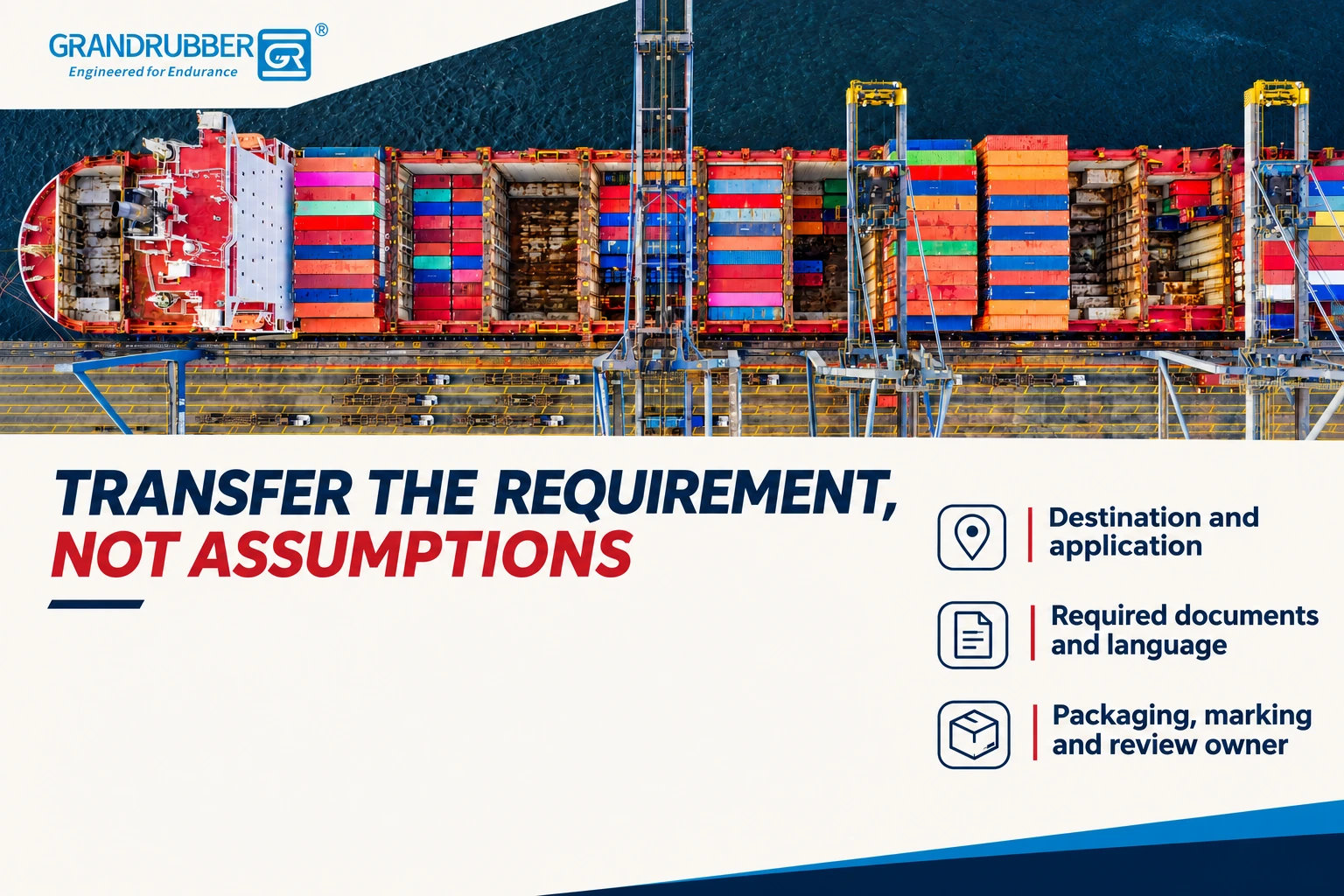
Moving an industrial-rubber enquiry to another market requires an explicit requirements handoff. Keep product duty, contractual acceptance and destination obligations separately identified. This guide supplies a coordination record, not country-specific legal advice or a list of mandatory certificates.
Start with the actual destination and responsible buyer
Identify the delivery destination, intended use and the buyer or importer responsible for stating applicable requirements. A distributor’s office location may differ from the final installation or import destination. Do not derive the technical specification solely from a country flag.
Product categories remain useful starting points, but they do not establish destination approval. Earlier research or draft marketing material should be treated as research, not as current legislation or an importer’s written requirement.
Separate requirement, evidence and acceptance
Record who requests each requirement, its exact reference/revision, the product or shipment it covers and the evidence requested. Identify document language and translation expectations. Assign who reviews the evidence and which unresolved items block release.
The first table is a handoff structure. It deliberately contains no invented national rules. Ask the responsible buyer, importer or competent adviser to confirm destination obligations where needed, and retain the original requirement alongside any working translation.
| Requirement | Identify | Responsible confirmation |
|---|---|---|
| Product | Duty and complete offered item | Buyer/supplier technical review |
| Documents | Reference, scope and language | Requesting buyer and reviewer |
| Destination | Final use/import context | Buyer/importer or competent adviser |
| Acceptance | Release basis and open items | Assigned acceptance authority |
Worked example: the same product goes to another installation
Assume a hypothetical distributor repeats a conveyor-belt item for a different destination. The product description is unchanged, but the new customer requests another document language and a project-specific acceptance pack. No regulatory rule or certificate is assumed.
Confirm whether the duty and construction are truly unchanged, then identify the added document and acceptance requirements. A prior shipment’s document set is a reference, not automatic evidence that it satisfies this order.
Use the second table to classify each change: product change, document change or destination question requiring confirmation. This prevents a translation request from silently becoming a claim that the product has another approval, and prevents a genuine technical departure being hidden as paperwork.
| New request | Check | Do not assume |
|---|---|---|
| Another language | Original and accepted translation | Another product approval |
| Another project | Actual duty and acceptance pack | Prior order is sufficient |
| Another destination | Confirmed applicable requirements | Country name supplies all rules |
| Another document | Exact subject and revision | A general brochure proves it |
Issue one agreed requirement matrix
Send the product specification, destination/use description and buyer-confirmed evidence requirements through the relevant product enquiry. Request a response against each line: offered, available evidence, departure or unresolved. Keep packaging/marking requirements linked to the shipment rather than buried in a general email.
Record who accepts the final pack and which revision governs the order. If a destination requirement remains unclear, keep that item pending and obtain the responsible confirmation. This article does not state that any existing GRAND RUBBER product is certified for a named market.
Buyer FAQ
Can one standard be assumed for an entire region?
No such rule is established here. Obtain the actual applicable requirement and edition from the responsible buyer or competent party.
Does translating a certificate extend its scope?
No. The translated document retains the original subject, scope and limitations; confirm how the recipient accepts translations.
Should I reuse a previous importer’s checklist?
Use it as a reference only and have the responsible parties confirm applicability to this product, shipment and destination.
Can the supplier decide every destination requirement?
Responsibilities must be assigned. Ask the buyer/importer to identify requirements within its remit and request the supplier’s evidence against them.
What if a requirement arrives after quotation?
Record it as a change, assess its product/document implications and obtain an agreed revised scope before relying on the earlier offer.
Related technical resources
Related products
 Cow Mats & Mattress CoversRubber cow mats, stable mats and mattress covers for different farm areas. Compare surface pattern, backing and dimensions against the floor layout, cleaning and fixing requirements.
 Multi-ply Fabric Conveyor BeltsEP/NN multi-ply rubber conveyor belts for mining, cement and bulk handling. Match whole-belt strength, plies and cover grade to your material and conveyor before ordering.
 Steel Cord Conveyor BeltsSteel-cord conveyor belts for high-tension, long-distance bulk conveying. Compare ST, STE and STH constructions against belt width, cord layout, pulley and splice requirements.
Document and page references
- Catalogue_GRAND_RUBBER.pdf, PDF pp6,7: Fabric-belt product/construction fields only; no destination rules inferred.
- Decision tables, hypothetical examples and follow-up questions are editorial purchase-review aids; they are not customer cases, site instructions or technical approval.
- Previous market research and draft catalogues are not current legal evidence; no country-specific compliance claim is made.
Download the reference tables
Source-labelled review extract. Historical references remain historical; this is not a formal TDS, certificate or current availability confirmation.
Download guide tables CSV