
Does ST1000 identify one complete belt construction?
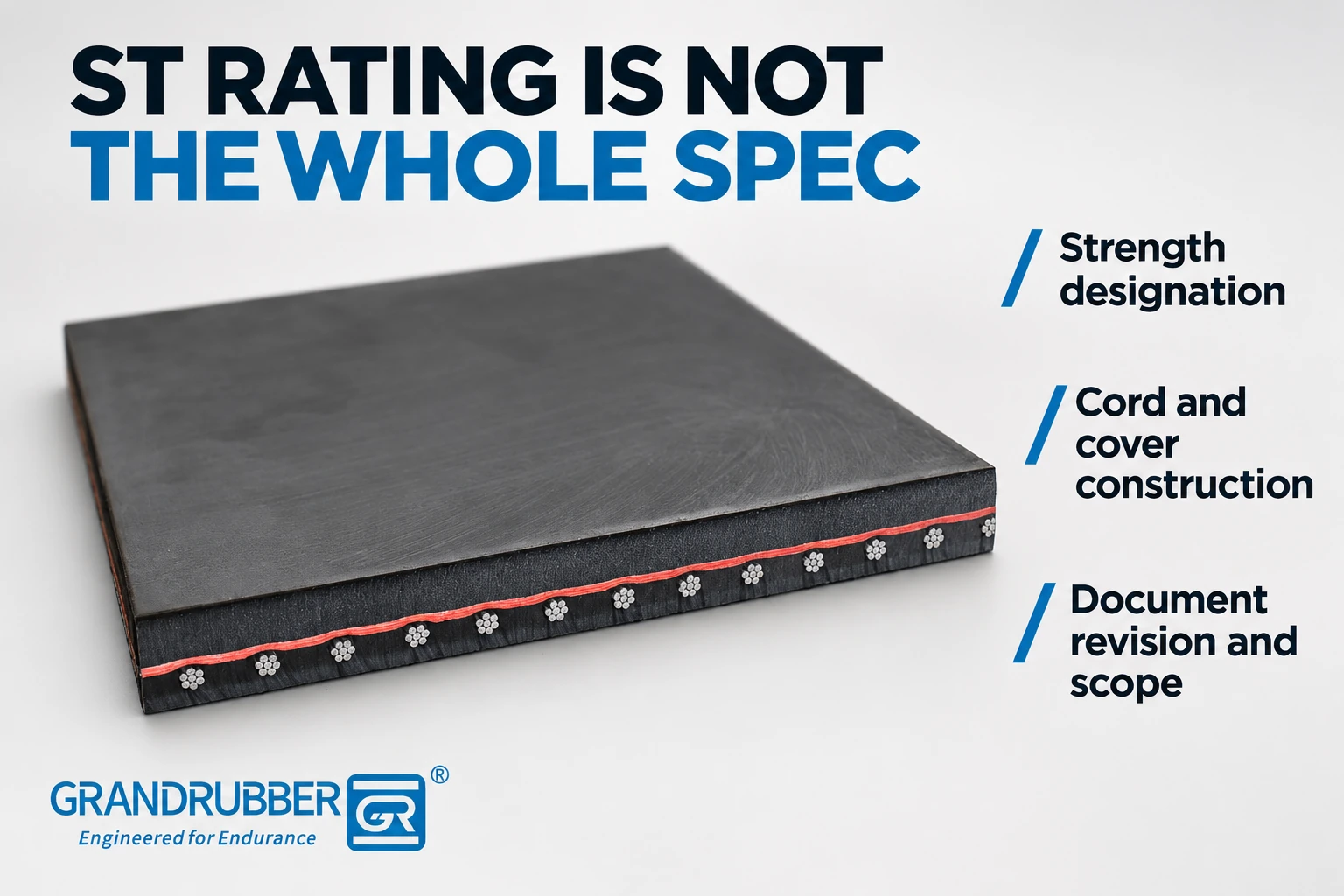
ST1000 is a strength designation, not a complete steel cord belt specification. Identify the source schedule and full offered construction before comparing covers, cord arrangement, width and joining requirements.
On this page
 Open full-size image ↗
No: ST1000 does not identify one universal construction. Keep the cited source schedule, belt width, cord arrangement, covers and applicable requirements together. Matching the nominal designation does not establish that two catalogue rows or offered belts are directly interchangeable.
A designation is only the start of the record
The general catalogue and belt manual contain steel cord construction tables, while the manual separates GB and DIN source schedules. Their headings and column meanings must travel with any extracted entry. A number copied without its schedule loses that context.
Whole-belt strength expressed per unit width is not the same quantity as the tensile stress of an individual steel wire. Do not substitute one for the other or use a nominal label as the entire material description.
Keep one complete source row intact
Record the referenced document, page and schedule, then the actual offered width, cord diameter/pitch/count and top/bottom covers where specified. Identify the grade, joining and any additional reinforcement requirement separately.
The first table compares the information categories, not numerical schedules. Do not combine a cover from one edition with cord details from another to make an apparently more favourable specification. A proposed alternative requires its own complete statement and responsible technical review.
| Entry | Keep with the source | Do not infer |
|---|---|---|
| Nominal strength | Designation and basis | One complete construction |
| Cord layout | Diameter, pitch, count and width reference | A universal row independent of schedule |
| Covers | Top/bottom values and compound | A cover from another edition applies |
| Joining/equipment | Applicable drawing and review | A source table approves every interface |
Worked example: the same ST label comes from different columns
Assume a hypothetical buyer receives two offers both labelled ST1000. One cites an identified schedule; the other says equivalent without stating the cord layout or cover split. No numerical cord geometry is selected in this example.
Ask the second supplier to identify its actual construction and reference. If its schedule differs, list the departures explicitly rather than filling the missing cells with the first supplier’s row. The comparison is not complete simply because both labels match.
Use the second table to record the clarification. It supports purchasing review but does not approve a splice design, assign tension or determine a minimum pulley diameter.
| Finding | Question | Disposition |
|---|---|---|
| Schedule not cited | Which document and row define the offer? | Open identity gap |
| Same designation only | What is the complete construction? | Not yet comparable |
| Different source basis | Which departures require review? | Alternative, not assumed match |
| Required inputs missing | Who establishes equipment/joining basis? | No release from label alone |
Send the designation with its construction context
Use the related steel cord or source-specific ST1000 product page to submit the existing requirement, offered construction and relevant equipment/joining references. Keep the chosen schedule revision in the material enquiry.
Ask for a quotation-specific construction statement and supporting evidence, with all departures visible. The related model pages are catalogue retrieval routes, not declarations that each version can replace every other belt bearing ST1000.
Buyer FAQ
Can I fill a blank cord count from another catalogue?
No. Ask which offered width and schedule apply. Record the source of any proposed count; do not invent a hybrid construction from adjacent tables.
Does the ST number specify the rubber compound?
No complete compound requirement follows from that designation. Identify the cover grade and applicable evidence separately.
Does a different schedule automatically mean the offer is unacceptable?
It means the difference must be explicit and assessed against the actual requirement. Do not assume acceptance or rejection from the label alone.
Can a whole-belt strength be treated as a wire material value?
No. Retain the quantity, units and subject of each entry. Ask the technical reviewer when the evidence does not identify which property is meant.
Will a matching designation preserve the existing joint?
Do not infer that. Request the construction and applicable joining/equipment review; a previous joint record does not approve an unidentified new layout.
Related technical resources
Related products
 Steel Cord Conveyor BeltsSteel-cord conveyor belts for high-tension, long-distance bulk conveying. Compare ST, STE and STH constructions against belt width, cord layout, pulley and splice requirements.ST1000 Steel Cord Belt · GB/T 9770-2013ST1000 steel-cord belt reference in the GB/T 9770-2013 catalogue schedule. Check cord layout, width and covers against the existing conveyor and splice drawing.ST1000 Steel Cord Belt · DIN 22131-2016ST1000 steel-cord belt reference in the DIN 22131-2016 catalogue schedule. Check cord layout, width and covers against the existing conveyor and splice drawing.
Related buyer question
Does ST1000 identify one complete belt construction?
No. ST1000 identifies a strength designation; the selected catalogue schedule, cord arrangement, covers and belt width still matter.
Document and page references
- GRAND_RUBBER_Conveyor_Belts.pdf, PDF pp22: GB and DIN schedules separately labelled; no numeric values reproduced.
- Catalogue_GRAND_RUBBER.pdf, PDF pp5: Historical source steel cord construction schedule and cover categories, not universal equivalence.
- Decision tables, hypothetical examples and follow-up questions are editorial purchase-review aids; they are not customer cases, site instructions or technical approval.
Download the reference tables
Source-labelled review extract. Historical references remain historical; this is not a formal TDS, certificate or current availability confirmation.
Download guide tables CSV