
Datasheet, test report or certificate: what does each prove?
Match each document to the specific claim it supports: a product description, a result for an identified specimen, or certification of a stated scope. More files do not close an evidence gap if they concern a different item or question.
On this page
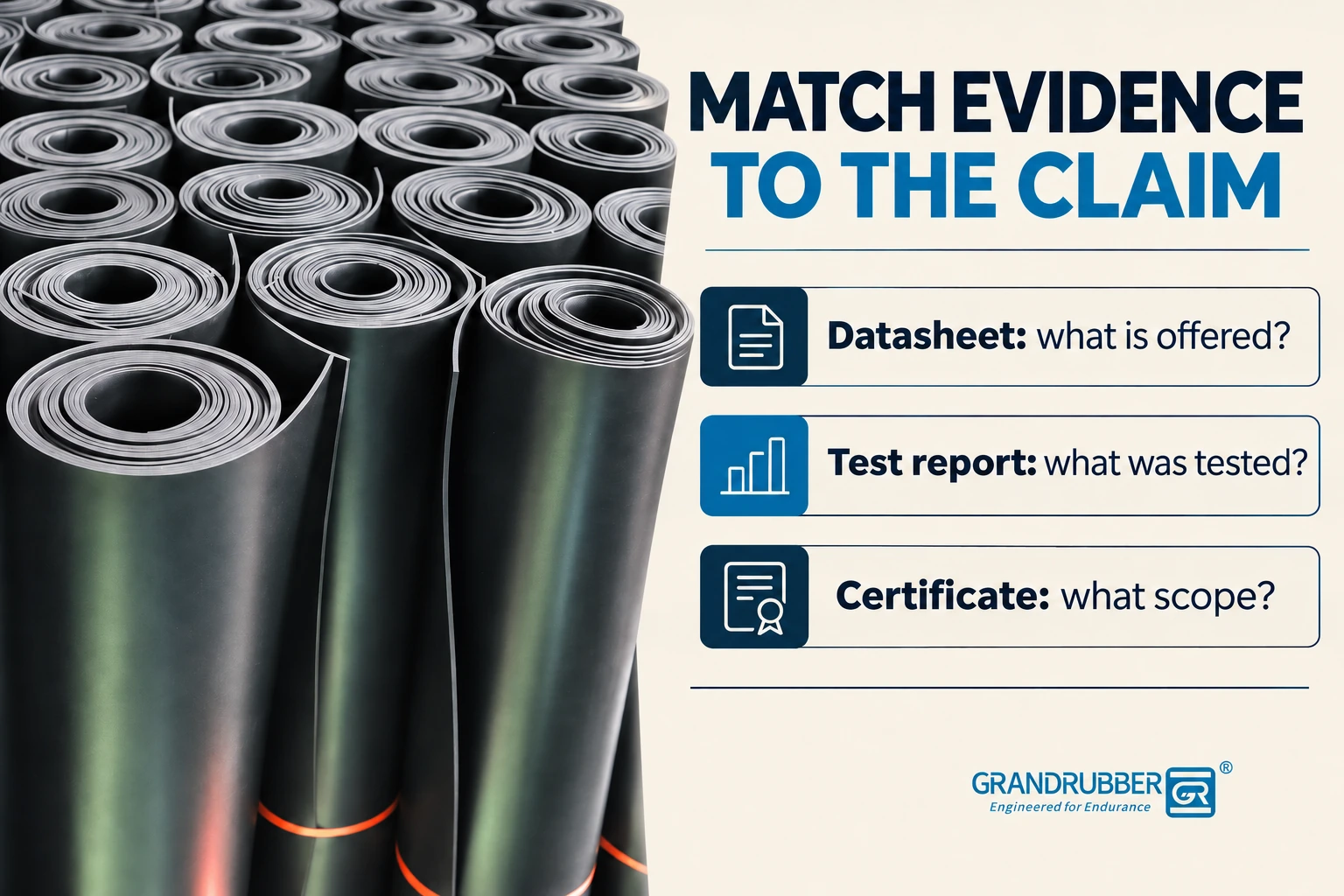 Open full-size image ↗
A datasheet, test report and certificate answer different questions. Start with the claim you need to verify, identify the document and its subject, and check whether its scope reaches that claim. Do not turn a named certificate or a catalogue property into a batch result. This guide classifies evidence; the separate inspection-pack guide organizes agreed checks and delivery records.
What is the document actually describing?
A technical datasheet describes an identified product and its stated specification. A test report records work on the specimen or item it identifies under the stated method and conditions. For a certificate, first establish whether the subject is a product, service or named management system. These descriptions are not interchangeable evidence.
ISO’s certification guidance distinguishes certification from accreditation and explains that ISO itself does not issue certificates. That context helps identify an issuer; it does not validate any GRAND RUBBER certificate. No current certificate original or particular batch result has been verified for this article.
Connect the document identity to the purchasing question
Write the offered item, the property or requirement under review and the cited file reference on one line. Then check the document’s product or specimen identity, issuer, date, method, conditions and limitations. Retain different revisions rather than choosing whichever appears more favourable.
A catalogue can help identify fabric-belt construction or a liner category without proving the delivered batch’s result. A belt report does not establish the composition of a separate adhesive. The first table identifies which question to put to the supplier before deciding whether the document is useful.
| Question | Relevant document content | What it does not establish |
|---|---|---|
| What is offered? | Identified datasheet/drawing and revision | A result for every delivered batch |
| What was tested? | Specimen identity, method, conditions and results | Suitability outside that scope |
| What is certified? | Issuer, subject, scope and current status | Every unrelated product property |
| Who issued the assurance? | Certification/accreditation identity where applicable | Authenticity from a logo alone |
Worked example: an impressive attachment leaves the requirement open
Assume a hypothetical belt offer includes an organizational certificate and an old rubber test report, while the buyer needs evidence for an identified offered cover. No certificate validity, sample result or acceptance limit is assumed.
Ask what the certificate’s stated subject covers and whether the test report identifies the proposed material. If the specimen belongs to another product, preserve the report as background and request the missing evidence. Do not replace the item identity in your spreadsheet and treat the report as newly applicable.
A useful outcome is a disposition for each claim: supported within the recorded scope, clarification required, or evidence not provided. The second table records that decision without declaring the product compliant merely because an attachment exists.
| Finding | Action | Record to retain |
|---|---|---|
| Item identity matches | Review the relevant property and conditions | Exact item/document reference |
| Different specimen or revision | Ask how applicability is established | Mismatch and required reply |
| Only a catalogue claim | Request required supporting evidence | Claim versus evidence status |
| Required file unavailable | Identify owner and next decision | Open item, not an invented PASS |
Request the missing evidence in one focused reply
Send the supplier a claim-and-document list showing the precise mismatch: for example, an unidentified sample or an unreferenced product revision. Ask for the corresponding original and an explanation of applicability. Avoid requesting every certificate name without relating it to the purchase.
Use the related product page for the component actually under review and attach only authorized relevant records. Keep technical evidence review separate from acceptance of an actual shipment. A completed document classification is not proof that every agreed inspection was performed, nor an authorization to apply an unidentified chemical or repair system.
Buyer FAQ
Can a translated copy replace the original?
Use a translation to aid understanding, but retain its link to the original issuer, reference and revision. Resolve discrepancies with the responsible issuer or supplier. Translation does not extend the document’s subject or make an unsigned draft an original.
Does an older report automatically become invalid?
Do not decide from its date alone. Check its subject, revision, the actual purchasing requirement and any current validity condition that applies. An older result may be relevant background without establishing the proposed item’s present evidence.
Can a management certificate confirm an abrasion result?
Not by itself. Identify the organizational scope and separately obtain evidence for the specified material and abrasion question. Keep a management-system assurance and a measured product property in different rows.
What if the specimen code is unfamiliar?
Ask the supplier or issuer to connect it to the offered product using a reviewable reference. Do not infer identity from a similar colour, trade name or test value.
Can the supplier’s summary page stand in for the full report?
It can help locate the evidence, but may omit identity, methods or limitations needed for your decision. Request the necessary original pages or complete record through an authorized route.
Should a missing report be entered as a failure?
Record “not provided” or the actual evidence status rather than inventing a test result. Whether that gap prevents acceptance depends on the agreed requirement and responsible review, not a fabricated FAIL or PASS.
Sources
Related technical resources
Related products
 NR40 Wear-resistant Rubber LiningsNR40 rubber lining sheets for fine-particle abrasive applications. Review material exposure, sheet thickness and surface options to define the lining and installation scope.
 Multi-ply Fabric Conveyor BeltsEP/NN multi-ply rubber conveyor belts for mining, cement and bulk handling. Match whole-belt strength, plies and cover grade to your material and conveyor before ordering.NR40 Natural Rubber LiningNR40 natural rubber lining for fine-particle abrasive service. Review the medium, temperature, substrate and bonding arrangement to specify sheet thickness and the required supporting documents.Chemical-resistant Conveyor BeltsConveyor belts for review where materials expose the covers to acids or alkalis. Identify the chemical, concentration, contact time and temperature before assessing the selected rubber grade.Aramid Conveyor BeltsAramid-reinforced conveyor belts listed in the DPP catalogue range. Compare the full construction, covers and conveyor geometry when reviewing a replacement or project specification.
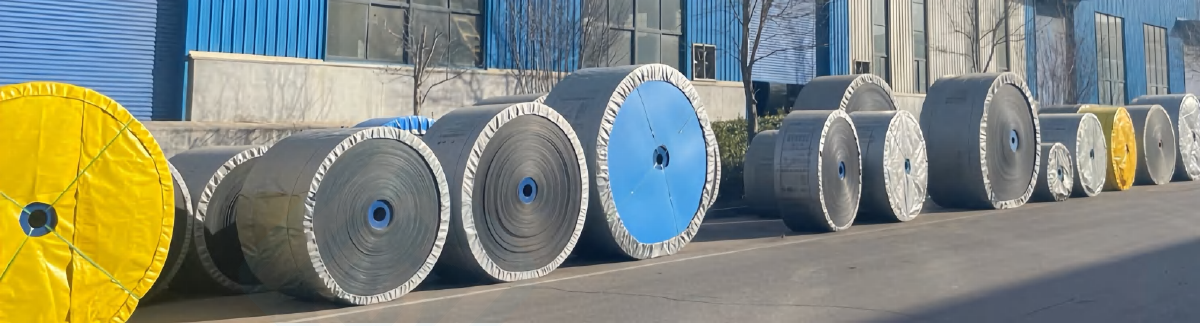 Solid-woven PVC / PVG Conveyor BeltsSolid-woven conveyor belts with separate PVC and PVG cover constructions. Select the complete belt around material exposure, conveyor dimensions and the required safety-document scope.
 Conveyor Components & Maintenance MaterialsConveyor components and maintenance materials for sealing, impact protection, lagging, lining and belt repair. Start with the equipment interface and operating problem to identify the required item.
 FKM Rubber SheetFKM rubber sheet for material-compatibility and sealing review. Specify the fluid, concentration, temperature and sealing geometry before selecting a grade and supporting test requirements.
Document and page references
- Catalogue_GRAND_RUBBER.pdf, PDF pp6,7: Construction/property entries illustrate catalogue specifications, not batch test reports.
- Decision tables, hypothetical examples and follow-up questions are editorial purchase-review aids; they are not customer cases, site instructions or technical approval.
Download the reference tables
Source-labelled review extract. Historical references remain historical; this is not a formal TDS, certificate or current availability confirmation.
Download guide tables CSV