
Rubber Lining Enquiries: Include Cleaning Media and Intermittent Additives
Describe production, cleaning and occasional exposures as separate operating states. Ask for a lining proposal against the complete exposure record, including unknown media and relevant pressure or vacuum conditions; a primary process-fluid name is incomplete.
On this page
 Open full-size image ↗
A lining enquiry can describe normal production accurately and still omit the exposure that controls the material discussion. Cleaning liquids, intermittent additions and periods between operations belong in the requirement record when the lining encounters them. This guide prepares that record for equipment and material reviewers; it does not select a compound, prescribe cleaning chemistry or approve a process.
Define the equipment boundary before listing chemicals
Identify the vessel, pipework or lined area under discussion, the substrate and the surfaces that may contact the process or cleaning media. A product moving on a conveyor belt and a liquid held against a vessel lining are different applications; do not treat their evidence as interchangeable because both products contain rubber.
Separate the supplied lining material from bonding, installation and equipment responsibilities. Mark existing equipment features and proposed modifications on the applicable drawing. Without that boundary, a chemical list may not tell the reviewer which interfaces, seams or retained components need assessment.
Create one row for each actual operating state
List normal production, cleaning, intermittent additions, changeover and known exceptional exposures as separate entries. For each, identify the actual medium or mixture, concentration basis, temperature, duration or frequency and the information source. Include relevant pressure or vacuum conditions for the responsible equipment review.
This is a procurement recording method, not a claim that every process has all these states. Write not applicable only with a reason; write unknown when information is unavailable. A commercial cleaning-product name may require further composition or application information before a material supplier can interpret the exposure. Do not replace that gap with a guessed chemical concentration.
Polycorp’s material-selection guide p2 asks for chemical and concentration information, including intermittent or recurring additives. Separating cleaning as its own row is an editorial way to make that complete exposure request usable; it is not a quoted cleaning procedure or a compatibility approval.
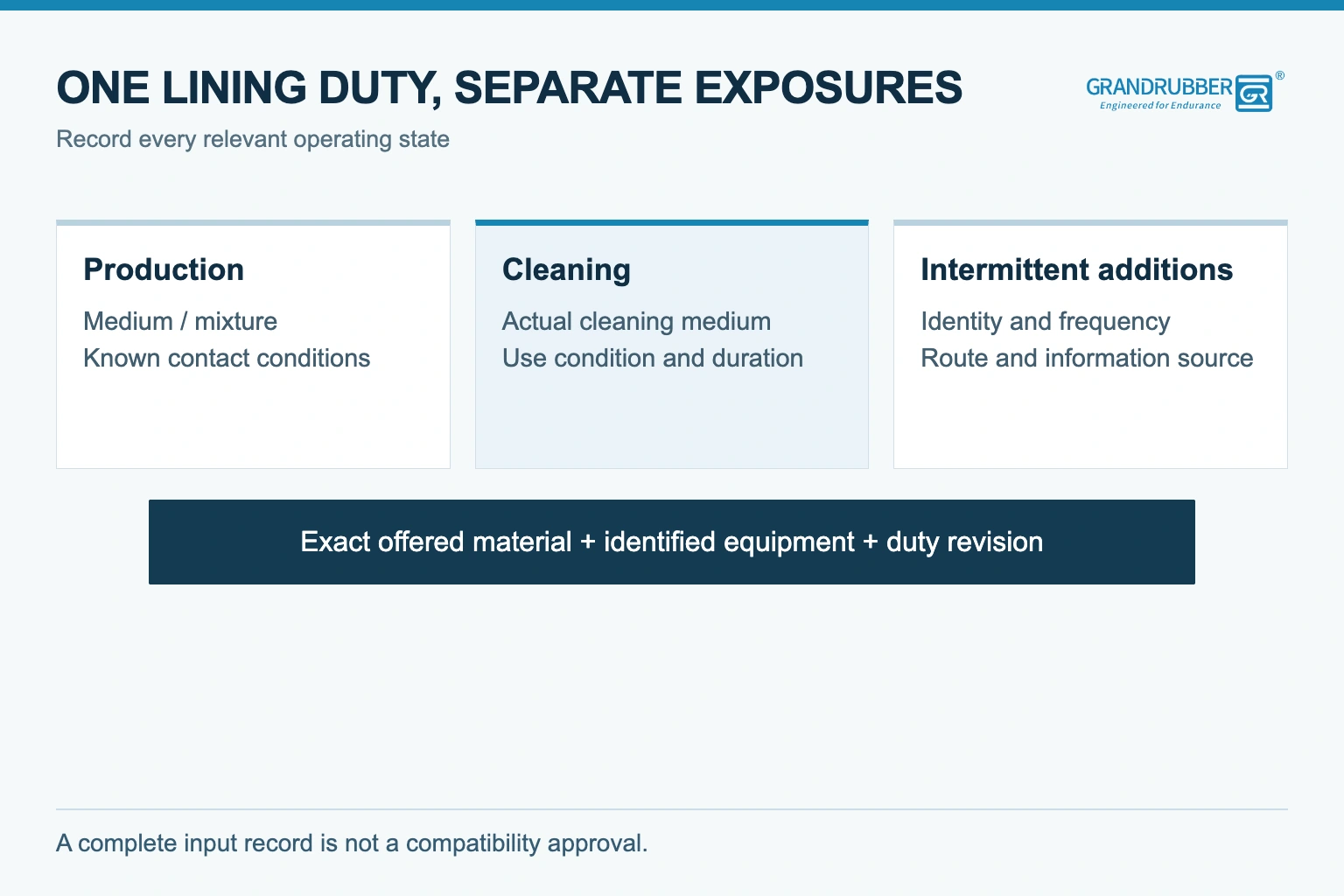
| State | Record | Keep separate |
|---|---|---|
| Production | Medium/mixture, concentration and contact context | A generic process name |
| Cleaning | Actual product, use condition and duration | A cleaning instruction |
| Intermittent addition | Identity, frequency and route | An assumed negligible exposure |
| Other state | Relevant pressure/vacuum or shutdown contact | An approved operating condition |
Distinguish a process input from a material approval
The first table keeps duty records apart from the evidence requested for the offered lining. A safety data sheet may help identify a supplied chemical and its stated hazards, but it does not by itself establish a rubber lining’s compatibility with every mixture or operating state.
Request the exact offered material identity and the supporting basis for the stated conditions. If data cover only one constituent or one test condition, ask how that scope relates to the proposed application. A general resistance label, historical chart or another manufacturer’s formulation table must not be presented as approval of a GRAND RUBBER compound.
Worked example: the cleaning state is absent from the first quotation
Assume a hypothetical buyer specifies the usual process medium and receives a preliminary lining proposal. The maintenance team later identifies a cleaning liquid and an occasional additive. Their concentrations and contact times are not established. No chemical, temperature, formula or compatibility result is invented.
Create separate exposure rows and ask the process owner to complete the unknown entries. Send the revised duty record back to the material and equipment parties. Do not assume that a short cleaning event is irrelevant, or that a successful assessment for the main fluid automatically extends to the cleaning state.
The second table records the change in the buying decision: the earlier proposal is tied to an incomplete duty revision. It may need clarification or reconsideration. Asking for a revised assessment is different from declaring that the existing lining has failed or that another rubber family must be used.
| Change | Clarification | Disposition record |
|---|---|---|
| New cleaning medium | What exactly contacts the lining? | Revised input row |
| Unknown concentration | Who confirms the actual basis? | Open evidence item |
| Changed pressure/vacuum | Which equipment/material review applies? | Separate engineering question |
| Earlier material offer | Which duty revision supported it? | Preliminary or re-reviewed proposal |
Make the supplier’s response match the duty revision
Ask the supplier to identify the material, complete proposed supply scope and the duty revision it reviewed. For each relevant state, request the applicable evidence, limitations and unresolved inputs. Keep required acceptance criteria separate from nominal catalogue information and actual reported results.
If the process changes after the proposal, record what changed and ask which conclusions require review. Avoid carrying a previous statement forward as a blanket approval. Where the material identity, substrate or application basis is not confirmed, the appropriate result is a preliminary information request, not a definite compound recommendation. Pressure, vacuum, cleaning execution and equipment operation remain with the responsible controlled engineering process.
Send one exposure matrix for the actual lined equipment
Use the related rubber-lining enquiry to submit the equipment drawing, exposure matrix and requested supply boundary. Ask for a marked material proposal that identifies what is supported and what still needs confirmation. Include the party responsible for process information so technical questions are answered against the same record.
The linked chemical-belt guide addresses belt exposure; this page addresses the lined-equipment duty and its operating states. Neither establishes a universal compatibility table or site-service capability. The useful next step is a complete, revision-controlled input for a product-specific discussion.
Buyer FAQ
Can I omit an additive used only occasionally?
Record the actual exposure and let the responsible review establish its relevance. Frequency alone does not prove that a material contact can be ignored.
Is the cleaning product’s brand name enough?
It may be a starting point. Ask what composition, concentration and use information the material reviewer needs for the actual contact.
Does an SDS certify lining compatibility?
No. Its subject and purpose differ from application-specific material evidence. Keep the chemical identity record and the lining assessment distinguishable.
Can I reuse a chemical-belt recommendation for a vessel?
Not automatically. The construction, interfaces, exposure and equipment duty differ; obtain the assessment applicable to the actual lined equipment.
Should unknown entries be filled with worst-case guesses?
Identify estimates and their source explicitly. Ask the process owner to establish a usable requirement rather than presenting a guess as measured duty.
Does this article recommend a cleaning method?
No. It organizes information for a purchase review and supplies no cleaning recipe, chemical-handling procedure or operating setting.
Sources
Related technical resources
Related products
 Mining Rubber SheetsRubber sheets with catalogue 10 MPa and 15 MPa grades for mining wear-protection locations. Compare abrasion, impact, dimensions and attachment conditions before choosing a grade.
 NR40 Wear-resistant Rubber LiningsNR40 rubber lining sheets for fine-particle abrasive applications. Review material exposure, sheet thickness and surface options to define the lining and installation scope.
Document and page references
- Polycorp: Material Selection Guide V5, exposure inputs only: Material Selection Guide V5, physical PDF p2, Chemicals and Concentration plus temperature/pressure/vacuum inputs.
- New comparison/checklist entries and worked examples are editorial review aids, not measured results, approved specifications or real customer cases.
Download the reference tables
Source-labelled review extract. Historical references remain historical; this is not a formal TDS, certificate or current availability confirmation.
Download guide tables CSV