
What should be checked before a belt repair?
Choose between cover repair, joint work and replacement only after the actual damage and reinforcement condition have been assessed. A patch size or fastener code is not proof that the proposed intervention is structurally suitable.
On this page
 Open full-size image ↗
Record damage to both the rubber and reinforcement, the belt identity and the required duty before requesting a repair or replacement disposition. Keep a surface repair, a joint intervention and a changed belt construction distinct. This guide organizes evidence for qualified assessment; it does not provide a repair procedure or authorize continued operation.
Separate the observed damage from its assumed cause
Record location, extent and available depth information with authorized photographs or inspection records. Identify exposed reinforcement, joint involvement and previous work where actually observed. Do not decide structural capability from a cover photograph alone.
The components catalogue separates repair strips/patches, splicing materials and mechanical systems. Those categories locate products but do not tell a buyer which intervention is appropriate for an unidentified damaged belt.
Keep belt, damage and proposed system identities together
Provide the complete construction, material/exposure conditions, damage record and relevant equipment/joining information. Ask the responsible reviewer what additional inspection is needed and what each proposed repair is intended to restore.
The first table separates the decision paths. A cover treatment does not establish reinforcement integrity, and a mechanical joint proposal does not automatically fit every thickness or pulley arrangement. Request the exact applicable system and controlled procedure rather than selecting from a catalogue geometry alone.
| Possible path | Question to resolve | Do not infer |
|---|---|---|
| Cover repair | What damaged area and restoration scope? | Reinforcement is acceptable |
| Joint work | Which belt/system/interface and procedure? | Any fastener fits |
| Replacement | Why is a new complete construction required? | A new belt resolves an unknown cause |
| Further inspection | Which critical fact is missing? | An evidence gap is permission to run |
Worked example: a fastener code does not resolve conflicting evidence
Assume a hypothetical proposal names an H fast-screw system but relies on a source table whose heading and strength row disagree. The actual model/rating mapping remains unresolved. No code is selected or load approved in this example.
The visible p38 schedule has conflicting entries for H400 and H2000 between its heading and strength row. Preserve that conflict and obtain the controlled offered-model documentation; do not choose the larger or more convenient entry.
The second table records this evidence gap alongside damage and equipment questions. A quoted fastener or patch can remain a proposal without becoming an accepted structural solution.
| Issue | Record | Required response |
|---|---|---|
| Damage unclear | Observed versus unassessed condition | Responsible inspection/disposition |
| Rating conflict | Exact source model and conflicting fields | Controlled offered-model mapping |
| Equipment unknown | Pulley/joining references | Applicable compatibility review |
| Work/acceptance unclear | Supplied material versus site tasks | Named scope and acceptance basis |
Ask for a written intervention disposition
Use the relevant repair/splice material enquiry to send the belt identity, damage assessment and proposal. Ask what is supported, what remains unknown, which work/system is proposed and who accepts the result.
A decision may require further assessment rather than immediate material purchase. Keep site isolation, preparation, installation and return-to-service decisions with the responsible controlled process. No grinding, drilling, curing or tension values are supplied by this article.
Mechanical fastener proposals need a defined thickness basis
After the damage assessment identifies joint work as a possible path, request a separate fastener-selection review. Identify the belt construction, relevant tension/rating basis, actual joint-area thickness record and applicable pulley information. Nominal whole-belt thickness and a worn local measurement describe different records.
Flexco’s selection bulletin identifies tension, thickness and pulley diameter as linked inputs. It also distinguishes thickness at the joint and the thickness basis when cover preparation is proposed. These are useful input categories, not approval to use its fastener ratings for a GRAND RUBBER product. The source’s preparation depths and model tables are not operating instructions or approved selections here.
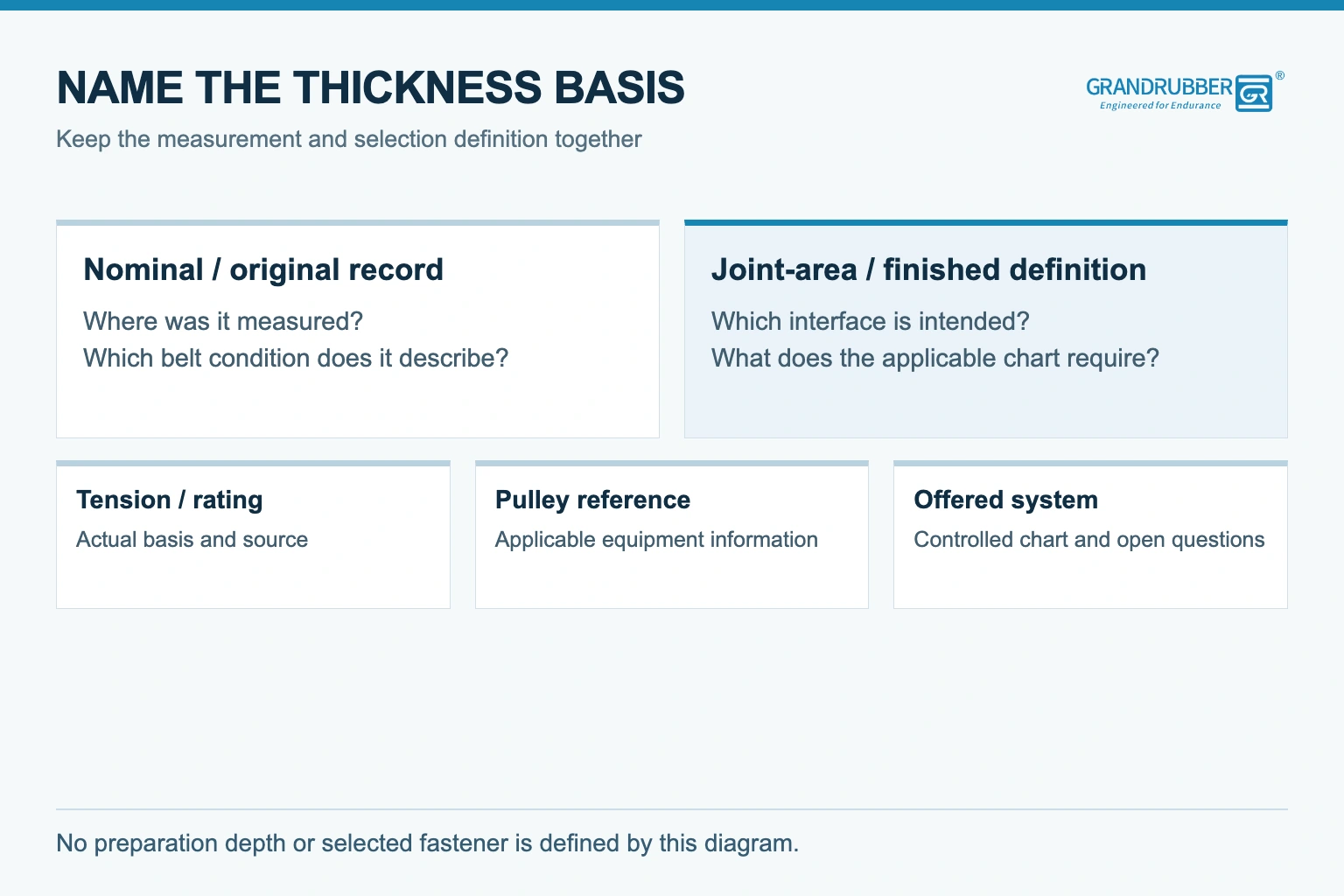
Worked fastener enquiry: original and prepared thickness are not interchangeable
Assume a hypothetical buyer sends nominal belt thickness and asks for a mechanical fastener. Another party proposes cover preparation before fitting, but the final interface thickness is not documented. No removal depth, fastener number or installation process is selected.
Record both the available original measurement and the intended finished-interface definition, with the responsible source for each. Ask the applicable system supplier which thickness basis its controlled selection chart requires. Do not subtract a generic preparation value to create a supposedly confirmed input.
The added table keeps that issue together with the tension and pulley basis. An overall belt strength label does not supply every operating input, and selecting the largest-looking row from another table does not resolve a missing requirement. Obtain one applicable offered-system schedule and its conditions.
| Input | Record separately | Open issue |
|---|---|---|
| Tension/rating | Actual stated basis and source | Not inferred from width alone |
| Thickness | Joint-area condition and required interface definition | Prepared versus original unknown |
| Pulley arrangement | Applicable equipment references and conditions | Not a generic minimum |
| Offered system | Controlled model/chart and assumptions | Rating conflict or unknown scope |
Keep catalogue conflicts open in the fastener response
The H400/H2000 heading-versus-row conflict already described above remains unresolved. A new third-party bulletin provides a way to organize questions, not evidence that either disputed GRAND RUBBER catalogue entry is correct. Request the controlled offered-model identity and clarification from the responsible supplier.
Ask who assesses the actual belt condition, confirms the applicable fastener range, checks equipment/joining compatibility and accepts the work. Keep repair disposition and fastener selection distinct: a compatible-looking joint component does not prove that damaged reinforcement is acceptable. Retain the accepted inputs and procedure references without publishing a site repair recipe.
Buyer FAQ
Does a larger patch provide a safer repair?
No conclusion follows from patch size alone. Obtain the relevant damage and structural assessment and the applicable repair-system basis.
Can photographs establish the condition of hidden reinforcement?
Not generally. They can support an inspection request but do not replace the assessment needed for hidden or uncertain damage.
Should the higher fastener rating resolve a catalogue conflict?
No. Retain the conflicting evidence and request the controlled model-specific clarification rather than choosing a value.
Does a material quotation approve the site procedure?
No. Identify the actual system, responsible personnel, controlled work procedure and acceptance separately.
Is reduced carryback proof that a damaged belt is acceptable?
No. Cleaning outcome and belt integrity are different questions. A cleaner interface assessment cannot substitute for the damage disposition.
Can nominal belt thickness replace the joint-area record?
Not automatically. Identify the actual location/condition and the thickness definition the applicable selection requires.
Can I deduct a standard cover-removal depth for the enquiry?
This article supplies no standard removal depth. Ask the responsible system parties for the applicable procedure and confirmed interface basis.
Does a Flexco table resolve the H400/H2000 discrepancy?
No. It is a different supplier’s system. The offered GRAND RUBBER model and its controlled rating evidence still require clarification.
Sources
Related technical resources
Related products
 Belt Repair Strips & PatchesRepair strips and patches in catalogue formats for conveyor belt maintenance. Match dimensions and bonding materials to the damage, including any exposed or affected reinforcement.
 Hot Splice MaterialsCover rubber, tie gum, rubber solution and cord-fill materials for belt splicing. Select the matched system using the belt construction and controlled splice procedure.
 Mechanical Belt FastenersMechanical fastener families for conveyor belt joints. Confirm belt thickness, reinforcement, pulley size and the applicable approved rating before selecting the fastening system.
Document and page references
- GRAND_RUBBER_Conveyor_Components.pdf, PDF pp33,34,35,36,37,38,39,40: Repair/splice categories and visible H heading/row conflict; no procedure or approved rating inferred.
- Decision tables, hypothetical examples and follow-up questions are editorial purchase-review aids; they are not customer cases, site instructions or technical approval.
- H400/H2000 source conflict remains unresolved; not a current rating or universal repair instruction.
- Flexco: fastener-selection input categories only: Physical PDF p1: tension, joint-area thickness and pulley inputs; no ratings, depths or preparation procedure adopted.
- New comparison/checklist entries and worked examples are editorial review aids, not measured results, approved specifications or real customer cases.
Download the reference tables
Source-labelled review extract. Historical references remain historical; this is not a formal TDS, certificate or current availability confirmation.
Download guide tables CSV