
Rock-Box Chute Linings: Why a Thicker Rubber Sheet Is Not the Same Design
A rock-box proposal changes the material-contact arrangement by intentionally retaining material. Review flow, geometry, retained load, attachment and access with the equipment authority before treating it as a sheet-thickness substitution.
On this page
 Open full-size image ↗
A rock-box lining is an equipment-interface proposal as well as a material proposal. In the manufacturer example reviewed here, plates and bars form ledges that retain ore, so incoming material encounters retained material. That changes the question from which sheet is thicker to whether the proposed geometry and material flow have been reviewed together. This guide prepares the buying decision; it does not design ledges, calculate loads or approve a chute conversion.
Distinguish a smooth lining from intentional material retention
A smooth protective surface and a lining arranged to hold a bed of material do not perform the same geometric task. The material supplier and equipment reviewer need to understand which concept is proposed before comparing rubber grades or panel prices.
Reglin’s screen-underflow case describes rubber wear plates and bars arranged on angled chute walls to retain ore and create rock-on-rock contact. That account concerns its own products and installation. It does not establish the same result for another ore, chute or GRAND RUBBER product. No claimed life improvement, cost saving, product code or fastening design is adopted here.
Start with the material route and available geometry
Identify the incoming material route, the impact and sliding regions, the existing chute shape and the outlet/interface constraints. Supply the known throughput basis, material size distribution, moisture or stickiness concerns and drop information from actual equipment records. Mark missing information as a review input.
The first table divides these questions by their decision role. A photograph can show the concept without establishing the internal free section, retained quantity or structural loading. An outline drawing should identify the proposed configuration and revision; a material swatch cannot describe the complete chute arrangement.
| Input | Identify | Decision supported |
|---|---|---|
| Material route | Flow/size/moisture and incoming path | Actual contact duty |
| Chute geometry | Layout, constraints and proposed retained zone | Flow-space review |
| Support/attachment | Substrate and component arrangement | Responsible mechanical review |
| Access | Inspection and replacement boundary | Maintainability scope |
Review what retention changes, not just what it protects
Intentional retention raises questions about the available flow path, buildup, changing material properties, support and inspection. These are editorial design-review questions, not a claim that every rock-box arrangement blocks or that a particular design is suitable. Ask the responsible engineer which conditions and checks apply to the actual proposal.
Identify the substrate, panel/bar arrangement, attachment scope and any retained existing components. Ask how the supplier’s material scope ends and the equipment design responsibility begins. A rubber quote cannot, by itself, confirm that the original support accepts a changed arrangement or that the discharge path remains suitable.
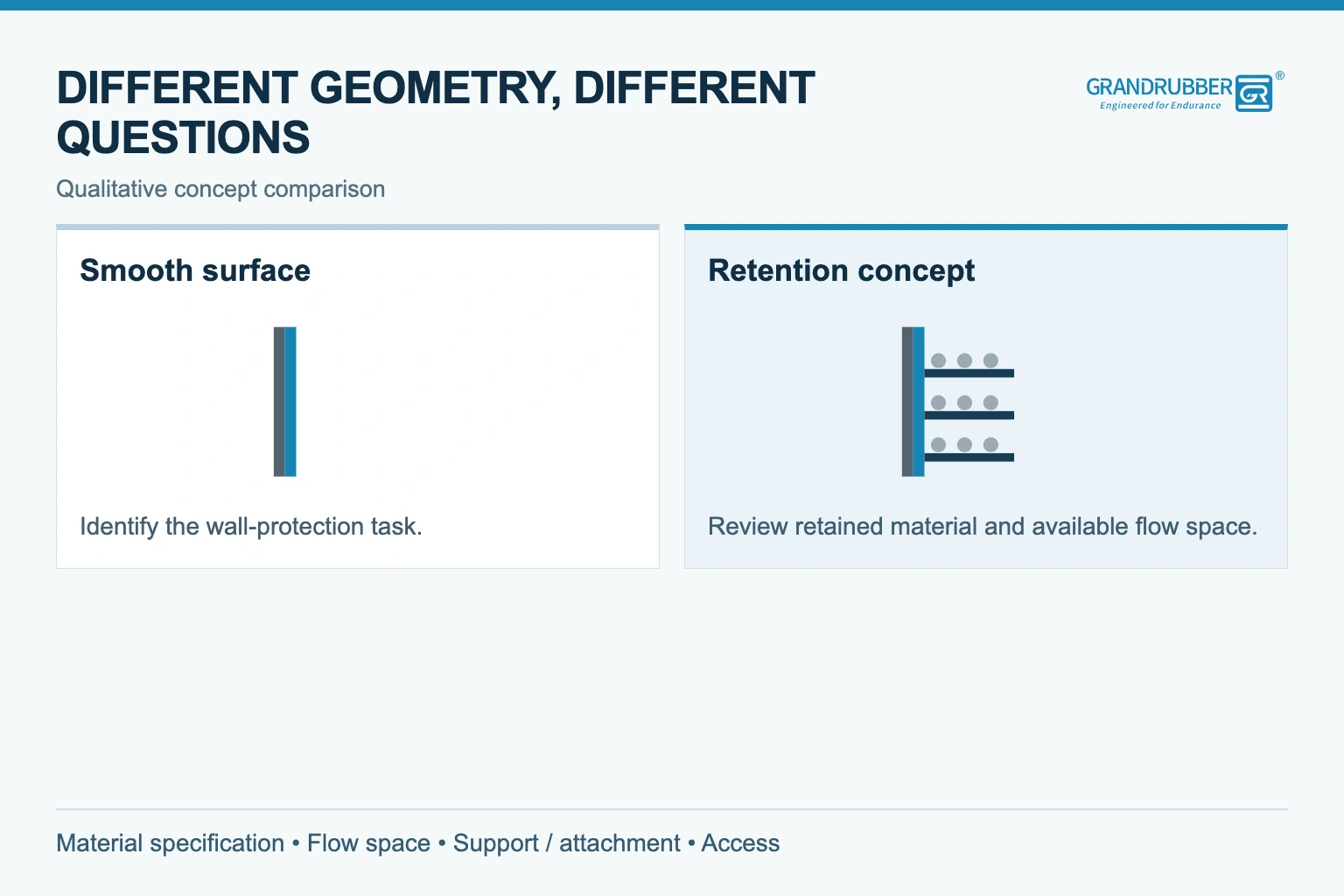
Worked example: the same outer panel size, a different flow space
Assume a hypothetical buyer receives a thicker smooth-panel option and a plate-and-bar option for the same chute zone. Both use the same outer mounting area, but the second proposes material retention. No dimensions, mass, capacity or performance figures are invented.
Do not rank them as interchangeable sheets. Ask for a marked layout showing the proposed arrangement and what the equipment reviewer needs to assess. Compare the material specification only after the different geometric functions and supply scopes are visible.
The second table records a useful purchasing outcome: a material option may be clear while the overall chute concept remains preliminary. If the proposal changes access, inspection or replacement work, assign those interfaces explicitly rather than burying them in a general supply line.
| Option | Question | Not established by material thickness |
|---|---|---|
| Smooth panel | What contact and wear task is addressed? | Intentional retained bed |
| Plate-and-bar arrangement | What retention/layout is proposed? | Approved flow or support |
| Material offer | Which product/drawing/evidence applies? | Complete chute design |
| Acceptance | Who closes equipment interfaces? | A case-study result for this plant |
Compare maintainability and evidence on a defined basis
Request the actual panel and bar identities, offered construction, drawing revision, included attachment parts and evidence applicable to the intended duty. Keep a nominal property, a material test result and a site durability claim separate. An attractive case-study outcome is not an offered-item guarantee.
Ask the site and equipment parties how the relevant areas will be inspected and how replacement scope is defined under their controlled arrangements. Do not copy the case’s rotation or reuse concept as a site instruction. If downtime or cost comparisons are required, use actual proposal scope and verified site records; leave unmeasured savings out of the decision.
Request a material proposal and an equipment disposition
Send the actual chute drawing and material-duty record through the related rubber-sheet or lining enquiry. Ask the supplier to identify the proposed materials and scope, and ask the responsible equipment authority to state which geometry/support/flow questions remain.
GRAND RUBBER’s rubber-sheet and lining categories support a material discussion; they do not establish supply of an engineered rock-box system or acceptance of chute design responsibility. Keep the final material schedule, accepted layout and responsible review together. If the geometry is not established, request that clarification before ordering a construction-specific panel set.
Buyer FAQ
Is a rock-box simply a thicker liner?
No. Its intended material-retention geometry is a separate design feature. Identify the concept before treating proposals as the same material line.
Does the published case prove that rubber beats steel everywhere?
No. It describes one manufacturer’s application. Material, geometry and duty must be reviewed for the actual equipment.
Can I copy the bars and ledges from a picture?
A picture does not establish dimensions, loads or suitable attachment. Obtain a controlled proposal and the responsible equipment assessment.
Does keeping the same outside panel size preserve capacity?
Not established. Ask the equipment reviewer to assess the actual flow path and proposed arrangement.
Can retained material be counted as free protection?
A purchasing comparison still needs the design, material and maintenance scopes. This article assigns no cost or guaranteed protective result.
What if only the rubber supply is within our order?
Identify the material boundary explicitly and name who provides and accepts the equipment design, attachment and site work.
Sources
Related technical resources
Related products
 Mining Rubber SheetsRubber sheets with catalogue 10 MPa and 15 MPa grades for mining wear-protection locations. Compare abrasion, impact, dimensions and attachment conditions before choosing a grade.
 NR40 Wear-resistant Rubber LiningsNR40 rubber lining sheets for fine-particle abrasive applications. Review material exposure, sheet thickness and surface options to define the lining and installation scope.
Document and page references
- Reglin: rock-box case, geometry concept only: Case Outcome: plate/bar ledges and retained ore; no lifetime result adopted.
- New comparison/checklist entries and worked examples are editorial review aids, not measured results, approved specifications or real customer cases.
Download the reference tables
Source-labelled review extract. Historical references remain historical; this is not a formal TDS, certificate or current availability confirmation.
Download guide tables CSV