
Conveyor Belt Troubleshooting: What to Record When the Return Side Rubs the Frame
A belt centered at the head and tail may still contact the frame along the return route. Map the contact location, belt-section pattern, operating condition and recent changes before requesting a corrective action.
On this page
 Open full-size image ↗
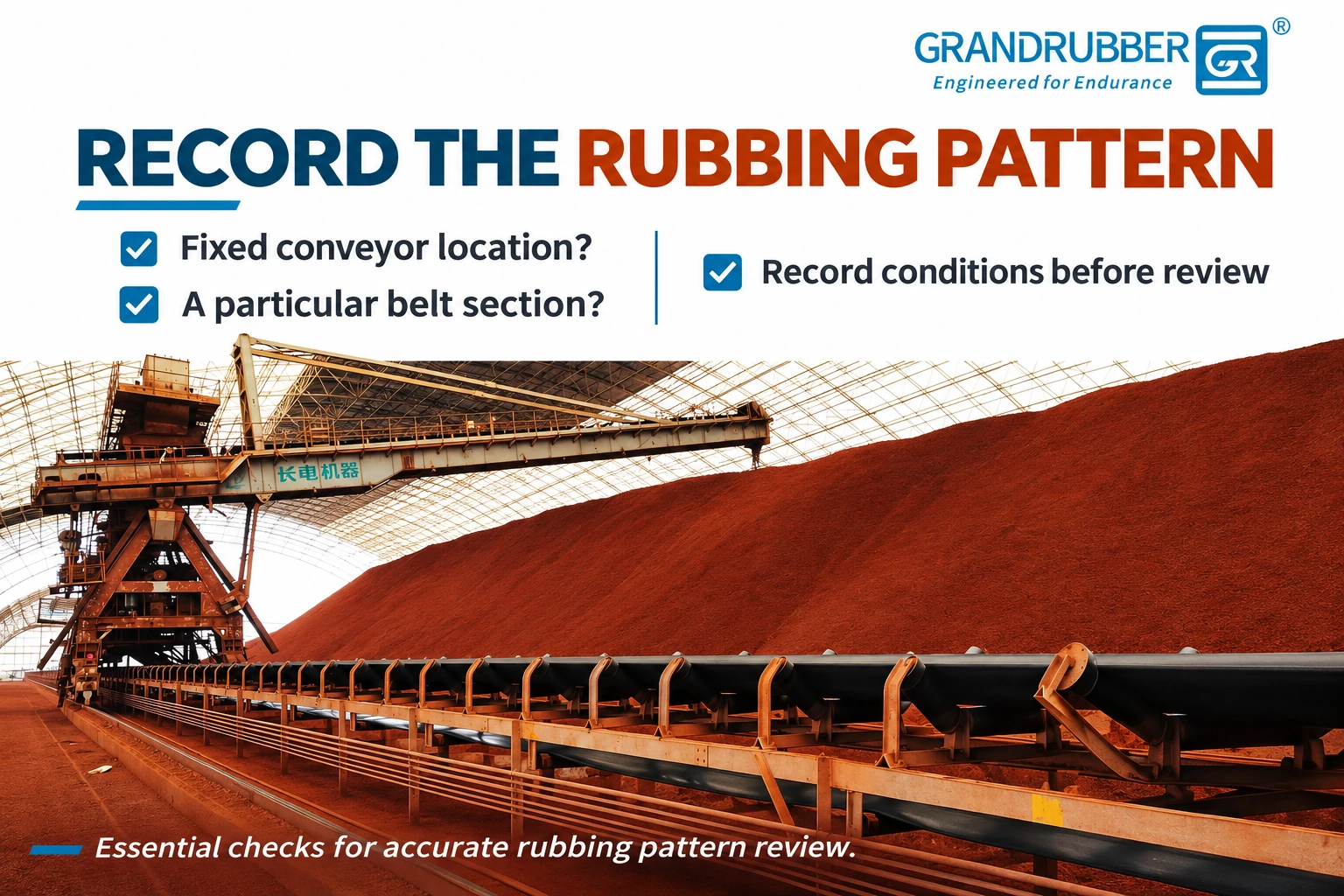
Record the symptom, its location and the operating conditions before choosing a corrective action. Head-and-tail centering is only part of that record: if the return side rubs the frame, document the affected part of the route and whether the pattern stays at that location or follows a particular section of belt. Ask the equipment specialist to interpret those observations before buying tracking devices or changing the belt.
This guide retains a general fault-recording checklist and adds a focused return-side example for maintenance teams, equipment buyers and belt suppliers. It is an evidence and enquiry guide, not instructions for running a damaged conveyor, adjusting rollers or changing belt tension.
Information to prepare for any belt problem
Photograph tracking, edge wear, cracking, cover damage or splice deterioration with location and date.
Record loading alignment, take-up, pulley and idler arrangement, tension and recent changes.
Separate observations from suspected causes. Corrective work requires the equipment safety procedure and technical review.
Use the equipment identifier, document revision and date on every record. Describe what was actually seen before naming a cause: “edge contacting the left frame at return station R3” is more useful than “bad tracking”. If speed or tension is reported, identify whether it comes from an approved setting, an instrument or an estimate. Never invent a measurement to complete a form.
Keep original observations and subsequent changes in time order. A supplier needs to distinguish the initial fault from the condition after an attempted correction. For a cracked cover or deteriorating joint, include the same record discipline even if the return-rubbing example below does not match the symptom.
Why can the return side rub when the head and tail look centered?
Those descriptions refer to different places on the conveyor. End-pulley observations do not establish the belt’s position or clearance everywhere between them. The return side is the route back from discharge; its supports, adjacent structure and contact points need their own location record.
Orthman’s Belt Conveyor manual, revision 25 September 2026, distinguishes deviation at a particular conveyor point from deviation associated with one belt section travelling along the route (Section N, p24). That distinction is useful for organizing evidence. The manual is a general reference for its equipment, not an approved adjustment procedure for an unidentified mobile screener.
A public mobile-screener discussion reported a new belt centered at both end pulleys but rubbing the frame underneath. The author reported empty running; no loaded-test conclusion or verified root cause was established. Treat that as an example of an incomplete record, not evidence that a particular roller, splice or frame adjustment will solve your machine.
How should the return-rubbing pattern be mapped?
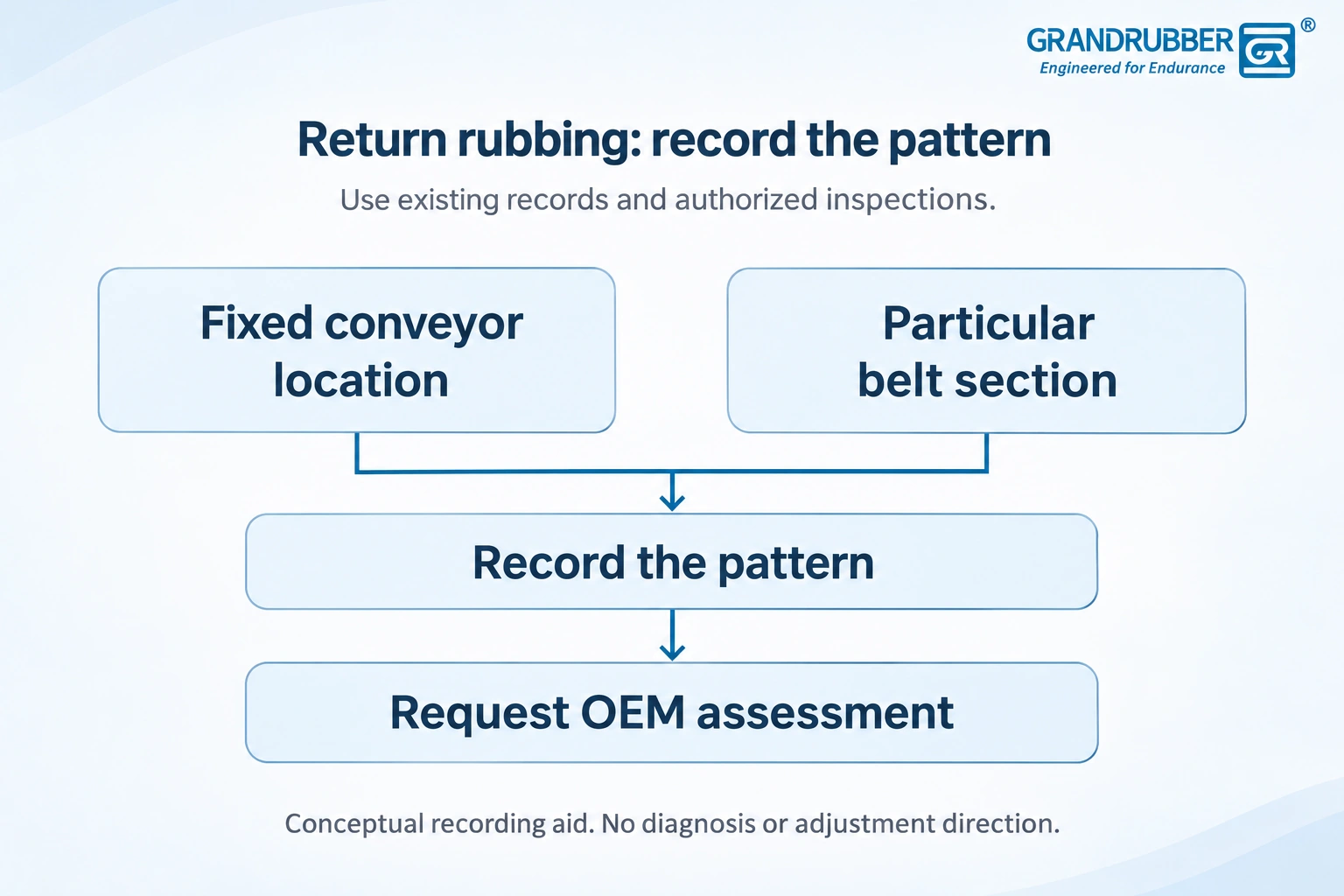
Use the first table to make a location sheet from existing records and an authorized inspection. Define the viewing direction so “left” and “right” do not reverse between photographs. Label the carrying and return routes, the head and tail, and the actual point of contact. Include a wider view showing where that point sits on the machine.
Then distinguish a fixed location from a repeating belt-section event. If the available record cannot show that distinction, state “pattern unknown”; do not improvise a running test to obtain it. A single close-up can show damage but usually cannot establish how the event repeats.
Record the contact as observed: belt edge against steel, a cover face against a component, or a different interface. Do not assume that all “bottom rubbing” describes the same fault. Mark whether an observation is current, historical or taken after a change. Ask the specialist which further safe inspection is required rather than adding unsupported measurements or guessed clearances.
| Record item | What to enter | If unavailable |
|---|---|---|
| Machine and condition | Model, deployed arrangement, date, empty/loaded and documented settings | Identify missing OEM record; no assumed equivalence |
| Contact position | Labelled station, belt face/edge, viewing direction and wider view | Request an authorized inspection location record |
| Pattern | Fixed machine location, one belt section, wandering, or unknown | State unknown; ask reviewer to define further evidence |
| Condition history | First occurrence, belt change/joining and other interventions | Keep reported chronology separate from confirmed facts |
| Measurements and documents | Units, reference drawing, method and responsible inspector | Do not infer a clearance from an unscaled photograph |
What belongs in the frame, roller and splice review?
Provide the machine model, arrangement drawing, belt identity, installation date and joining record to the equipment specialist. Ask for the relevant return-support and structure checks under the machine’s own instructions. On a folding machine, identify the deployed arrangement and the applicable OEM drawing; a nearby conveyor is not automatically a dimensional reference.
Flexco’s Quick Fixes guide, issue 7, lists rollers or pulleys, splice condition and material buildup among possible tracking influences. It also distinguishes persistent deviation from wandering. These categories justify collecting different evidence; they do not diagnose this particular symptom.
Keep proposed remedies in a separate column. A report that a roller turns does not document its alignment or the full return arrangement. A new belt does not by itself prove a defective belt, nor does it establish correct installation. If splice or belt geometry is questioned, ask the qualified reviewer to identify the examination and acceptance basis rather than drawing a conclusion from an edge photograph.
Do not purchase a trainer simply because the symptom is described as tracking. Request a written explanation of the documented pattern, the problem the device would address and the conditions that must already be acceptable. A component proposal should follow the assessment, with its mounting and application scope explicit.
How should empty and loaded observations be compared?
Label operating condition on every existing observation. Include material, feed arrangement and the recorded speed or operating setting where available. “It was centered” without the condition and date is not a useful before-and-after statement.
Orthman’s commissioning section (p11) treats no-load and loaded checks as distinct stages. That supports keeping the records separate; it does not authorize a loaded trial on equipment already contacting structure. The responsible site team and machine OEM determine whether operation or further testing is permissible and what the procedure requires. Physical inspection or maintenance requires the machine’s isolation and stored-energy controls.
If only an empty-run record exists, write “loaded behaviour not established”. Ask the specialist to include that uncertainty in the disposition. A missing test result is not a prediction that loading will correct the rubbing, and a comment suggesting a trial is not a substitute for the site’s decision.
When an authorized intervention has been completed, compare the same locations and documented conditions. Record other changes made at the same time so that an apparent improvement is not automatically attributed to the last adjustment.
How should a fault record become a supplier action request?
The second table separates facts, hypotheses, requests and acceptance. It lets a maintenance manager ask for an assessment, an equipment supplier review the machine interfaces, and a belt supplier review a defined construction without each party assuming a different job.
A practical request reads: “The return edge contacted the frame at the labelled location in the attached dated record. Head and tail positions were recorded under the stated condition. Please identify the additional inspection needed, the proposed corrective scope, and how completion will be verified.” This is an illustrative request, not a quotation from the original discussion.
Request a written disposition with unresolved items and an owner for each. If replacement is proposed, identify the required belt construction, machine interfaces and joining requirements before comparing prices. If machine work is proposed, identify who is responsible for that work and its acceptance. Keep the original fault evidence available after the record is closed; it provides a baseline if the symptom returns.
| Record category | Example entry or question | Decision boundary |
|---|---|---|
| Observed fact | Return edge contacted frame at the labelled station in the supplied record | Not an identified root cause |
| Hypothesis | Return arrangement, contamination, joining or belt geometry requires assessment | Not an instruction to adjust or replace |
| Evidence gap | Loaded behaviour and relevant drawing not established | Not permission for a trial run |
| Requested response | Inspection scope, supported conclusion, proposal, exclusions and unresolved items | No guessed tension, offset or tolerance |
| Acceptance record | Responsible party, applicable procedure, conditions checked and result | No “fixed” label based only on one endpoint photo |
Selection, supply boundary and one next step
The catalogue identifies options for review. Confirm the actual construction, interfaces, duty and acceptance requirements before ordering. A catalogue entry does not establish stock, installation service or certification.
Use the related product family only after identifying the actual belt type. This guide remains relevant to several families; the source screener discussion does not establish that its belt was fabric, steel cord, sidewall or anti-stick. Those links are navigation options, not a diagnosis or recommendation for that machine.
Send one annotated fault record with the existing belt specification and the OEM arrangement to the responsible supplier for review. For a GRAND RUBBER belt enquiry, select the matching related product page and ask for the construction and interface questions to be answered alongside the record. Machine adjustment, installation and site acceptance remain separately assigned scopes.
Buyer FAQ
Does rubbing in the middle prove that the belt itself is crooked?
No. The contact location does not identify its cause. Ask the reviewer to separate a location-specific pattern from an event associated with a particular belt section, then evaluate the relevant machine and belt evidence.
Can the same adjustment be copied from the other conveyor on the screener?
Do not assume the two arrangements are identical. Provide both machine documents if relevant and ask the OEM which references and settings apply. A nearby conveyor is not an approved substitute drawing.
What if an adjustment is already at its limit?
Record which adjustment, its documented position and the history of changes, then refer it to the OEM or responsible specialist. The limit does not establish a root cause or justify extending the mechanism, removing a guard or improvising another correction.
Is an empty-run result enough to close the record?
Only the applicable acceptance procedure can determine that. State which conditions were actually assessed and which remain unknown. An empty-run observation should not be presented as a loaded-service acceptance result.
Should I buy tracking rollers before asking the supplier?
Request the assessment first. The proposal should explain which documented pattern the device addresses, its application limits and the required interfaces. Device availability alone does not establish suitability.
What photos are useful if I cannot safely get a close-up?
Use existing authorized photographs, drawings and records. Explain the missing view and ask the responsible inspection team for a safe evidence plan. Do not reach into equipment or remove guarding to complete the enquiry.
Can this same record be used for cover cracking or splice deterioration?
Yes. Retain the equipment identity, dated location record, operating conditions and change history. Add symptom-specific evidence requested by the relevant supplier. The return-rubbing example is an extension of the general record, not the only fault this guide covers.
Does “new belt” establish a warranty claim?
It establishes a reported chronology, not responsibility. Preserve the order specification, delivered identity, installation and joining records, and condition evidence. Ask the relevant parties to assess the claim against the actual contractual and technical basis.
Sources
- Orthman Belt Conveyor IOM, 25 September 2026, pp3,11,24: isolation, commissioning and troubleshooting categories; equipment-specific
- Flexco Quick Fixes, issue 7: tracking pattern and possible influences
- Public question context: mobile-screener return rubbing; self-report, no verified repair outcome
Related products
 Multi-ply Fabric Conveyor BeltsEP/NN multi-ply rubber conveyor belts for mining, cement and bulk handling. Match whole-belt strength, plies and cover grade to your material and conveyor before ordering.
 Steel Cord Conveyor BeltsSteel-cord conveyor belts for high-tension, long-distance bulk conveying. Compare ST, STE and STH constructions against belt width, cord layout, pulley and splice requirements.
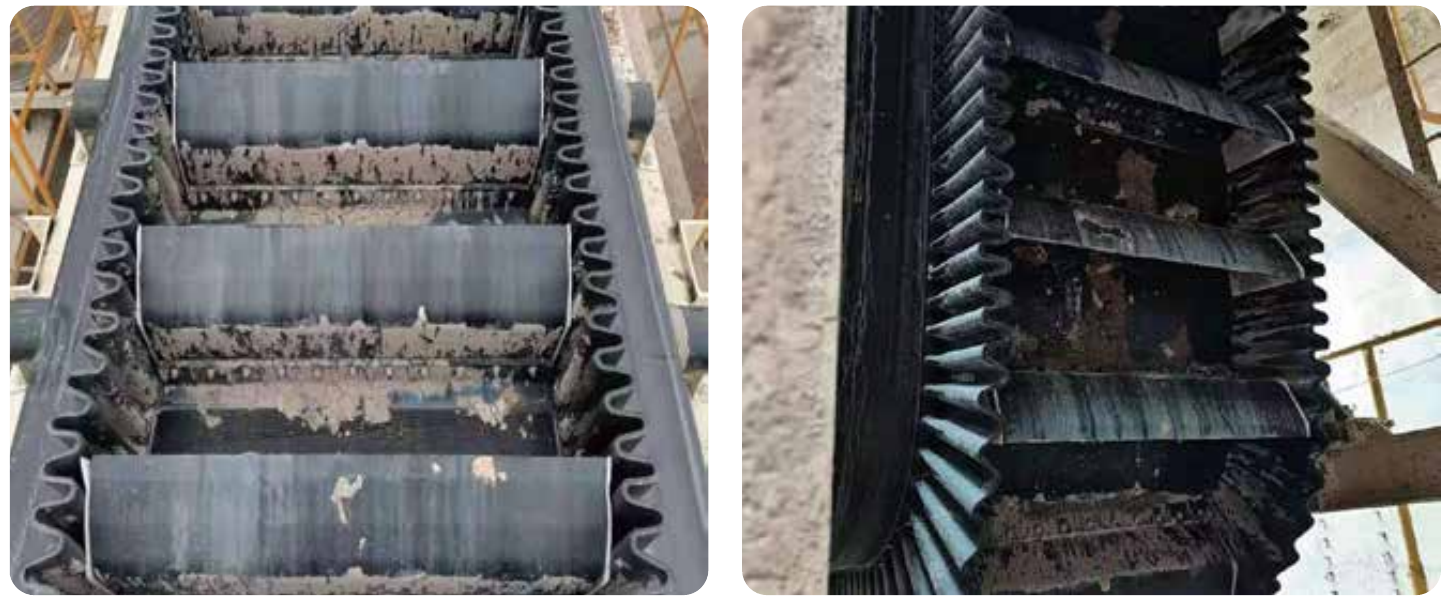
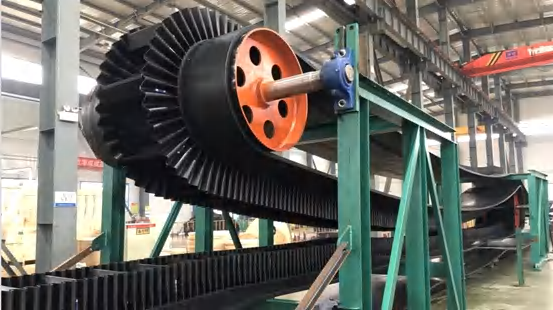 Corrugated Sidewall Conveyor BeltsConveyor belts combining a base belt, corrugated sidewalls and cleats for lifting bulk materials. Review lift, incline and loading geometry together when specifying the assembly.
 Anti-stick Conveyor BeltsConveyor belts with covers listed for material-release applications. Describe the material, moisture, temperature and sticking location to assess the cover and cleaning arrangement.
Document and page references
- Existing guide and GRAND_RUBBER_Conveyor_Belts.pdf p19 retained as historical provenance; expanded fault-recording tables are editorial aids, not catalogue-derived procedures.
- Orthman IOM GEN 9/25/26, p24: point-specific versus belt-section deviation; p11: distinct empty and loaded commissioning stages. No corrective settings reproduced.
Download the reference tables
Source-labelled review extract. Historical references remain historical; this is not a formal TDS, certificate or current availability confirmation.
Download guide tables CSV