
How do you identify an existing sidewall belt?
Identify the existing sidewall belt with a complete, revision-controlled geometry record. Match the drawing’s own symbols to basebelt, cleats, sidewalls and inset; photographs and two overall dimensions do not establish replacement equivalence.
On this page
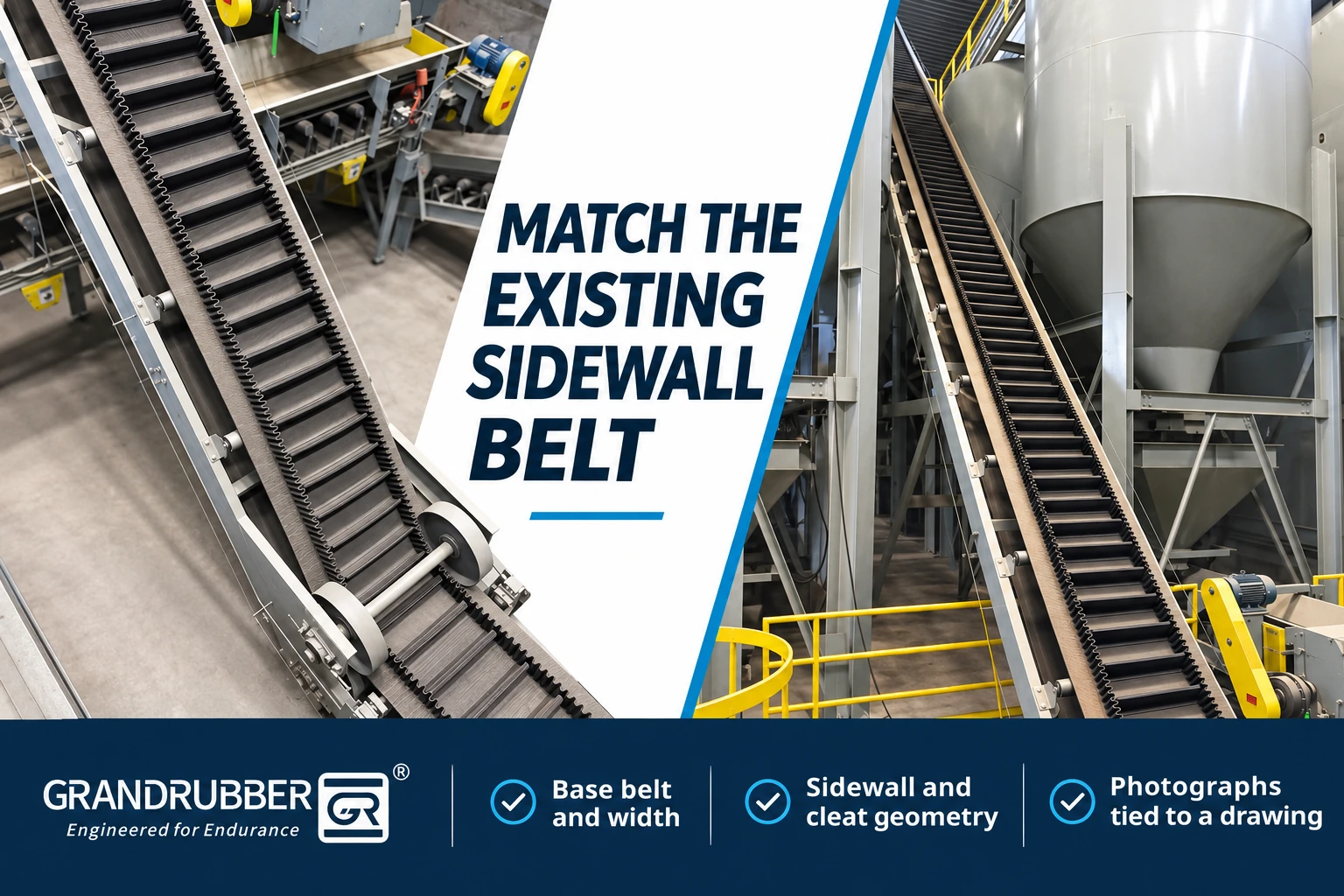 Open full-size image ↗
An existing sidewall replacement needs the whole belt geometry and construction, not just width and sidewall height. Record the dimension definitions used by the applicable drawing, the current belt identity and what is still unknown. Do not reproduce a worn shape as an approved nominal design without review.
Read the symbols from the actual form
On the cited replacement questionnaire, BW is belt width and CW is cleat width; H identifies sidewall height, CH cleat height, CP cleat pitch, SW sidewall width and FS inset.
If a buyer’s drawing uses another symbol or separately specifies usable clear width, record its definition explicitly. The same letters can otherwise conceal a different measurement. Keep photographs labelled as observations alongside the controlling geometry reference.
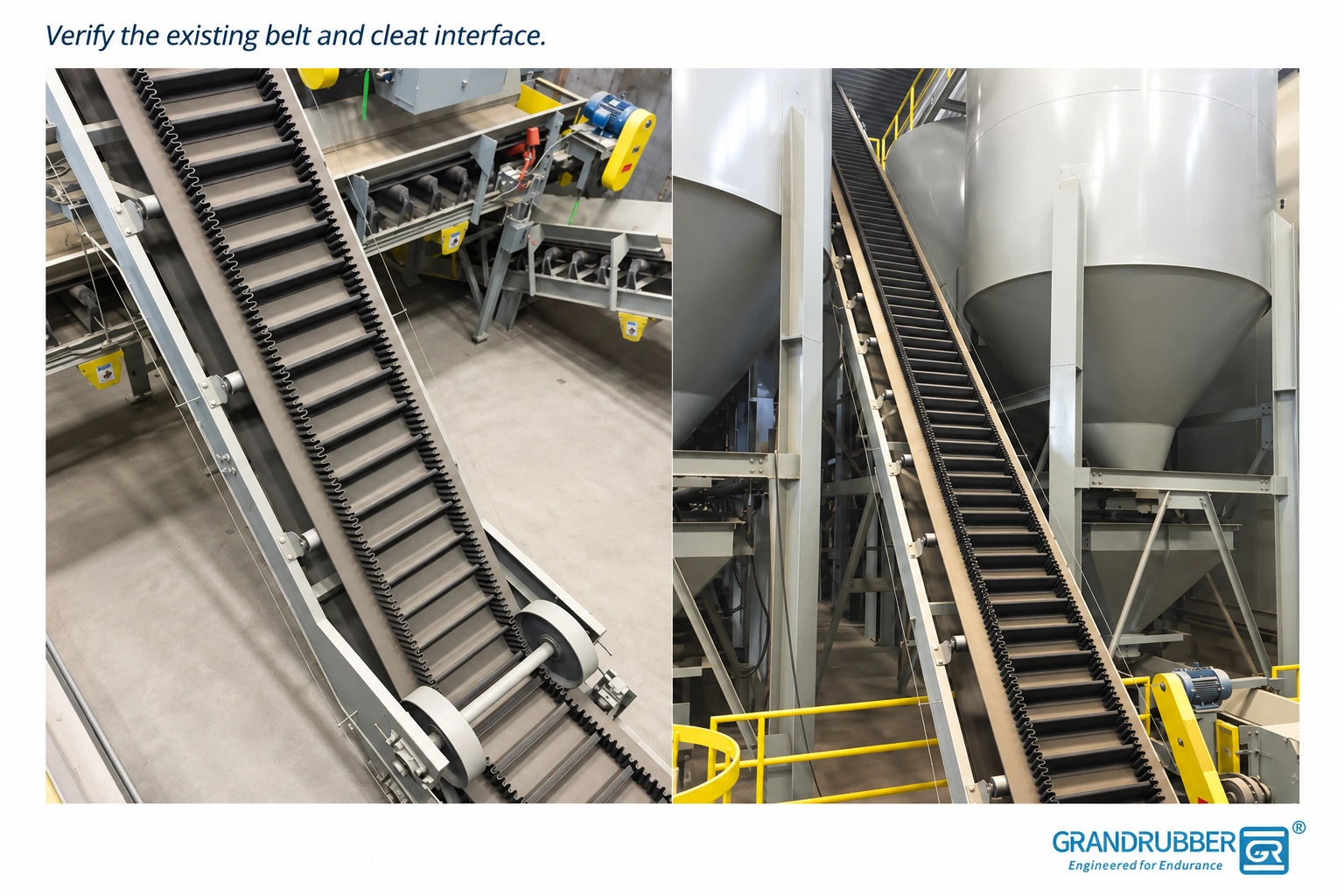
Record the complete geometry and construction
Capture cleat type, pitch and position, sidewall arrangement, inset and the open or endless length basis. Include reinforcement, strength/plies, cross-rigid construction and both covers where documented. The source also asks for material, temperature and side-blinker information.
The first table is a collection aid, not a tolerance schedule. State measurement methods and whether a value is nominal, measured on a worn belt or proposed. A photograph without scale or an old marking may help identify questions while leaving hidden construction and dimensions unresolved.
| Part | Definition to identify | Evidence status |
|---|---|---|
| Basebelt | BW, covers, construction and length basis | Nominal/documented versus worn measurement |
| Cleat | Type, CW as defined, CH and CP | Exact drawing and revision |
| Sidewalls | H, SW, FS and arrangement | Measured/confirmed/proposed |
| Equipment interface | Cross-rigid requirement, route and joining | Applicable equipment references |
Worked example: equal overall width, different cleat definition
Assume a hypothetical replacement quote matches belt width and sidewall height, but refers to a cleat code with no drawing revision. The buyer’s record contains an unlabeled transverse dimension. No actual dimension or interchangeability is assigned.
Ask which dimension that record describes and obtain the applicable cleat/sidewall drawing. Do not label it CW by habit or assume the new cleat leaves the same working space. Confirm pitch, inset and construction against the same reference.
The second table separates identity, dimensional definition and replacement disposition. The correct first response can be an information gap, rather than a fabricated nominal specification.
| Partial match | Still unresolved | Required reply |
|---|---|---|
| Same width | Cleat and sidewall arrangement | Marked geometry comparison |
| Same height | Type, pitch, inset and construction | Applicable drawing identity |
| Similar photograph | Scale and hidden belt structure | Documents and authorized inspection |
| Same model wording | Revision and equipment fit | Technical disposition of actual offer |
Request a marked replacement comparison
Send the existing drawing, identification and authorized measured record with the proposed replacement through the related sidewall product enquiry. Ask the supplier to mark what matches, what departs and which hidden or missing details require technical review.
Keep the current arrangement and joining requirements with that comparison. A historical drawing may need clarification, and a new model name is not proof that it fits the existing machine. No measurement, repair or handling procedure is authorized by this dimensional checklist.
Buyer FAQ
Is CW always the space between the sidewalls?
No. The cited questionnaire defines CW as cleat width. Use the actual drawing definition and record any separate clear or usable width rather than transferring symbols by memory.
Can I use worn sidewall height as the new nominal height?
Do not silently make that substitution. Identify the worn measurement and ask the responsible reviewer to establish the intended nominal geometry.
Does an identical-looking cleat code settle pitch?
No. Request the drawing and revision identifying its dimensions and arrangement. A code or photograph alone may leave the replacement geometry open.
What if the existing cross-rigid construction is unknown?
Mark that uncertainty and ask the relevant technical parties which records or assessment are needed. Do not infer reinforcement from the cover appearance.
Should an open belt length and finished endless length be compared directly?
First establish each measurement basis and supply form. Keep them distinct until the joining and equipment requirements have been reconciled.
Related technical resources
Related products
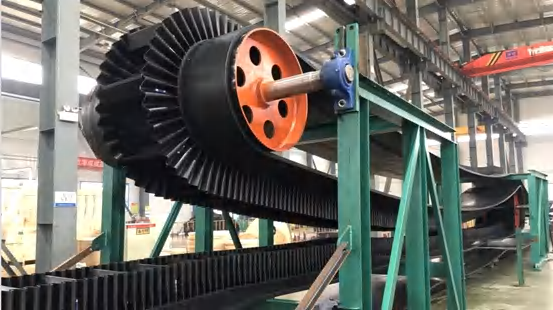 Corrugated Sidewall Conveyor Belts
Related buyer question
How do you identify an existing sidewall belt?
Record the entire belt geometry; width and sidewall height alone cannot define a replacement.
Document and page references
- GRAND_RUBBER_Conveyor_Belts.pdf, PDF pp17: Replacement drawing symbols and construction questions. CW is cleat width on this form; not a universal symbol convention.
- Decision tables, hypothetical examples and follow-up questions are editorial purchase-review aids; they are not customer cases, site instructions or technical approval.
Download the reference tables
Source-labelled review extract. Historical references remain historical; this is not a formal TDS, certificate or current availability confirmation.
Download guide tables CSV