
What is needed to specify a new sidewall conveyor?
For a new sidewall conveyor, define the material, required duty and route together before choosing belt geometry. Separate fixed project constraints from proposed dimensions and ask the responsible design team to resolve missing inputs.
On this page
 Open full-size image ↗
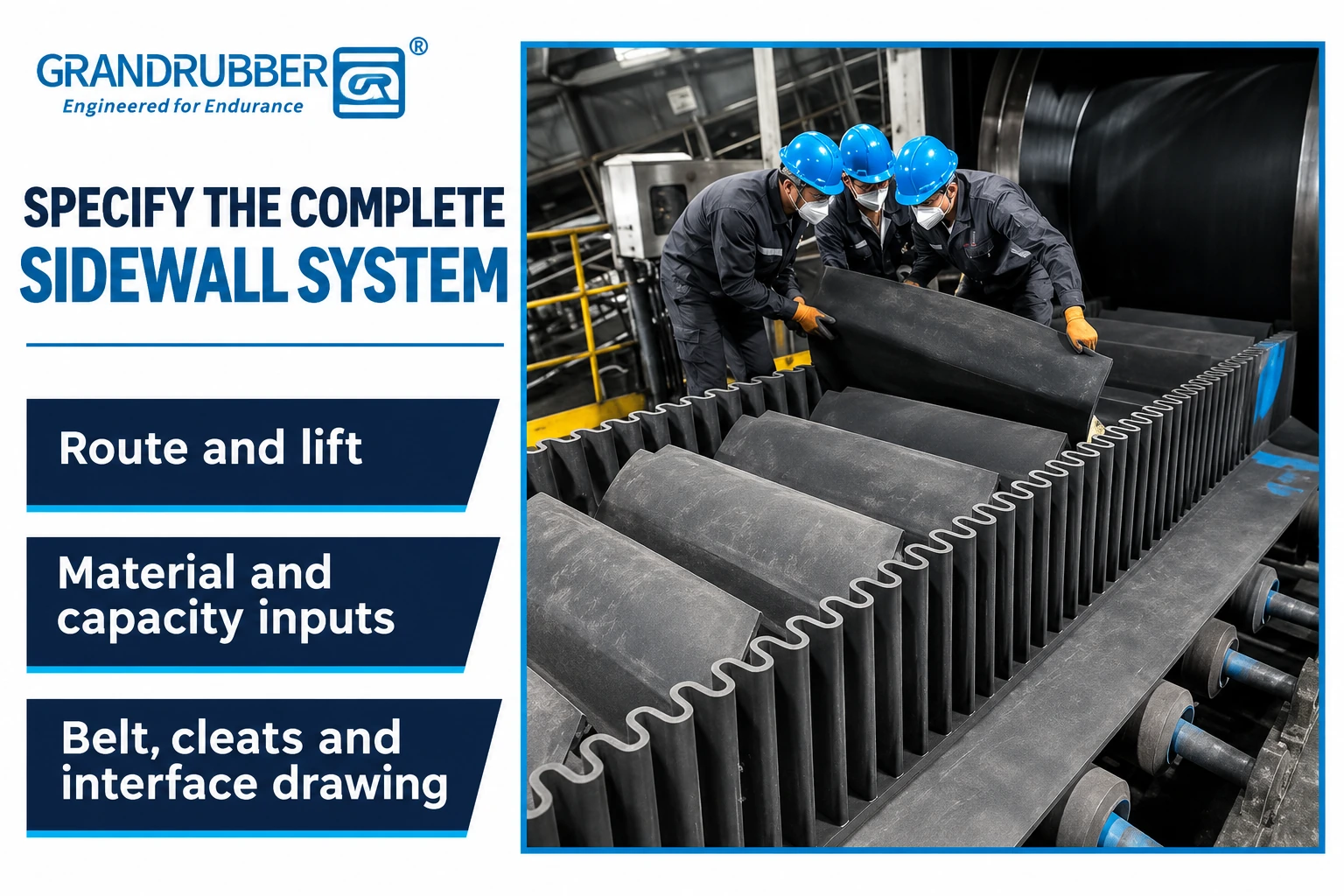
Start a new sidewall-conveyor enquiry with material and route information, not a sidewall height chosen from a picture. The belt, sidewalls and cleats must be reviewed within an identified conveyor arrangement. This guide organizes a new-system handover; the separate replacement guide records the geometry of an existing belt.
Use the new-installation form as an input map
The belt manual’s new-installation questionnaire places material information alongside the conveyor configuration. It asks for capacity, bulk density, lump size, moisture, material temperature and route geometry, including lift and horizontal lengths. Record the source and units for the entries rather than copying values from another project.
Distinguish a required throughput from a tested capacity and a proposed width from a fixed interface. A completed form does not approve a design; it gives the designer a traceable starting point.
Explain why the material and route belong together
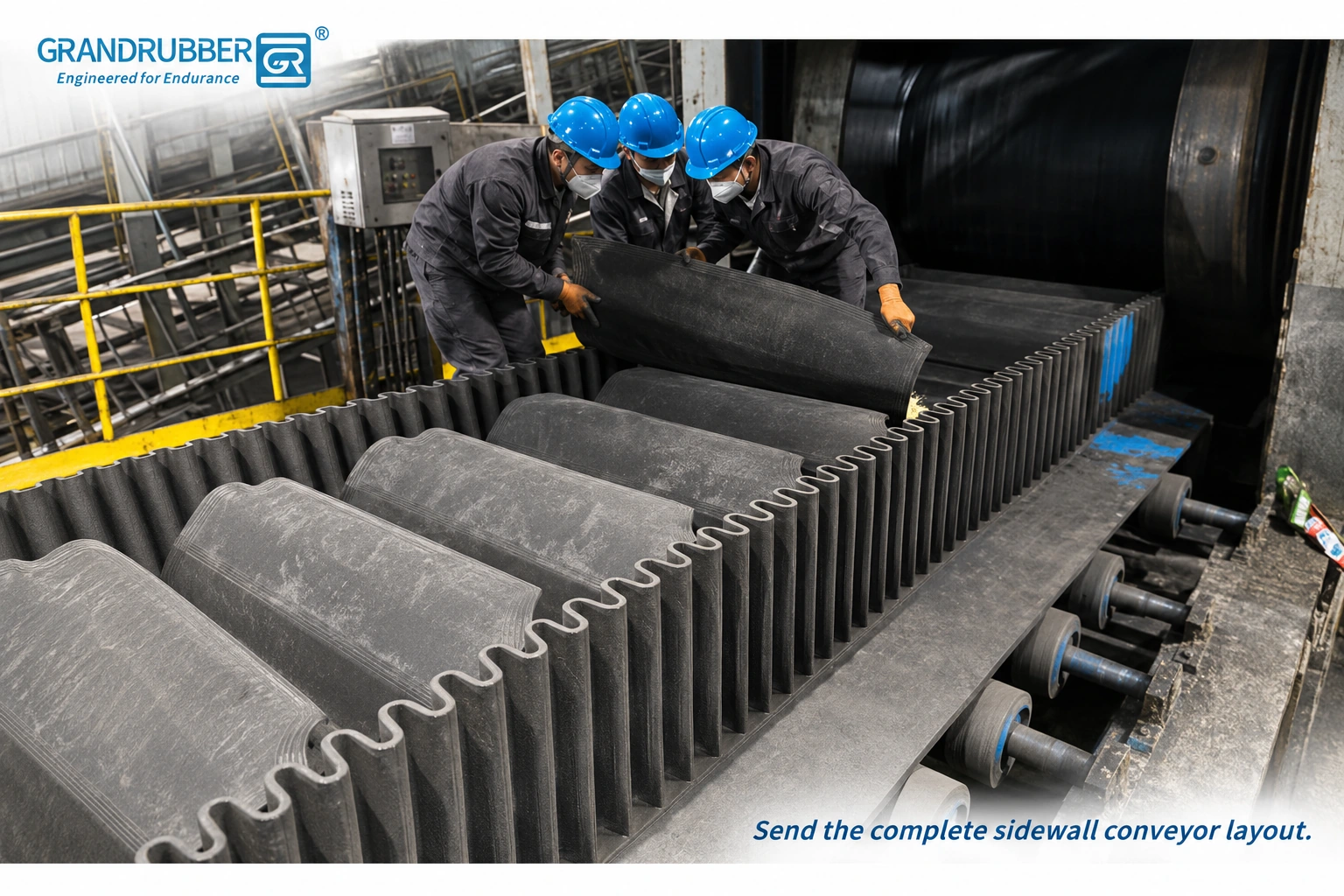
Tell the reviewer whether the material is loose bulk, damp, variable in size or otherwise subject to a known condition. Include the loading and discharge arrangement, incline, available space and documented speed if already specified. Label missing material properties as unknown rather than using an unverified generic density.
The first table links each input to the question it must resolve. If the layout changes, retain the old revision and identify which inputs changed. A new lift or discharge point should not remain hidden behind an unchanged belt label.
| Input group | What to record | Question it supports |
|---|---|---|
| Material | Identity, size, bulk condition and source | What is the actual conveying duty? |
| Duty | Required capacity and operating pattern | What requirement must the design address? |
| Route | Lift, incline, horizontal lengths and drawing | What geometry is proposed or fixed? |
| Interfaces | Loading, discharge, space and existing equipment | Which constraints need joint review? |
Worked example: the route changes after an early proposal
Assume a hypothetical project receives an early belt concept, then relocates its discharge point while keeping the desired throughput. No belt dimensions, capacity calculation or operating angle is approved in this example.
Issue the revised arrangement and ask which proposed belt, cleat and sidewall details need reconsideration. Do not treat the early concept as a fixed component order merely because material demand stayed the same. The effect of the route change must be assessed with the relevant design inputs.
The second table records fixed constraints, proposals and open decisions. It lets purchasing request a revised technical response without inventing the missing design values.
| Status | Example entry | Next action |
|---|---|---|
| Fixed requirement | Buyer-defined throughput or interface | Confirm unchanged requirement |
| Revised constraint | New discharge location on a dated drawing | Identify affected design questions |
| Supplier proposal | Belt/sidewall/cleat concept | Request revision against the new layout |
| Unresolved | Material or equipment detail not established | Assign an evidence owner before release |
Turn the inputs into a design-review request
Send one material sheet and one labelled arrangement revision through the related sidewall-belt enquiry. Identify who owns conveyor design and which dimensions are imposed by interfaces. Ask for a proposed construction, its assumptions and the unresolved inputs.
Loading/discharge equipment, supporting structure, drives, joining and site installation are not automatically included in belt supply. Record the requested boundary. A catalogue questionnaire or allowable-looking incline does not establish complete-system approval or an installation procedure.
Buyer FAQ
Can the required capacity alone select the belt width?
No complete design follows from capacity alone. Supply material and route information and identify the equipment constraints so the responsible designer can evaluate a construction.
What if bulk density is unknown?
Mark it unknown and identify who can establish a suitable project value. Do not use another material’s value simply to complete a capacity field.
Can a catalogue maximum incline be used for any material?
No. Treat it as source context, not application approval. The actual material, loading and layout must be reviewed together.
Should belt speed be guessed to obtain a quotation?
State whether speed is fixed, proposed or undecided. Ask the design authority which input is needed; an assumed value should not silently become a requirement.
Does belt supply include the new conveyor machine?
Only if explicitly offered and agreed. Separate the belt, equipment design, mechanical components and installation scope in the enquiry.
Related technical resources
Related products
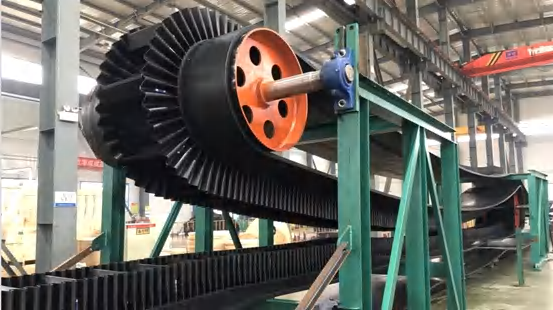 Corrugated Sidewall Conveyor Belts
Document and page references
- GRAND_RUBBER_Conveyor_Belts.pdf, PDF pp16: New-installation questionnaire and units; not a conveyor capacity/design approval.
- Decision tables, hypothetical examples and follow-up questions are editorial purchase-review aids; they are not customer cases, site instructions or technical approval.
Download the reference tables
Source-labelled review extract. Historical references remain historical; this is not a formal TDS, certificate or current availability confirmation.
Download guide tables CSV