
What information belongs in a conveyor belt quotation request?
A useful conveyor belt quotation request separates documented requirements, observations and missing inputs. Identify the belt and duty, assign each uncertainty to the right reviewer, and state whether you need preliminary guidance or a defined quotation.
On this page
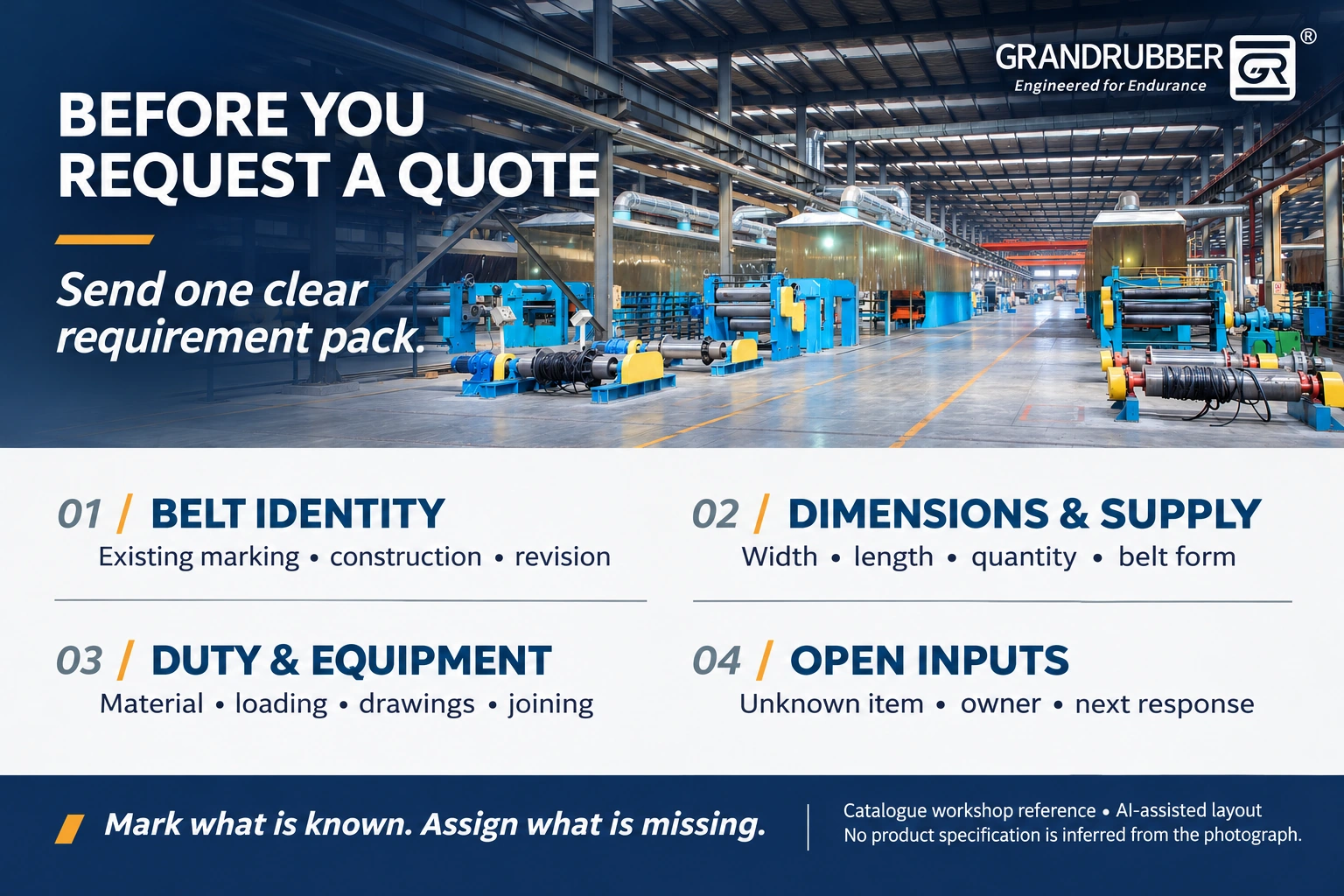 Open full-size image ↗
A conveyor belt request for quotation should identify what is being bought, the evidence behind that requirement and who can resolve missing information. You do not need to invent a complete specification before contacting a supplier. You do need to distinguish confirmed inputs from observations, proposals and unknowns so the reply addresses the decision you can actually make.
This checklist is for a new-belt or replacement enquiry. It organizes the information handover; it does not select a belt construction or turn an incomplete enquiry into an approved order.
1. Decide what kind of answer the enquiry needs
Begin with the purpose: identify an existing belt, review a proposed replacement, or quote an already defined requirement. Put that purpose in the first sentence. An enquiry seeking identification needs a different reply from a request to price an approved drawing.
For replacement work, include the equipment reference and the reason for replacement. For a new conveyor, identify the project drawing and the party responsible for the conveyor design. A belt seller should not have to infer whether the job is to reproduce a documented construction or help clarify a missing specification.
State the requested output: a list of information gaps, a technical proposal with departures, or a quotation against the named revision. This makes an early discussion useful without presenting the supplier’s assumptions as the buyer’s requirements.
2. Give each technical input an evidence status
Use the first table to distinguish the value, its source and its status. Keep a belt marking or previous order description exactly as received, then identify what it does not establish. Record width, required length or roll lengths, quantity and supply form where known; identify units instead of letting the supplier infer them.
For fabric belts, the carcass is the reinforcing textile construction beneath the rubber covers. State the designation, plies, whole-belt strength and top and bottom covers separately when the documents provide them. For steel cord belts, send the existing cord and splice information as well as the designation. GRAND RUBBER’s fabric and steel cord catalogue pages separate these construction entries; a short product name is not the complete requirement.
Attach the relevant drawing revision or record identifier beside the entry. A measured condition on a used belt, an old nominal requirement and a proposed replacement value should remain distinguishable. If two records disagree, show both rather than silently selecting the larger or newer-looking value.
| Input | Record with its reference | Status to keep visible |
|---|---|---|
| Item identity | Belt family, marking and equipment reference | Original record or proposed identification |
| Dimensions and quantity | Width, length basis, roll/piece quantity and supply form | Documented requirement or item still to establish |
| Construction | Reinforcement, rating, plies/cord details and two covers | Complete statement or explicitly missing fields |
| Duty and interfaces | Material, operation, drawing, pulleys and joining | Observed duty versus design requirement |
| Delivery request | Destination, handling constraints and requested timing | Buyer request, not supplier confirmation |
3. Send the operating context that changes the review
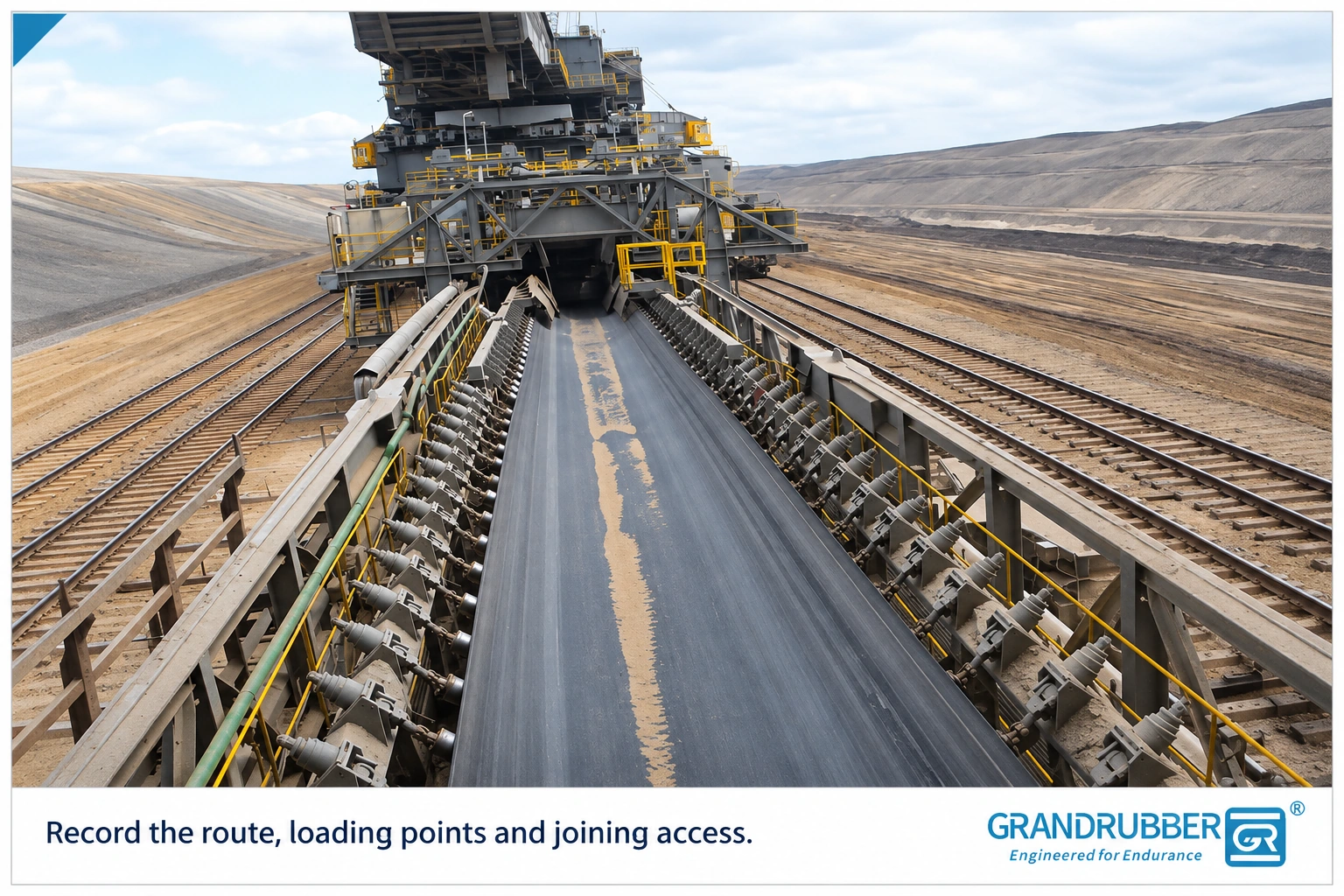
Describe the conveyed material and the route: material size and condition, loading arrangement, normal operation and relevant interruptions. Include the available layout, pulley and joining information. Say whether the concern is an unidentified original belt, observed damage or an intended change in duty. These inputs explain why a substitution may need review; they are not a substitute for the equipment design.
Add special conditions only when relevant. For hot service, separate material and belt exposure records. For cold service, identify ambient conditions and starts separately from steady running. For an endless supply, identify how the required finished circumference is defined and whether installation access permits that supply form. The catalogue pages for cold-resistant and truly endless constructions are retrieval aids, not proof that a remembered temperature label or nominal loop length defines an offered belt.
Do not identify a material as harmless, oil resistant or suitable for a particular site solely from colour or a generic application name. Record what substance or condition is actually known and ask what additional evidence the technical reviewer needs.
4. Assign the missing input instead of guessing it
The second table assigns a next action to each gap. Ask the person who controls the relevant evidence: the site team for equipment records and observations, the design authority for a requirement, and the supplier for what its proposed product and offer establish. The exact allocation depends on the project; these are enquiry roles, not a contract assigning legal responsibility.
Use a question, an owner and an expected response. “Cover dimensions unknown; site engineering to identify the approved baseline or define the inspection needed” is actionable. “Supplier to assume a standard cover” leaves the buyer unable to distinguish a stated requirement from an unsupported substitution.
If the missing information prevents a firm technical offer, ask for a conditional response that identifies assumptions and the next evidence needed. Do not label that response an approved equivalent or release it as an order without the required review.
| Gap | Suggested evidence owner to identify | Requested response |
|---|---|---|
| Unclear old designation | Buyer records and belt supplier | Identify what the record establishes and what it omits |
| Missing equipment/interface drawing | Site engineering or equipment authority | Supply the applicable revision or define the review needed |
| Unknown worn versus nominal dimensions | Responsible technical inspection team | Establish the basis; do not infer original nominal values |
| Proposed alternative construction | Supplier and responsible technical reviewer | State the proposal, evidence, departures and unresolved acceptance |
| Unconfirmed supply form or delivery | Purchasing and supplier | Clarify actual scope and requested versus confirmed conditions |
5. Worked example: a replacement request with an incomplete marking
Assume a hypothetical buyer has an equipment identifier, an old purchase description and authorized photographs, but no confirmed cover split or current joining drawing. No dimensions, price, delivery date or damage cause are invented for this example. The immediate decision is what to send and who must answer the gaps.
Send the old description as a historical reference, the photographs as observations and the missing cover/joining information as open items. Ask the supplier which construction details can be identified from its records and which require the site or equipment specialist. Ask the site team to establish the applicable drawing and the meaning of the recorded length.
If the supplier proposes a construction in reply, place that proposal in its own column. It is not evidence that the old belt had the same construction. The useful first-round result is an agreed information request or a clearly conditional proposal, rather than a price attached to a guessed complete specification.
6. Release one coherent enquiry pack
Send one short cover note, one input-and-gap sheet and the referenced attachments. Give the pack a revision so later clarifications do not leave different suppliers quoting different requirements. Keep requested destination, package constraints and project timing visible as buyer inputs; they do not establish stock or an agreed delivery commitment.
Choose the related product page that matches the identified family and send that same pack with the enquiry. The related categories cover different constructions, not interchangeable alternatives. GRAND RUBBER’s listed belt families can provide a starting point for review, while the offered construction and documents remain order-specific.
Ask for one response that separates the proposed specification, departures and missing inputs. Comparing multiple received offers is the next decision; do not dilute this initial handover by trying to rank suppliers before the requirement is clear.
Buyer FAQ
Can I enquire before all dimensions are confirmed?
Yes, if you state the purpose and the missing fields. Ask for identification or preliminary technical guidance rather than disguising the enquiry as a fully defined order. The supplier should identify which gaps prevent a firm offer and which party must resolve them.
What if the old purchase order and the belt marking disagree?
Attach both with their dates and item references. Ask the responsible parties to reconcile them before choosing the replacement baseline. A historical order may describe a requirement while the marking identifies a delivered item; neither should silently overwrite the other.
Does a total metre quantity define the roll schedule?
No. State the total separately from the required roll lengths or finished pieces, their units and the supply form. If that schedule is undecided, identify who will determine it. Do not assume that a total quantity means one roll or several identical rolls.
What additional clarification matters for an endless belt?
Identify the finished loop dimension and how it is measured, the intended construction and the installation access. Distinguish a truly endless construction from an open belt to be joined. The word endless alone does not define the supplied form or an approved joint.
Do I have to choose every test and standard before requesting guidance?
Send the actual customer or equipment requirement where one exists and mark unspecified items as open. Ask which evidence is relevant to the proposed construction. Do not select certificate names or test limits merely to complete a template.
Should commercially confidential attachments be sent with every enquiry?
Share only what is needed for that review and what your organization authorizes. A redacted drawing or an extracted requirement may be sufficient initially. Preserve enough item and revision context for a useful answer without exposing unrelated customer or commercial records.
Related technical resources
Related products
 Multi-ply Fabric Conveyor BeltsEP/NN multi-ply rubber conveyor belts for mining, cement and bulk handling. Match whole-belt strength, plies and cover grade to your material and conveyor before ordering.
 Steel Cord Conveyor BeltsSteel-cord conveyor belts for high-tension, long-distance bulk conveying. Compare ST, STE and STH constructions against belt width, cord layout, pulley and splice requirements.
 Cold-resistant Conveyor BeltsCold-resistant conveyor belts for low-temperature conveying. Review minimum ambient temperature, startup and pulley-flexing conditions against the selected construction and catalogue grade.
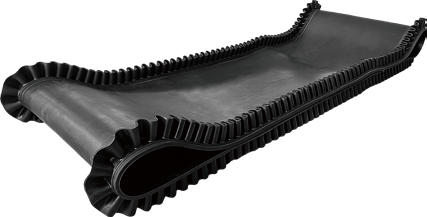 Truly Endless Conveyor BeltsJoint-free conveyor belts with a closed-loop carcass. Confirm loop length, width, thickness and conveyor layout together before specifying a replacement.Aramid Conveyor BeltsAramid-reinforced conveyor belts listed in the DPP catalogue range. Compare the full construction, covers and conveyor geometry when reviewing a replacement or project specification.
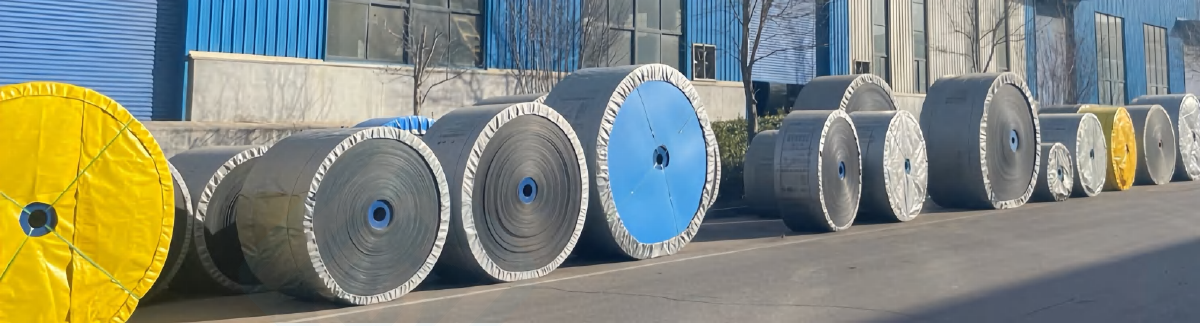 Solid-woven PVC / PVG Conveyor BeltsSolid-woven conveyor belts with separate PVC and PVG cover constructions. Select the complete belt around material exposure, conveyor dimensions and the required safety-document scope.
Document and page references
- Catalogue_GRAND_RUBBER.pdf, PDF pp6–7: fabric reinforcement, covers and separately stated construction fields; not a complete project specification.
- GRAND_RUBBER_Conveyor_Belts.pdf, PDF p22: source-specific steel cord schedule; p27: fabric construction; pp28,36: endless/cold categories. No catalogue size or temperature range adopted as an order value.
- Input status, role assignment, hypothetical request and tables are editorial enquiry methods, not a verified customer quotation request or installation approval.
Download the reference tables
Source-labelled review extract. Historical references remain historical; this is not a formal TDS, certificate or current availability confirmation.
Download guide tables CSV