
What information is needed for belt storage and handling?
Prepare a package-specific lifting, support and storage handover before a belt arrives. Use actual package identity, mass and approved handling references; a product catalogue sketch is not a universal lifting plan.
On this page
 Open full-size image ↗
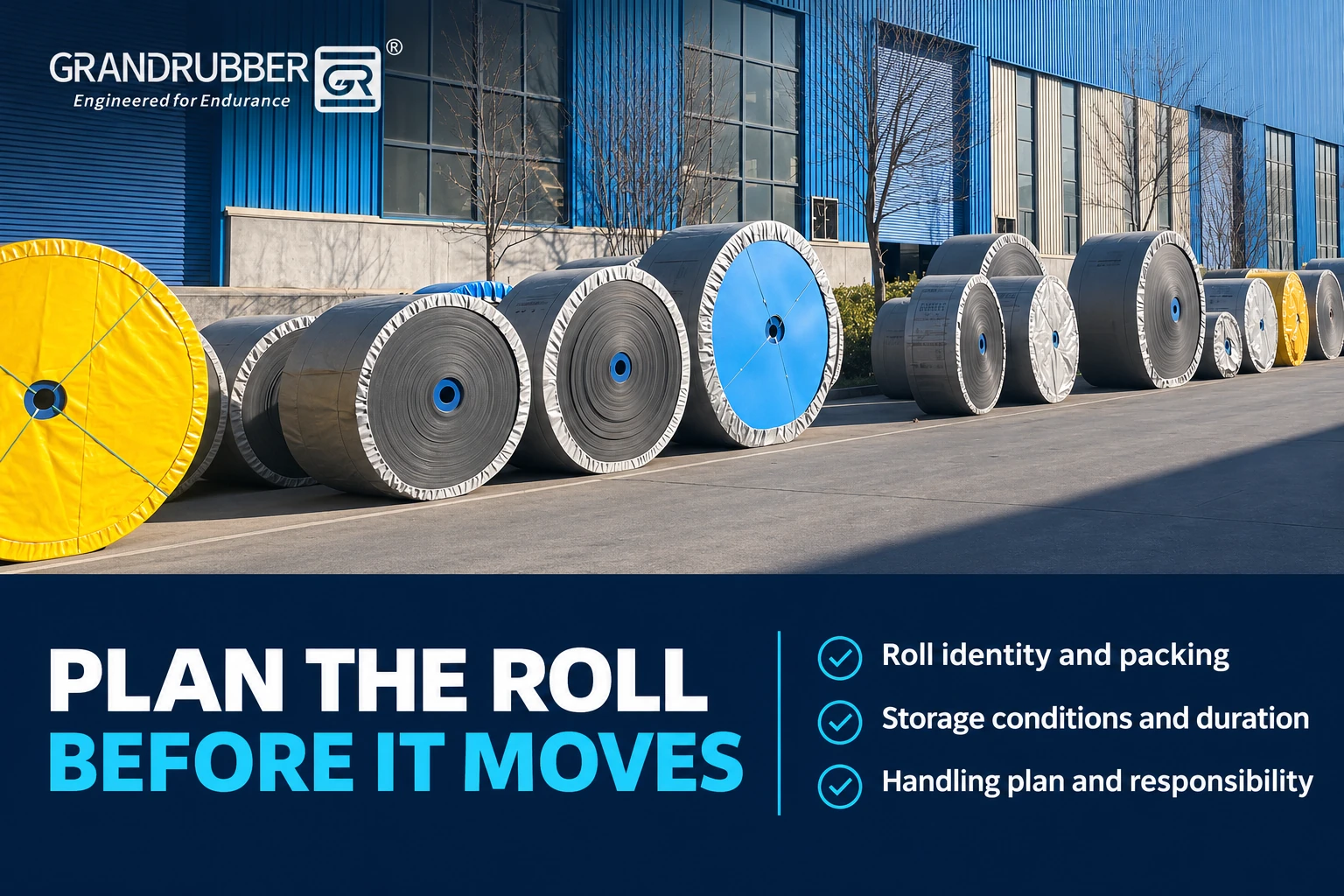
Plan storage and handling around the actual supplied package and belt form. Request the package data and responsible handling plan instead of adapting a web illustration to unknown lifting equipment. This guide prepares the information handover; it does not specify rigging, lifting points or a safe operating procedure.
Identify what is arriving before planning the lift
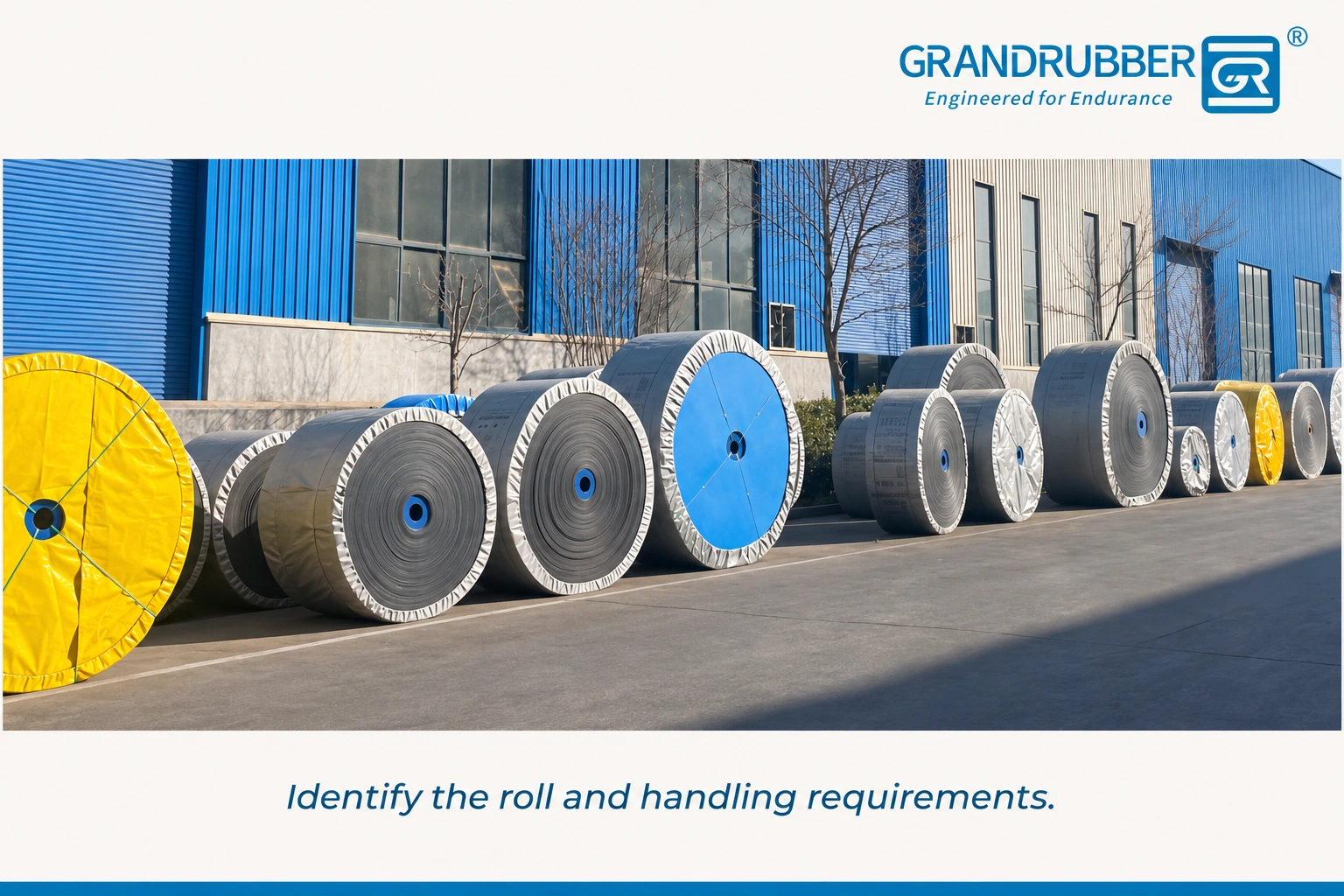
Distinguish a belt roll, crate, open belt and finished endless or sidewall package. Record item/package identity, dimensions, verified mass and any supplied centre-of-gravity or support information. A product width alone does not define the handling task.
The cited manual page concerns sidewall-belt storage and offloading and includes product-specific illustrations. Its stated conditions and equipment dimensions must not be generalized to an unidentified roll or crate. The source is evidence to request the proper package instructions, not a substitute for them.
Hand over package data and storage conditions
Identify who will unload, inspect, support and store the package and where the controlling plan will be available. Record expected storage duration and environmental exposure, packaging condition and any damage observed on receipt.
The first table separates supplier package information from the site’s handling assessment. Missing mass, uncertain support or damaged packing needs resolution by the responsible parties before the task proceeds under their approved procedure. This page supplies no default rigging dimensions or storage-temperature guarantee.
| Record | Evidence to request | Responsible question |
|---|---|---|
| Identity | Belt and package references | Is this the actual supplied package? |
| Mass/support | Verified package data and applicable drawing | What does the handling team need? |
| Condition | Authorized receipt observations and packing status | Who assesses a discrepancy? |
| Storage | Applicable requirements and expected exposure | Who maintains the storage record? |
Worked example: an unmarked crate arrives before the records
Assume a hypothetical site receives a crate carrying a sidewall belt, but the available note gives only the belt designation. Package mass and the applicable handling reference are not identified. No lift is planned or authorized in this example.
Preserve the received condition and item markings through the site’s approved receipt process, and request the missing package record from the supplier. Ask the responsible handling team what evidence it needs. Do not treat a similar crate photograph or last shipment’s mass as confirmation for this package.
The second table records evidence gaps and ownership. An urgent installation date does not turn a missing handling input into an acceptable assumption.
| Gap | Next action | Avoid |
|---|---|---|
| Unverified mass | Obtain package-specific information | Guess from a previous shipment |
| No handling reference | Refer to supplier/site handling authority | Adapt a web sketch |
| Damaged crate | Record and obtain disposition | Assume hidden belt condition |
| Changed storage | Document conditions and request review | Treat old instructions as universal |
Keep receipt, storage and installation records connected
Request one package-specific handover containing the item reference, packing/handling information and identified storage requirements. Record later movement, packaging damage or changed storage conditions for the responsible review.
Use the relevant belt-product enquiry for supplier information and the appointed competent site team for the handling plan. Material supply, unloading and installation may be separate scopes. Do not interpret catalogue storage diagrams as authorization to use a particular lifting attachment or to continue with damaged packing.
Buyer FAQ
Can I estimate package mass from belt width?
Do not use that as verified lifting data. Obtain the actual package information and have the responsible handling team assess it.
Does the catalogue prescribe our lifting equipment?
No. The cited drawings have a product-specific context; equipment and execution require the applicable package information and approved site plan.
What if installation is delayed?
Record the extended storage period and actual conditions, then ask which supplier requirements or condition checks need review. Do not invent an unlimited storage life.
Should damaged packing be removed to inspect the belt immediately?
Follow the responsible site’s receipt and safety procedure. Record the issue and obtain the required disposition; this guide gives no unpacking instruction.
Does delivery acceptance prove storage remained suitable?
No. Maintain subsequent condition and storage records. A receipt check concerns a point in time, not every later exposure or movement.
Related technical resources
Related products
 Steel Cord Conveyor BeltsSteel-cord conveyor belts for high-tension, long-distance bulk conveying. Compare ST, STE and STH constructions against belt width, cord layout, pulley and splice requirements.
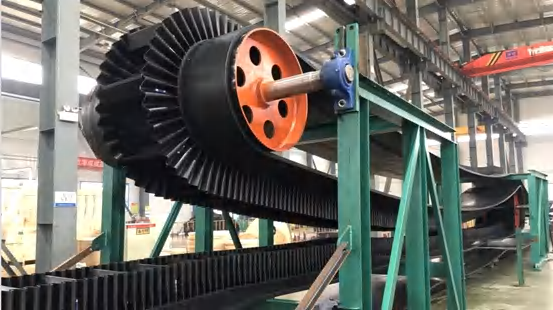 Corrugated Sidewall Conveyor BeltsConveyor belts combining a base belt, corrugated sidewalls and cleats for lifting bulk materials. Review lift, incline and loading geometry together when specifying the assembly.
Document and page references
- GRAND_RUBBER_Conveyor_Belts.pdf, PDF pp18: Sidewall-specific storage/offloading context; no rigging values or universal operating instructions copied.
- Decision tables, hypothetical examples and follow-up questions are editorial purchase-review aids; they are not customer cases, site instructions or technical approval.
Download the reference tables
Source-labelled review extract. Historical references remain historical; this is not a formal TDS, certificate or current availability confirmation.
Download guide tables CSV