
Conveyor Maintenance Contracts: Who Supplies Parts, Installs Them and Signs Off?
A maintenance contract may include spare parts, but the label does not define them. Identify each material line, installation task and acceptance owner before comparing offers or releasing a parts order.
On this page
 Open full-size image ↗
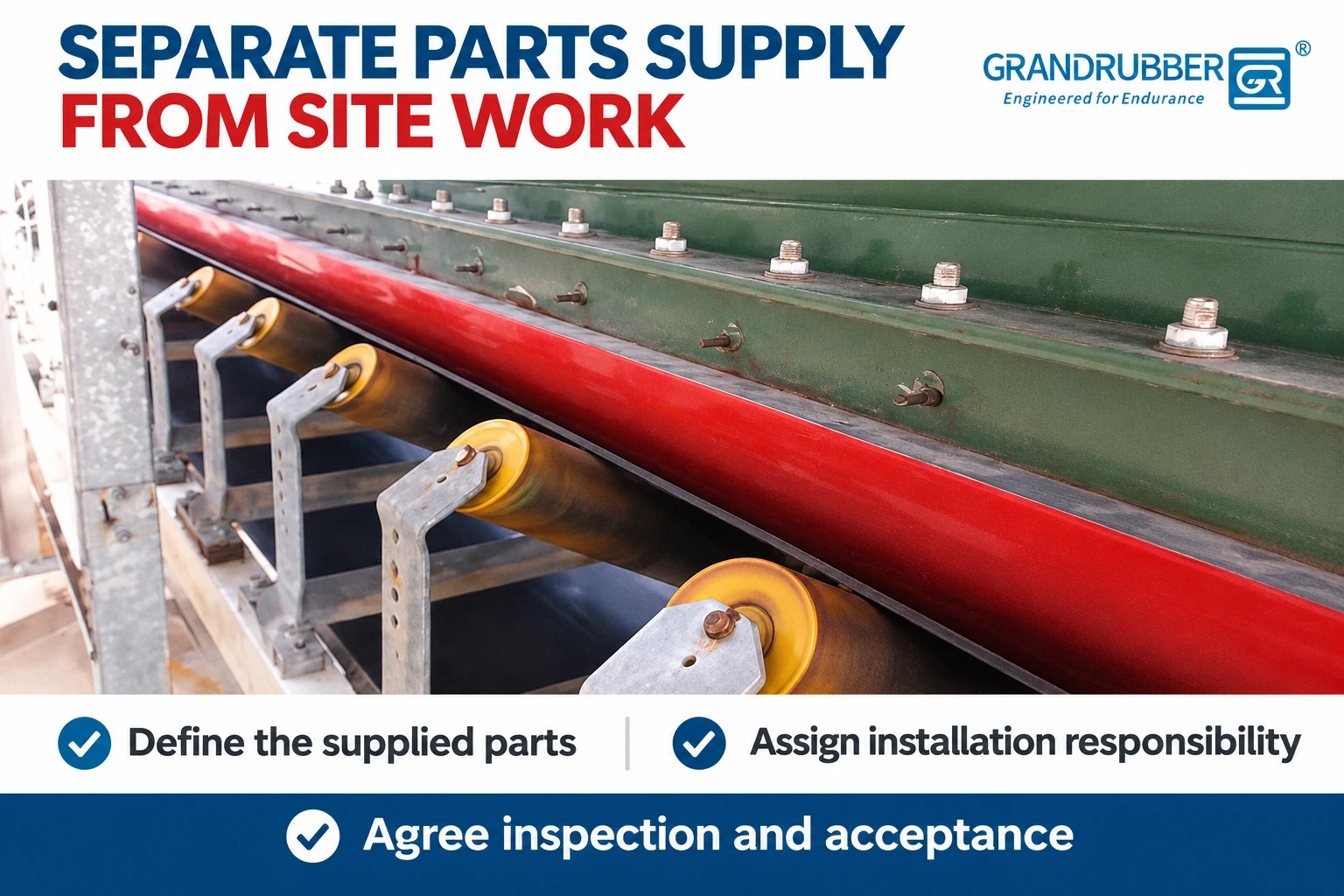
A conveyor maintenance contract can include replacement parts, labour or both. Its title alone does not tell a buyer which rubber parts are included, who confirms their specification, or who accepts the installed result. Before comparing prices, turn the requirement into named material lines and service tasks, with a responsible party and an acceptance record for each.
The practical test is simple: could the parts supplier and the maintenance contractor read the same scope sheet and identify exactly where each person’s work begins and ends? If not, the quotation is still missing decisions. This guide shows how to expose those gaps without treating an early parts estimate as a confirmed order.
1. What does the maintenance notice establish, and what remains undecided?
Knysna Municipality in South Africa listed tender T 38 of 2026/27 on 12 November 2026. Its official advertisement concerns 36 months of planned maintenance for electrical and mechanical equipment, including conveyor and compaction systems at the waste transfer station. The municipal listing and advertisement describe the same procurement, not two independent demand signals.
The announcement establishes a maintenance-service requirement. It does not establish a separate rubber-parts order, nor does it tell this reader whether replacements are included within the eventual maintenance arrangement. The complete technical tender package was not reviewed for this article. Any conclusion about parts quantities, dimensions, approved brands or replacement frequency would therefore go beyond the evidence reviewed.
For another plant facing a similar scope question, distinguish three statuses on the enquiry: confirmed work, a proposed allowance awaiting assessment, and work excluded from the offer. An allowance is a planning entry that still needs confirmation; it should not be presented as an identified purchase quantity. This is an editorial procurement method, not a description of the Knysna tender terms.
The useful lesson is to ask where the parts schedule and service schedule meet. Do not assume that a service contractor supplies every consumable, or that a material supplier installs everything it delivers. Either arrangement may be possible, but the quotation needs to state which arrangement is actually offered.
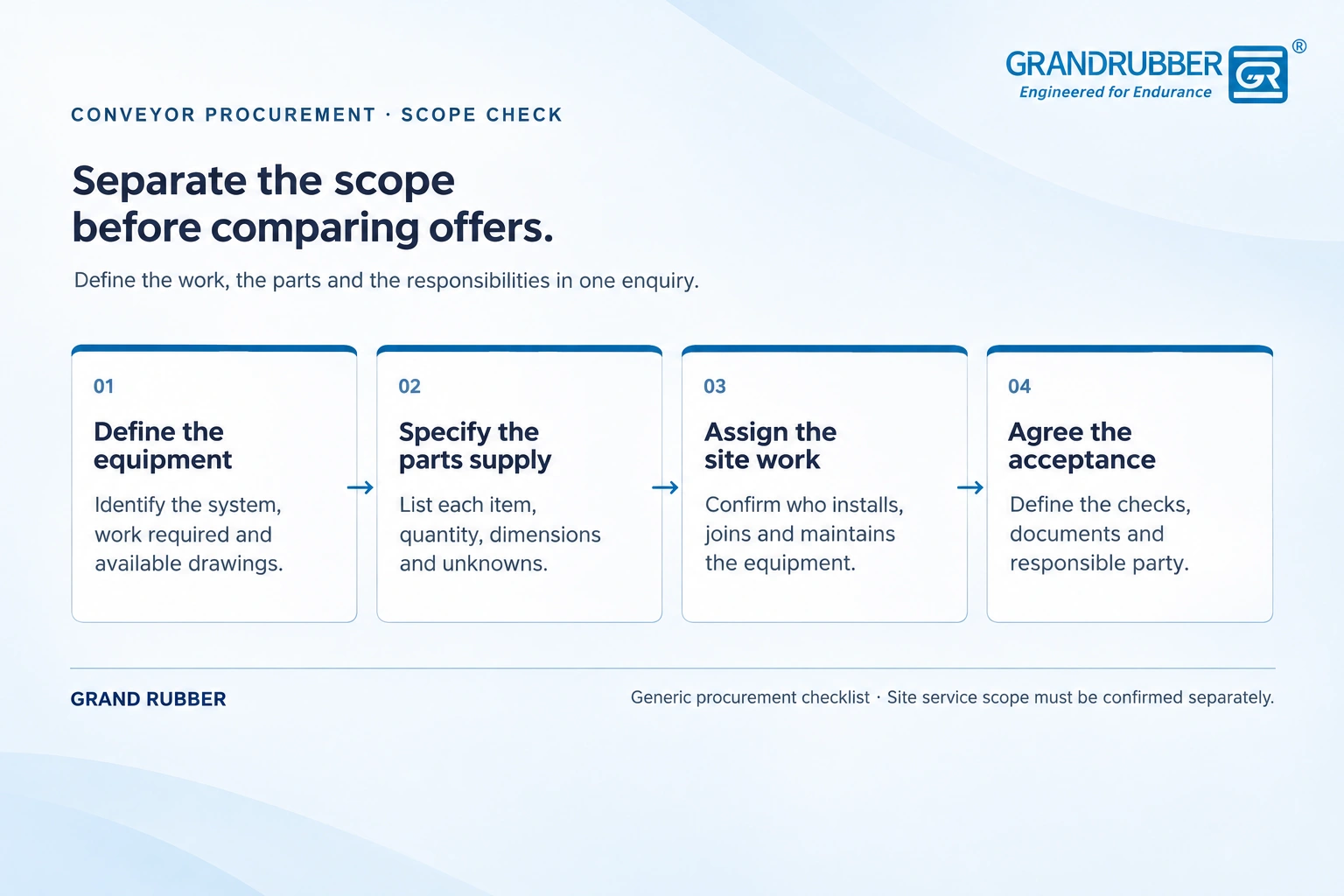
2. Build a responsibility matrix that exposes the missing decisions
Use one row for an action, not one row for a vague department name. Identify who requests the replacement, who confirms its technical definition, who supplies it, who performs the site work and who accepts the relevant result. A responsibility matrix is simply a table recording these assignments and the evidence needed at each handover. The table below is a proposed discussion tool; the parties must agree the actual allocation.
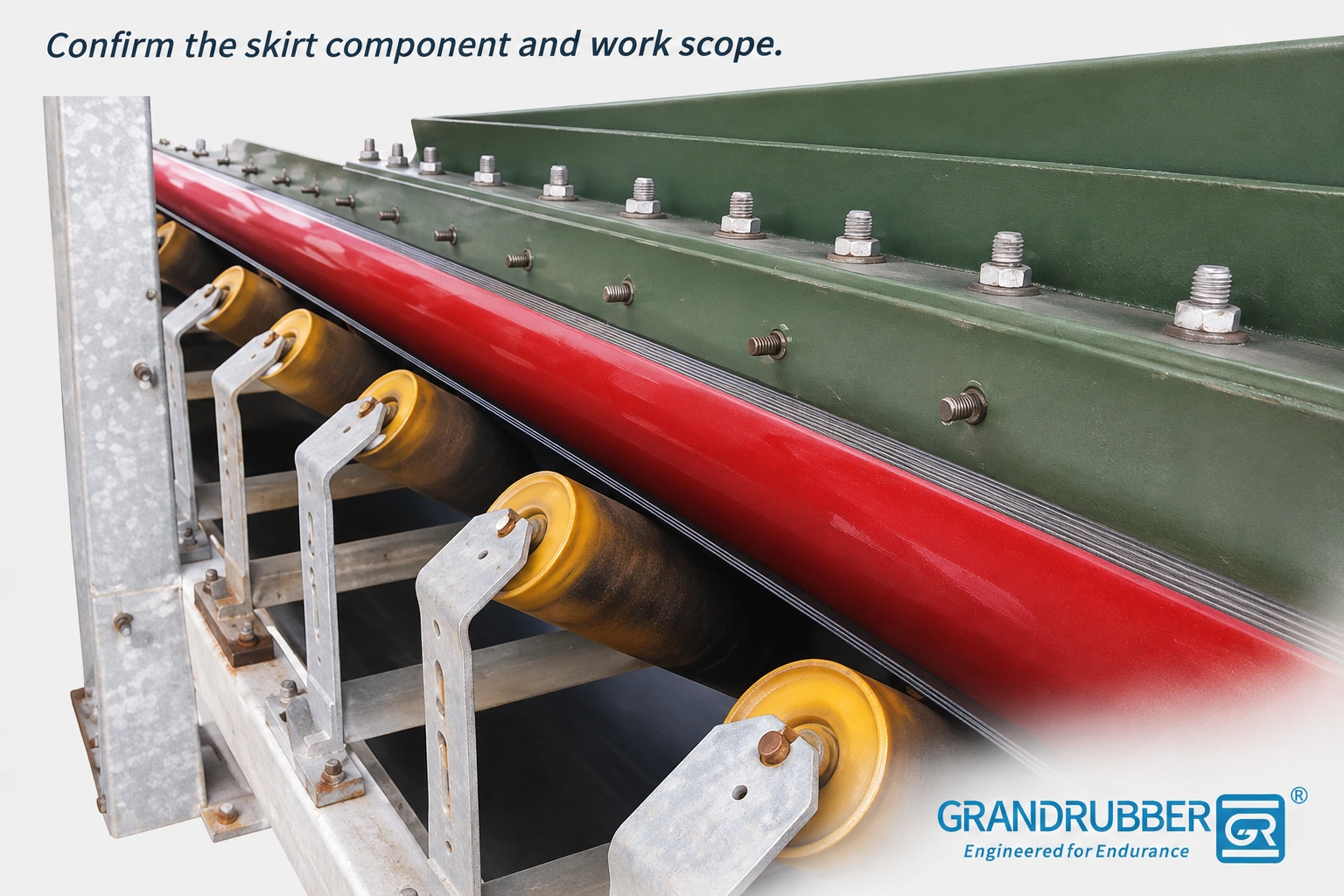
For a fabric conveyor belt, separate the delivered belt from joining and installation work. The carcass, meaning its textile reinforcement, and rubber covers describe the material construction. They do not tell the buyer who will prepare or execute the joint. For skirting, meaning the seal alongside a conveyor loading area, a material strip and its retaining arrangement are separate things to identify. These are generic product-category examples, not parts listed in the municipal advertisement.
Pay particular attention to handovers involving more than two parties. If a maintenance contractor measures a component and a distributor orders it, record the drawing revision the distributor is authorised to use and who resolves a mismatch. The parts supplier needs a defined material requirement; it should not silently become the owner of an unperformed site survey. Equally, a contractor should not have to infer the delivered construction from a loose product name.
The most useful unresolved column contains a question and an owner: for example, whether the retaining hardware is reusable and who will confirm it. Writing only “to be confirmed” leaves the task unassigned. Do not select dimensions, a compound or an installation method simply to close an empty cell.
| Action | Name the responsible party | Evidence or decision needed |
|---|---|---|
| Assess the need | Who confirms that replacement is required? | Inspection finding; confirmed or provisional item status. |
| Define the material | Who approves the part and drawing revision? | Identified material line and applicable technical reference. |
| Supply and deliver | Who supplies it, and where does delivery end? | Offer inclusions, exclusions and agreed delivery interface. |
| Prepare the site | Who arranges the supporting site work? | Assigned access, preparation and removal scope. |
| Join and install | Who performs and accepts the installation tasks? | Agreed service scope and applicable controlled procedure. |
| Accept the material | Who checks the supplied item and documents? | Agreed identity, condition and documentation checks. |
| Accept site handover | Who accepts the agreed completed site work? | Defined handover criteria and responsible sign-off party. |
| Resolve a change | Who can authorise a revised part or work item? | Updated reference, unresolved effects and approval record. |
3. Compare two offers by their boundaries, not their headline totals
Consider a hypothetical buyer replacing a belt and a loading-point seal during a planned stoppage. Offer A covers delivery of the identified materials. Offer B includes materials and selected fitting work but leaves removal and equipment preparation to the buyer. Neither description tells the buyer, by itself, whether all the work needed for the intended replacement is covered. This example illustrates scope comparison; it is not a real customer quotation or a pricing recommendation.
Before comparing totals, put both offers against the same work breakdown. Ask whether measuring, drawings, transport, unloading, removal, joining, fitting, consumables, waste handling and acceptance activities are included, excluded or undecided where relevant. Do not add a guessed cost to a missing activity and then report the offers as equivalent. Ask the responsible party to define and price the omitted work, or record that it remains outside the comparison.
The second table gives an example of questions that reveal the difference between the offers. Its entries are assumptions for the example, not industry-standard allocations. An installed price may still exclude necessary supporting work; a supply-only price may be entirely suitable if another appointed party covers that work. The buyer’s decision depends on the complete agreed arrangement.
Keep delivery acceptance distinct from site handover. Receiving the correct material does not, on its own, demonstrate that the installation and equipment operation have been accepted. Likewise, a running conveyor does not identify every material supplied or prove that each required document was received. Define the checks and records for each stage without inventing a test result or assigning liability from the article.
If an assessment changes the part requirement, update the affected line and drawing revision before release. Identify who authorises the change and which delivery or installation assumptions need to be reconfirmed. Avoid allowing an earlier provisional list to remain in the material order after the site requirement has changed.
| Activity | Offer A: material delivery | Offer B: selected fitting included | Buyer clarification |
|---|---|---|---|
| Material identification | Identified items included | Identified items included | Are both offers using the same drawing revision? |
| Removal of old items | Outside stated material scope | Left to buyer in this example | Which appointed party completes removal? |
| Joining and fitting | Not included in example | Selected tasks included | Which exact tasks and consumables are covered? |
| Supporting equipment work | Not established | Not established | Who owns any work needed outside the replacement itself? |
| Acceptance | Material checks to be agreed | Material and fitting checks to be agreed | Who records acceptance at each handover? |
4. Turn the scope sheet into one actionable material enquiry
Prepare one scope sheet that another person can review without reconstructing the conversation. Give each proposed material line a reference, its equipment location, confirmed or provisional status, the available drawing revision, quantity basis and material-supply boundary. Beside it, name the party responsible for measurements, installation and acceptance, and assign each unresolved item to someone.
Use the sheet to ask a focused question: can the supplier review this identified material line and list any specification gaps or departures before a quotation is finalised? If the need is still an equipment assessment, commission that assessment through the appropriate service route rather than disguising it as a complete parts enquiry. The article does not qualify any party to carry out site work.
Multi-ply fabric conveyor belts and rubber/polyurethane skirting products serve different material roles. These categories can support a material discussion, subject to the selected specification and supporting documents. They do not establish local electrical maintenance, compactor servicing or site-installation capability. The two related product pages are relevant material starting points, not a claim that GRAND RUBBER participates in the cited tender.
Your next step is to send the one-page scope sheet for the material you have actually identified. Mark unknowns openly and ask for a written list of what the offered material includes and excludes. Use the existing belt-specification guide for detailed belt fields; keep this scope review focused on responsibilities and handovers rather than duplicating a full specification catalogue.
Buyer FAQ
What if the replacement quantity cannot be confirmed until the shutdown?
Show the item as provisional and identify the inspection or measurement that will establish the quantity. Record who will confirm it and when a material order can be released. A planning allowance can support discussion, but it is not a verified quantity or a promise that the supplier will hold stock.
Does a quoted replacement belt arrive ready to install?
Not necessarily. Ask whether the offer is for a roll, a finished endless belt or another explicitly defined supply form, and confirm the joining scope separately. The supplied form, installation access and applicable equipment requirements need review together. Do not infer a completed joint from the words replacement belt.
Are adhesives, fasteners and retaining hardware included with the rubber part?
Ask for a separate inclusion or exclusion against the accessories actually required. A rubber strip does not identify its retaining hardware, and a belt line does not define every joining consumable. Identify the approved system and the party supplying it; do not substitute an accessory from a catalogue merely because it appears related.
Can photographs replace a missing drawing?
Photographs can help identify the part and the questions still open. They do not establish an approved size, hidden interface or material construction. Ask the responsible technical or site party which measurements and drawing details are required. Keep the enquiry preliminary until those inputs are adequate for the proposed supply.
What if the buyer supplies the parts and appoints another company to install them?
Record that arrangement explicitly. Agree who checks the supplied parts before work, who raises a mismatch and who can authorise a changed requirement. Give the installer the relevant material and drawing information. Buyer-supplied material should not leave installation responsibilities or acceptance records implicit.
Can one warranty statement cover both the material and another contractor’s work?
Ask the parties to state which supplied product or service each warranty covers, its conditions and its issuer. Do not read a material warranty as a promise about another party’s installation, or assume the reverse. Any combined undertaking needs explicit agreement; this article does not interpret contractual liability.
What should be recorded if the material is accepted but a problem appears after installation?
Keep the material identity, delivery checks, installation record and operating observations together. Assign a contact for coordinating the review without deciding the cause in advance. The timing of a problem alone does not establish a material defect or an installation error; request the evidence needed for a technical assessment.
Can an urgent shutdown date be treated as the supplier’s confirmed delivery date?
No. State the requested shutdown timing and ask for a separate confirmed delivery basis after the material requirement is reviewed. Record unresolved specifications, drawing approval, delivery interfaces and installation dependencies. A requested date is a planning input, not evidence of agreed stock, manufacturing lead time or site availability.
Sources
- Knysna Municipality: current tenders, T 38/2026/27 listing dated 12 November 2026
- Knysna Municipality: T 38 of 2026/27 official advertisement, page 1
Related products
 Multi-ply Fabric Conveyor BeltsEP/NN multi-ply rubber conveyor belts for mining, cement and bulk handling. Match whole-belt strength, plies and cover grade to your material and conveyor before ordering.
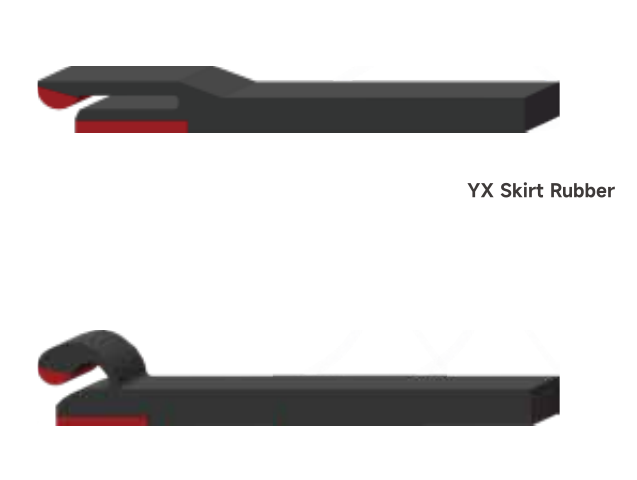 Rubber & PU SkirtingRubber and polyurethane skirting parts for conveyor transfer-point sealing. Match the profile, clearance and mounting arrangement to the belt surface and conveyed material.
Document and page references
- Catalogue_GRAND_RUBBER.pdf, PDF page 6 (printed pages 8-9): multi-ply fabric belt construction and product category; no order-specific supply or installation approval.
- GRAND_RUBBER_Conveyor_Components.pdf, PDF page 7 (printed 7/42): Skirt Rubber, YX/YX-S rubber and polyurethane components; no specific size, performance or installation commitment reproduced.
- Responsibility matrix, worked offers and FAQs are editorial procurement examples; they are not tender clauses, real quotation data, a legal opinion or approved installation instructions.
Download the reference tables
Source-labelled review extract. Historical references remain historical; this is not a formal TDS, certificate or current availability confirmation.
Download guide tables CSV