
How should an STE or STH pulley schedule be used?
Read an STE or STH pulley schedule with its series, tension basis and pulley role. A minimum-diameter entry taken outside its stated conditions is not a machine design approval.
On this page
 Open full-size image ↗
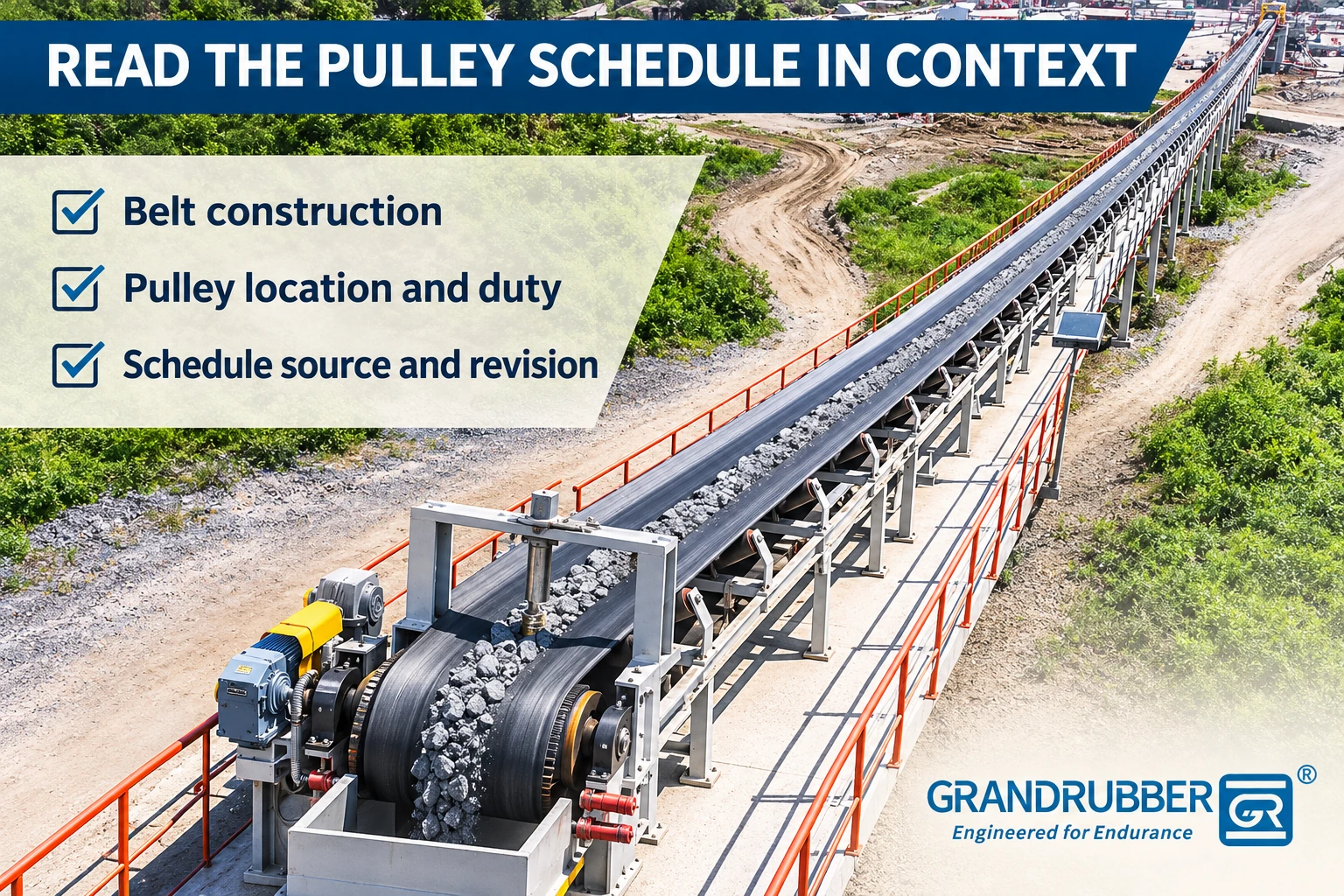
Do not choose one minimum pulley diameter from an STE/STH catalogue and apply it everywhere. Identify the complete belt series and construction, the applicable tension condition and the pulley’s role, then have the equipment requirement reviewed. This guide explains schedule reading, not pulley calculation or field adjustment.
Find the conditions before finding a number
The cited STE and STH pages show separate constructions and pulley headings. Their notes tie the source minima to a percentage of a tension range and a stated safety-factor basis; they also flag startup acceleration as relevant to tension ranges. Those qualifications belong with any extracted entry.
Retain the actual source note in the review pack. A catalogue threshold with its conditions removed is incomplete evidence, even if a machine drawing happens to show the same nominal diameter.
Identify the pulley and the operating basis
Distinguish the drive, other tension-related positions and snub duty according to the applicable equipment documents. Record series/rating, one- or two-layer anti-rip construction where relevant, tension information and the drawing revision.
The first table captures the reading sequence. If the project does not establish the relevant tension or pulley classification, ask the design authority for it. Do not select the apparently least restrictive column or convert a catalogue value into an instruction to modify equipment.
| Step | Required reference | Stop if missing |
|---|---|---|
| Series | Exact STE or STH construction | Do not mix source rows |
| Pulley role | Machine arrangement and position | Do not use a generic column |
| Tension basis | Applicable project condition and source note | Do not assume the percentage basis |
| Related construction | Cover/breaker/joining requirements | Do not infer from family name |
Worked example: a smaller entry is found in another column
Assume a hypothetical buyer sees a smaller minimum in one schedule column and wants to use it for a different pulley position. The actual working condition and construction match have not been established. No diameter or load is assigned here.
First identify what the smaller entry is conditional on and whether the proposed pulley has that role. Check the actual series and construction rather than using a similar family name. A missing tension input is an unresolved design question, not permission to use the smaller figure.
The second table records why the quoted entry can or cannot support the current comparison. Technical acceptance remains with the responsible design review.
| Proposed use | What needs checking | Unresolved outcome |
|---|---|---|
| Different pulley role | Which column actually applies? | No direct transfer |
| Different series | Does the construction match? | Separate comparison |
| Unknown operating basis | Who supplies the tension/startup reference? | Design input required |
| Project change | Which accepted interface must be revisited? | Re-review, not automatic approval |
Request a documented interface check
Send the identified STE/STH construction, complete pulley arrangement and available tension/startup references through the relevant product enquiry. Ask the reviewer to identify which source basis and equipment checks apply.
Retain any approved project requirement separately from the catalogue reference. If the belt construction or operating basis changes, ask what needs re-evaluation. No generic wrap, adjustment, tension or minimum-diameter recommendation is issued by this page.
Buyer FAQ
Is the largest listed minimum safe for every case?
Do not replace a design review with that shortcut. The applicable construction and machine requirements must be identified; selecting a larger catalogue entry does not establish all other interfaces.
Can the STE row be used for an STH offer?
Not without a supported comparison of the actual constructions and conditions. Keep their source schedules separate.
Where should unknown operating tension be recorded?
As an unresolved input with a responsible equipment/design owner. Do not infer it from the belt strength designation.
Does adding an anti-rip layer leave the schedule unchanged?
Identify the exact offered construction and ask which source row and interface requirements apply. An extra layer is a construction detail, not a label to ignore.
Can this article specify a replacement pulley?
No. It organizes the document check; dimensions and acceptance need the responsible project design and controlled equipment information.
Related technical resources
Related products
 STE Steel Cord Conveyor BeltsSTE steel-cord belts with catalogue breaker and pulley schedules. Review reinforcement configuration, working tension, width and splice requirements together before selecting a model.STH Steel Cord Conveyor BeltsSTH steel-cord belts with model-specific cord, breaker and pulley references. Check the selected width, loading conditions and complete splice arrangement before comparing alternatives.
Document and page references
- GRAND_RUBBER_Conveyor_Belts.pdf, PDF pp24,26: Series-specific source notes, tension percentages and pulley-role columns. No numerical diameter or tension recommended.
- Decision tables, hypothetical examples and follow-up questions are editorial purchase-review aids; they are not customer cases, site instructions or technical approval.
Download the reference tables
Source-labelled review extract. Historical references remain historical; this is not a formal TDS, certificate or current availability confirmation.
Download guide tables CSV