
Does Pre-Cured Rubber Mean the Lined Equipment Is Ready for Service?
Pre-cured describes the rubber’s supplied state; it does not by itself establish completion or acceptance of the whole installed lining system. Identify the actual sheet, bonding system, substrate and applicable release requirements. Obtain the responsible system disposition before treating the material label as permission to put equipment into service.
On this page
 Open full-size image ↗
Pre-cured describes the rubber’s supplied state; it does not by itself establish completion or acceptance of the whole installed lining system. Identify the actual sheet, bonding system, substrate and applicable release requirements. Obtain the responsible system disposition before treating the material label as permission to put equipment into service.
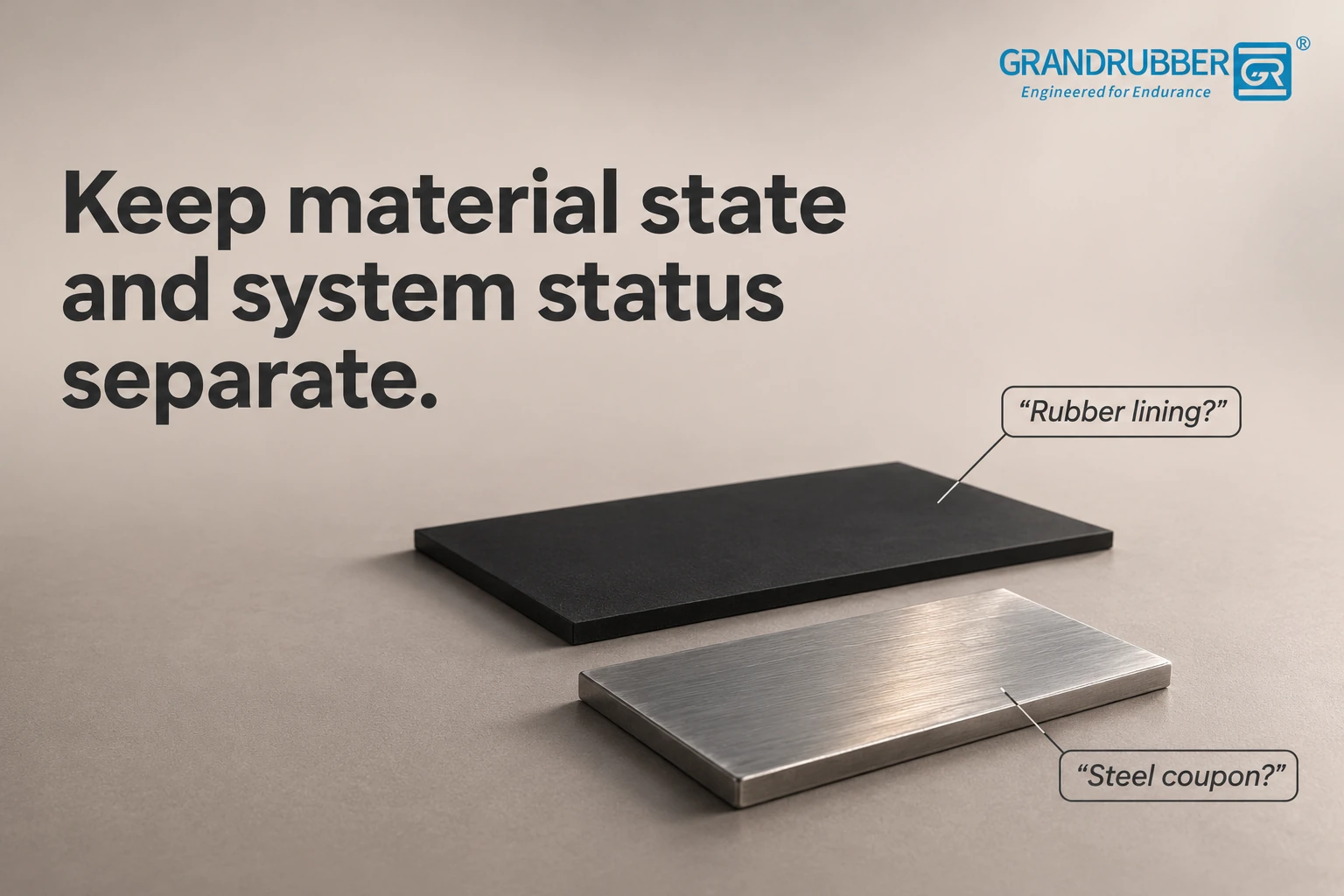
Material cure state and installed-system status are different subjects
A sheet can have a defined supplied material state while the equipment-lining project still has other work and acceptance requirements. A buyer should identify what the word pre-cured modifies. It should not silently become a statement about every adhesive, interface, inspection and service condition in the project.
REMA TIP TOP’s heavy-corrosion-protection page distinguishes pre-cured lining materials from unvulcanized materials and separately presents primers and adhesives for lining systems. This illustrates the difference between material state and the wider system. Its readiness claims concern its own products and arrangements; they do not establish a GR lining system’s return-to-service conditions.
The useful purchase question is therefore: which actual product state is supplied, and what separately remains necessary for the proposed installation and release? Ask that before using the label to compare shutdown schedules or promising an equipment restart.
Define the actual offered lining system, not just the sheet name
Identify the proposed rubber material and supplied state, the substrate/equipment, and the stated bonding or other applicable system scope. Ask which party selects and confirms the compatible components and which documents define that response. A generic sheet category does not identify an approved combination.
Separate included material supply from application work, equipment preparation, inspection and the release decision. The same purchase may involve several parties; listing one material supplier should not hide an unassigned responsibility at an interface. The project needs the actual scope rather than assumptions about a turnkey service.
The first table asks for these identities and responsibilities. It supplies no preparation recipe, adhesive substitution, cure schedule or service waiting time. Those requirements belong to the actual system’s controlled documentation and the responsible competent parties, with the intended exposure explicitly identified.
| Record line | What to identify | What it cannot establish alone |
|---|---|---|
| Rubber state | Actual offered sheet and supplied condition | The whole equipment is ready |
| System components | Actual applicable bonding/interface scope | Any similar product is interchangeable |
| Application scope | Included work and responsible parties | Material supply includes all site activities |
| Acceptance basis | Actual project/system requirements and records | A delivery note proves installation completion |
| Release | Responsible disposition for the actual configuration | A marketing label authorizes restart |
Ask what makes the installed assembly eligible for release
Obtain the applicable system requirements and ask the responsible party what records and acceptance are needed for the actual equipment. The answer may involve identified installation and inspection evidence, but it must come from the real system and project requirements. This guide does not invent a universal checklist of mandatory tests.
Keep the rubber’s supplied state on the material line. Put the condition of the installed system and the acceptance status on separate lines. A delivery note showing that a sheet arrived is not a record that the equipment has completed every required activity; equally, an installation record should not be described as a material certificate if it is not one.
Where restart timing matters commercially, request the actual basis and responsible approval for the proposed system and conditions. Do not calculate a universal start time from the prefix pre- or from another supplier’s webpage. The equipment owner needs the appropriate system-specific response.
Worked shutdown comparison: a product-state label becomes a restart promise
Assume a hypothetical owner compares two lining proposals during a planned shutdown. One says pre-cured sheet, while the other lists a different supplied state and application scope. The comparison assigns the first an immediate restart without asking about its actual bonding system or release requirements. No real shutdown, cure time or GR project result is represented.
That schedule conclusion is unsupported. Ask both bidders to identify the complete proposed scope and the requirements governing installed-system readiness. A different material state may change parts of the work, but it does not allow the buyer to leave all remaining interfaces and acceptance blank.
A useful response states who owns each remaining activity, which actual documents govern it and what evidence supports the proposed completion schedule. If the supplier offers material only, retain that honest limitation instead of turning its material description into a site-service promise.
The second table compares the evidence gaps without ranking the systems. No bond-setting time, temperature, pressure or chemical condition is supplied. Those values cannot be borrowed from an unrelated material or a manufacturer’s broad marketing statement.
| Comparison entry | Unresolved issue | Request |
|---|---|---|
| Pre-cured sheet means immediate restart | System and release requirements omitted | State applicable remaining work and acceptance |
| Material-only quote treated as turnkey | Site responsibilities assumed | Identify included and excluded activities |
| Adhesive changed after comparison | Earlier combination no longer identified | Obtain applicable substitution assessment |
| Installed marked released | Required evidence not linked | Identify actual release authority and disposition |
Keep installation changes and the final configuration connected
If a sheet, primer, adhesive, substrate condition or exposure changes, refer the revised input to the actual system authority. A prior response for one combination should not be silently applied to another. Keep the final selected identities linked to the actual installation and release records.
Distinguish a component substitution request from a completed equivalence assessment. Matching rubber family or a broadly similar adhesive description does not itself establish that the changed arrangement is accepted. Ask what evidence and responsible review apply rather than performing a substitution from catalogue labels.
The same discipline applies to handover wording. Supplied, installed, inspected and released should represent the actual events they name. A progress report should retain any outstanding requirement without implying that the equipment may operate before the authorized responsible disposition.
Request a material-and-release scope statement
Provide the actual equipment/substrate references, intended exposure, required material scope and project timing questions with a rubber-lining enquiry. Ask GRAND RUBBER what material and available documentation it can supply. Do not assume that its category entry includes installation, a named adhesive system or authorization to restart equipment.
Use the bonding-material storage guide for the separate question of identified material time records. The present issue is whether the supplied state of the rubber has been confused with completion of the installed assembly. Tracking one component’s age does not answer that wider question.
The immediate next action is a scope statement linking the offered material state to the actual remaining system work and release authority. Compare schedules only after those responsibilities and evidence are identified; do not let one product label stand in for the whole project.
Buyer FAQ
Does pre-cured mean no project-specific release requirements remain?
No such conclusion follows from the rubber-state label. Obtain the actual installed system’s requirements and responsible release disposition.
Can a restart time be copied from another manufacturer’s page?
Do not transfer it to a different material/system. Request the applicable response for the actual supplied combination and conditions.
Is material supply the same as installation service?
Only the actual quotation scope establishes included work. Keep material, application and equipment acceptance responsibilities explicit.
Does a sheet delivery note prove the lining is accepted?
It records delivery within its scope. Link separate required installation, inspection and release evidence to the actual assembly.
Can an adhesive with a similar description be substituted?
A descriptive similarity is not an equivalence assessment. Obtain the applicable system review for the proposed change.
Does this guide prescribe a curing or waiting period?
No process parameters or universal timing are given. Use the responsible system’s controlled requirements for the actual arrangement.
What should the next enquiry ask for?
An identified material/supplied state and a clear scope statement for the actual system, remaining work, evidence and release responsibilities.
Sources
Related technical resources
Related products
 NR40 Wear-resistant Rubber Linings
Document and page references
- REMA TIP TOP — Heavy Corrosion Protection: Precured versus unvulcanized rubber lining sections; separate primers/adhesives for lining systems. Product-family distinction only. Manufacturer immediate-use claims cannot establish GR system readiness. No bonding, curing, chemical or return-to-service instructions.
- Editor-derived evergreen purchasing analysis; hypothetical examples are not real cases, field results or approved operating procedures.
Download the reference tables
Source-labelled review extract. Historical references remain historical; this is not a formal TDS, certificate or current availability confirmation.
Download guide tables CSV