
Does a Rubber-Lined Flange Face Replace a Separate Gasket?
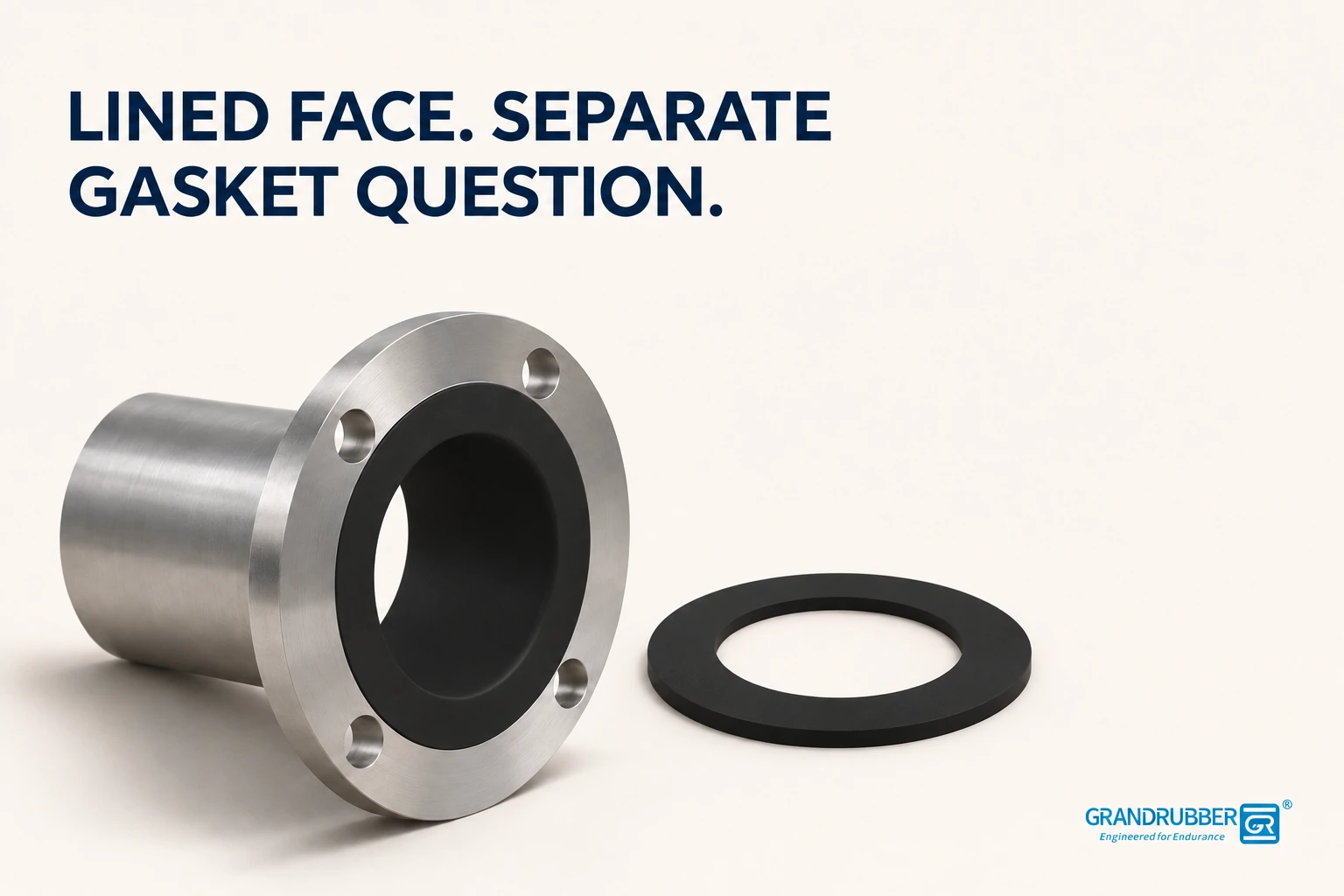
Not automatically. The lining on a flange face and a separate gasket are different parts of the proposed mating joint. Identify both faces, their materials and the applicable joint design before deciding whether a separate gasket is required. The decision belongs to the actual assembly, not the word rubber.
On this page
 Open full-size image ↗
Not automatically. The lining on a flange face and a separate gasket are different parts of the proposed mating joint. Identify both faces, their materials and the applicable joint design before deciding whether a separate gasket is required. The decision belongs to the actual assembly, not the word rubber.
Describe the mating joint rather than one lined component
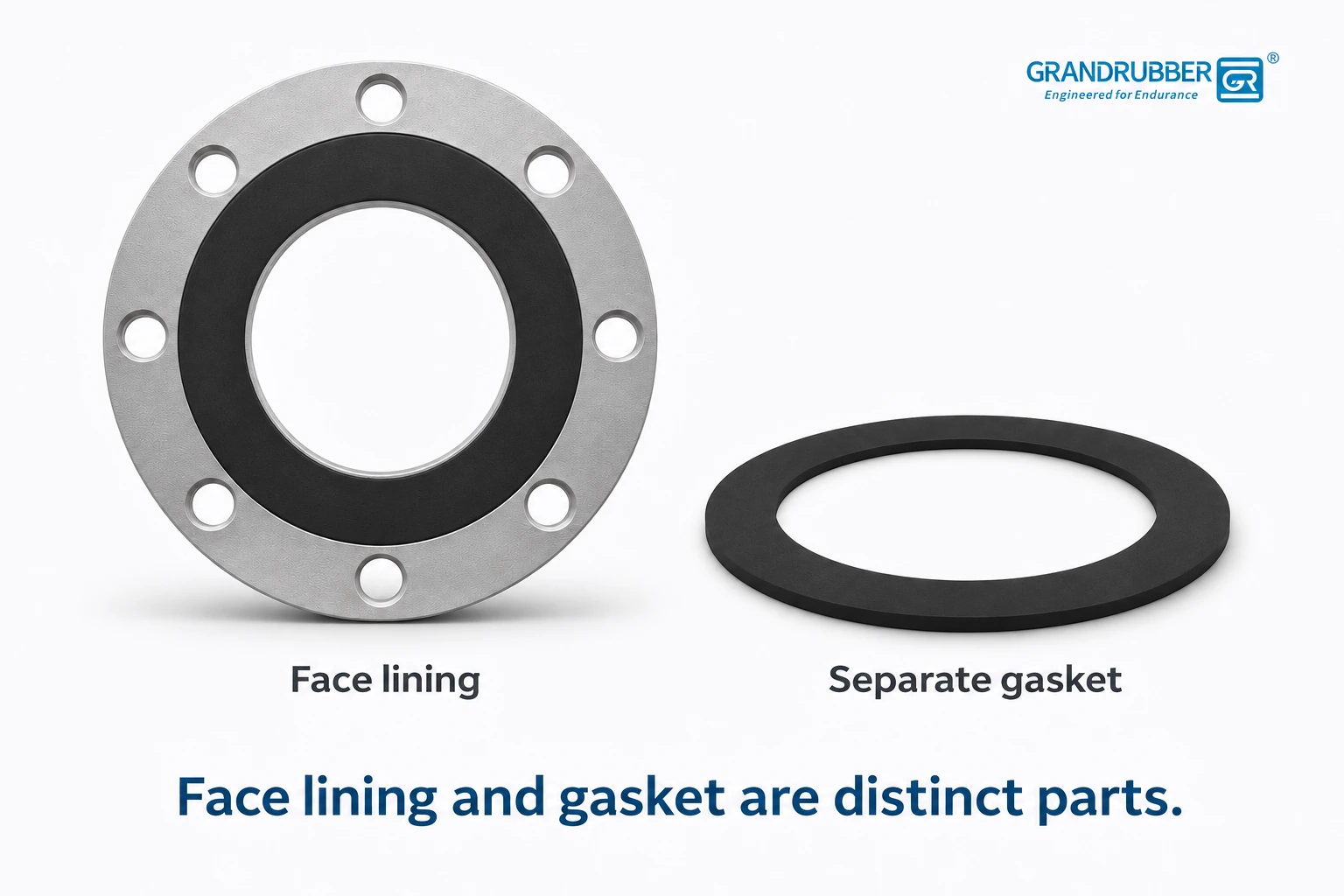
A rubber-lined pipe or vessel nozzle is one side of an assembled connection. Its face lining may protect a surface, while a separate gasket is a distinct sealing item in the joint. The buyer should identify the complete mating arrangement before comparing a quote that includes a gasket with one that does not.
Polycorp’s flange guidance says that an in-service gasket may be used between mating surfaces and makes method selection dependent on the specification, materials and service. Its pipe-lining guidance separately notes a soft gasket over a hard-rubber-lined flange face in the described arrangement. These examples show why a blanket no-gasket assumption is unsafe purchasing logic; they are not a universal GR joint design.
The question is not whether rubber can be present at both interfaces. It is what each material is intended to do in the actual assembly and which responsible party has accepted the arrangement. A photograph of the lined face cannot establish every mating component, sealing requirement or included supply item.
Identify both faces, the lining and any separate sealing item
Ask for the mating component drawing and identify the flange-face construction on each side. Record the lining material and its stated role, the proposed separate gasket if any, and the actual service requirement. Retain missing information as an open input rather than assuming the other face matches the one in the supplier’s photograph.
Where a supplier uses soft or hard rubber terminology, ask which actual material and document are meant. Those categories do not, by themselves, provide a universal gasket prescription. A joint-specific response should explain what is included and what applicable design or supplier instruction governs the proposed combination.
The first table creates a common scope for the fabricator, lining contractor and gasket or joint supplier. It is not a design calculation. This guide gives no bolt torque, compression percentage, flange dimension, release-agent recommendation or assembly sequence. Those belong to the applicable controlled design and responsible technical process.
| Subject | What to establish | Do not assume |
|---|---|---|
| First flange face | Actual component, lining and drawing | The mating face has the same construction |
| Opposing face | Actual material and surface/lining description | A supplied photo defines the whole connection |
| Separate gasket | Whether proposed, specified and supplied | Visible rubber face lining means gasket included |
| Service and joint basis | Actual requirement and responsible design response | A material name approves pressure or chemical duty |
| Supply boundary | Who supplies lining, gasket and other joint parts | Every work-stage item remains in the service joint |
Separate liner continuity from the sealing design question
Protecting a component’s process-exposed surface and sealing a mating joint are related requirements, but they are not identical. An accepted lining arrangement does not necessarily identify every separate sealing element. Equally, supplying a gasket does not establish that the lining and equipment have been accepted for their service.
Ask the responsible parties which requirements each component satisfies and how the actual interface is assessed. A material supplier can identify the proposed material and its documentation; the joint designer or equipment owner must provide the relevant assembly requirement and disposition. Preserve those scopes rather than asking one general catalogue description to approve the whole connection.
The distinction is especially useful when comparing offers from different suppliers. One may include a lined component only, while another also lists a gasket or related joint parts. Establish their actual scope and applicability before treating a difference in the commercial total as a difference in material quality.
Worked quotation: a lined face is treated as an included gasket
Consider a hypothetical pipe enquiry whose connection schedule requires the sealing arrangement to be confirmed. One quote identifies flange-face lining but says nothing about a separate gasket. The buyer’s comparison marks the gasket included because rubber is visible on the face. No actual project or leak outcome is being reported.
That check mark adds a scope claim the quotation did not make. The buyer should ask whether the proposed joint uses a separate gasket, who defines it and whether it is supplied. If no separate gasket is proposed, obtain the applicable assembly-specific basis rather than inferring approval from the lined face alone.
A second quote may include a gasket without identifying the mating faces or lining material. It answers a supply question but leaves the technical relationship open. The correct response is to reconcile the proposed components and responsible review, not to select it merely because the parts list is longer.
The second table retains these different gaps. Its purpose is to make the next enquiry answerable: what is physically included, what arrangement is being proposed and whose documented decision applies to the actual joint? It does not authorize assembling or operating the connection.
| Quotation situation | Established answer | Clarification needed |
|---|---|---|
| Lined face only | Lining is proposed on a component | Separate gasket requirement and supply status |
| Gasket listed; faces undefined | A sealing item is listed | Compatibility and role in the identified mating joint |
| No gasket proposed | An assembly alternative is suggested | Applicable design basis and responsible disposition |
| Temporary work-stage seal shown | A contractor-stage item exists | Whether it belongs to the final service assembly |
Keep temporary fabrication or curing items out of the in-service parts assumption
Project records may mention blinds, fixtures, temporary sealing items or other equipment used during fabrication or processing. Do not assume that every item pictured in a work-stage document is part of the final service joint. Ask which supplied components remain in the operating assembly and which belong only to a contractor’s work method.
The same care applies to an illustration taken from another manufacturer’s procedure. It can explain why interfaces need definition, but its parts and instructions should not be copied into a GR order without an applicable technical basis. Keep the source’s context visible in internal evidence and request the actual project drawing.
If the mating component, lining or service changes during procurement, obtain an updated interface response. A previous decision may concern a different assembly. Preserve the final accepted item and joint references with the supply schedule so later installers do not have to infer the intended gasket scope.
Send one assembled-joint scope request
Include both mating components, their face/lining identities, the service requirement and the proposed separate sealing item with the enquiry. Ask GRAND RUBBER to identify only the lining-material supply and documents actually offered; ask the relevant joint or equipment authority to identify the assembly disposition. The NR40-related product entry is not a universal gasket or pressure-joint approval.
Use the lining-drawing guide for the complete installed interfaces. This article addresses a specific decision within that larger drawing: whether the face lining and separate gasket have distinct and accepted roles. Keep the material, supply and design answers connected to the same joint identification.
The buyer’s next step is a marked mating-joint schedule showing included parts, exclusions and the responsible answer for any unresolved sealing item. Do not release an assumed gasket scope based on the word lined or a photograph alone.
Buyer FAQ
Does every rubber-lined flange require a separate gasket?
No universal rule is established here. Obtain the applicable assembly-specific requirement for the actual face materials, joint design and service.
Can hard and soft rubber face descriptions determine the gasket alone?
They can signal different interface questions but do not replace the actual material identity and joint design. Treat manufacturer examples within their stated scope.
Does a gasket in the parts list prove the joint is approved?
It proves only that the quotation lists an item. The proposed assembly still needs the applicable technical response and accepted scope.
Can I use torque values from an unrelated manufacturer’s lining manual?
Do not transfer them as the setting for this joint. Obtain the applicable controlled assembly basis from the responsible technical parties; this guide supplies no torque instruction.
What if only one supplier controls the lined component?
Ask for its supply and material scope, then identify who controls the mating part and sealing decision. A single component quotation cannot silently define the entire assembly.
Is a gasket used during curing necessarily the final service gasket?
No such conclusion follows from a work-stage mention or picture. Ask which components remain in the operating assembly and which are temporary contractor equipment.
What should be carried into the final order?
Retain the identified mating joint, accepted lining/sealing arrangement, supplied components, exclusions and responsible disposition, with the correct drawing revision.
Sources
- Polycorp Rubber Lining Application Manual — Section7
- Polycorp Rubber Lining Application Manual — Section8
Related technical resources
Related products
 NR40 Wear-resistant Rubber Linings
Document and page references
- Polycorp Rubber Lining Application Manual — Section7: p1 method scope; p5 section3Gaskets. Source says an in-service gasket may be used; not a universal gasket prescription. No torque, curing fixture or release-agent instructions adopted.
- Polycorp Rubber Lining Application Manual — Section8: p3 note after4.5 about hard-rubber flange-face lining and separate soft gasket. Named-system example only; no general GR requirement, gasket compound, geometry, torque or assembly procedure inferred.
- Editor-derived evergreen purchasing analysis; hypothetical examples are not real cases, field results or approved operating procedures.
Download the reference tables
Source-labelled review extract. Historical references remain historical; this is not a formal TDS, certificate or current availability confirmation.
Download guide tables CSV