
How to specify a belt for hot clinker or sinter
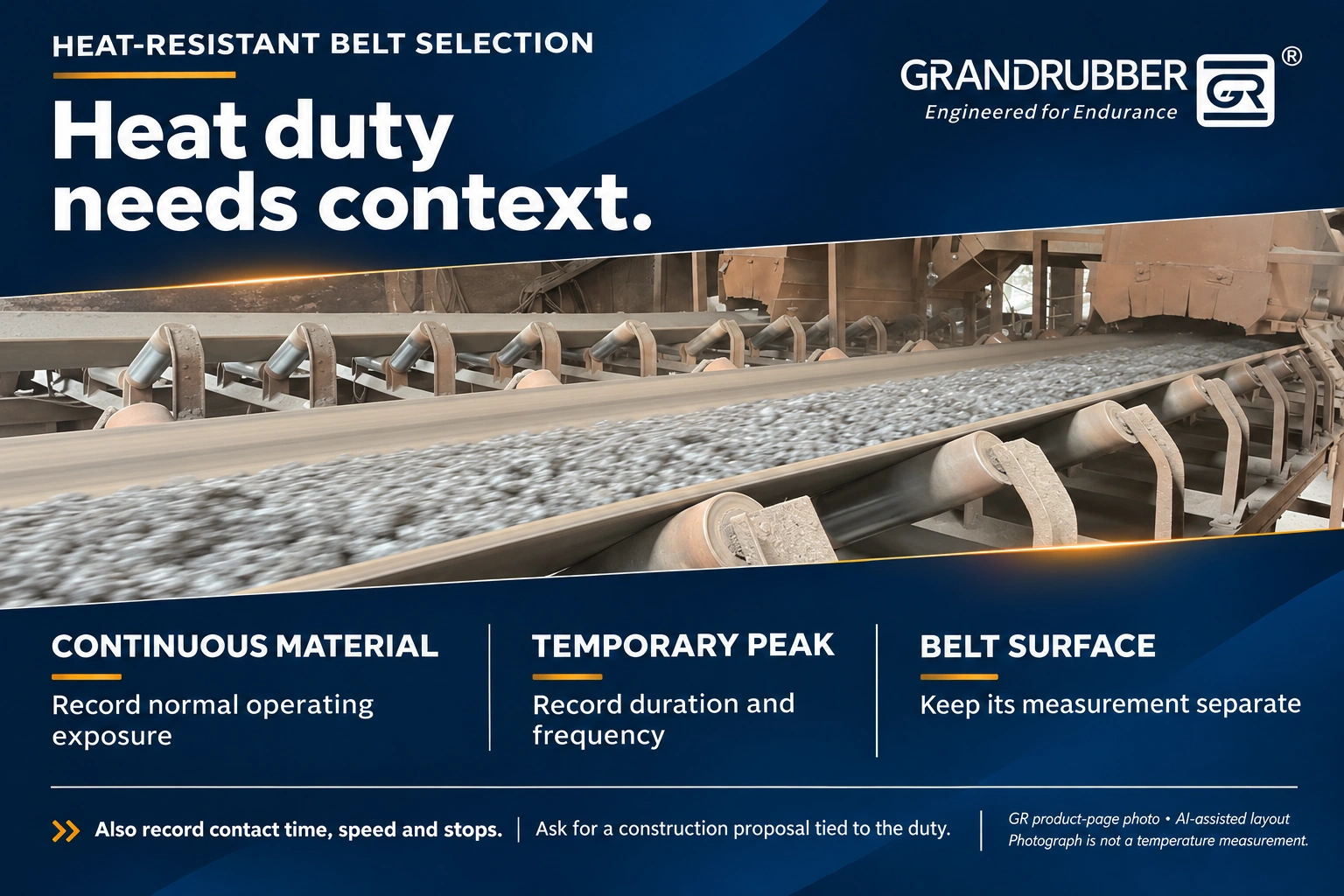
For hot clinker or sinter, review the exposure record with the complete belt construction and conveyor conditions. Keep continuous material, temporary peaks and belt-surface temperatures distinct, then ask which offered compound, carcass and joining basis match that duty.
On this page
 Open full-size image ↗
Select a heat-resistant conveyor belt through a documented review of the actual hot-material exposure and the complete belt, not from the highest temperature printed in a catalogue. The cover compound, reinforcement, joining and mechanical duty must be considered together. A short peak label or a heat-resistance test reference is not a complete service specification.
This guide helps buyers assemble and evaluate that selection review for clinker, sinter and comparable hot bulk-material duties. It does not assign a temperature grade, operating limit or guaranteed life to an unidentified belt.
1. Start with the duty that the proposed belt must serve
Identify the material, its size and condition, loading arrangement, conveying route, normal operation and relevant stops or starts. State whether the request is for a new application, a replacement against a documented specification or investigation of an observed problem. These are different review starting points.
Record where the hot material contacts the belt and the available information about contact duration, throughput, speed and cooling conditions. Use documented settings or measurements and identify their source. If an input is unknown, ask the site or equipment team to establish it rather than borrowing a catalogue condition.
Heat-belt selection involves hot bulk-material conditions and separate construction options. A product category does not establish that every listed grade, material or peak figure suits your combination of exposure and equipment.
2. Keep each temperature attached to its measurement context
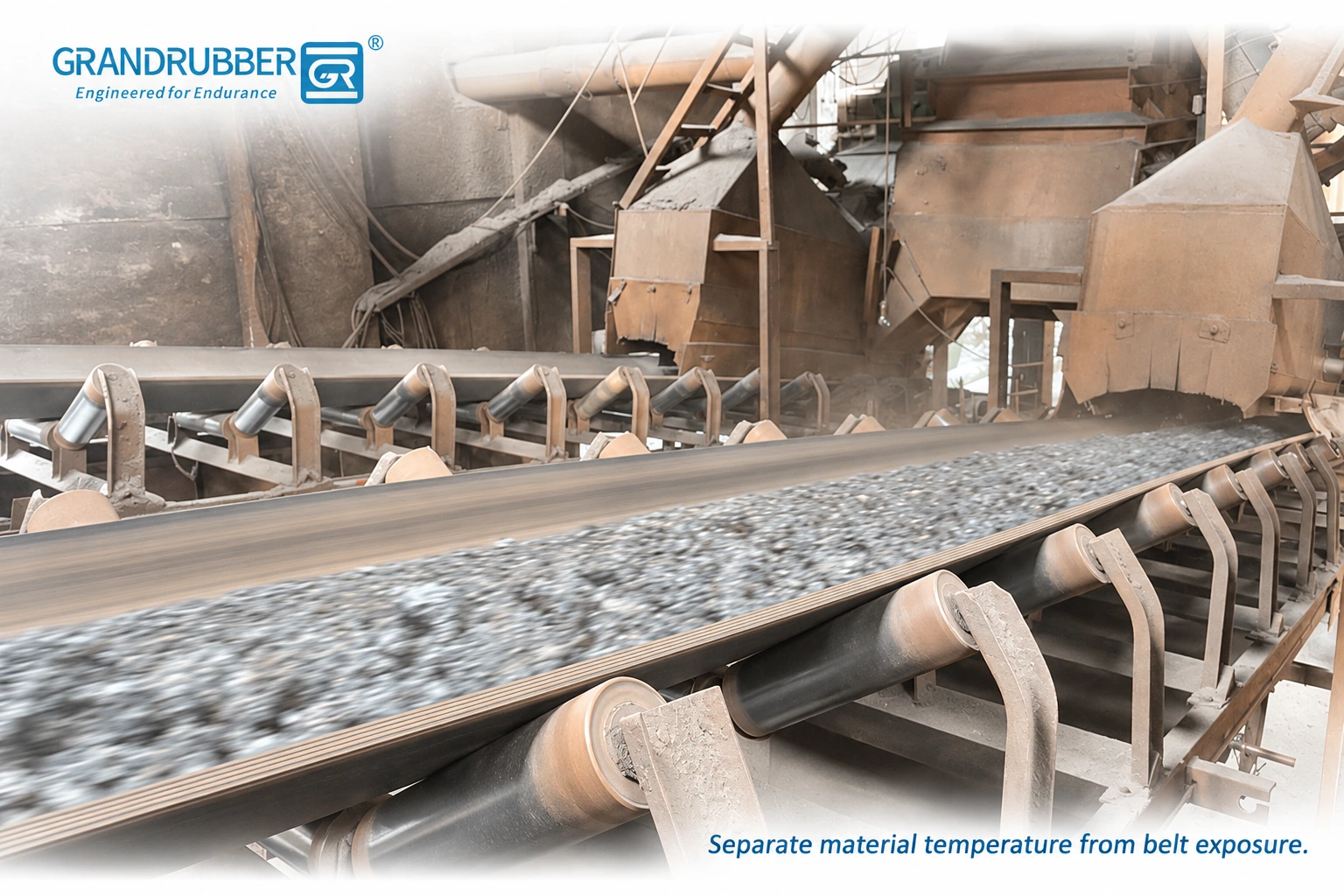
The first table is an exposure-record template. Continuous material temperature, a temporary material peak and the actual belt-surface temperature describe different records. Give each its location, method, timing, duration or frequency and operating condition where known. A value without that context should remain an incomplete input.
A source label matters too. The general catalogue p8 describes its T4 entry in a test-temperature context, while the belt manual p35 separately labels continuous, peak and belt-surface columns. Do not combine the most favourable entries into a new continuous service limit or assume the same grade label resolves a difference in basis.
This page uses those records to organize whole-belt selection. The related three-temperatures guide focuses on how to distinguish the measurements themselves; it is not replaced by this broader duty review. No new temperature threshold is selected here.
| Record | Context to attach | Open item if missing |
|---|---|---|
| Normal material condition | Measurement point, method and operating period | Who establishes a representative record? |
| Temporary peak | Location, duration/frequency and source of the report | Is the peak exposure actually characterized? |
| Belt-surface condition | Belt face/location, method and related duty state | Do not substitute a material-temperature entry |
| Contact and cooling | Route, loading, documented speed and cooling conditions | Which equipment or site record is required? |
| Stops or changed operation | Relevant documented condition and time history | Ask for assessment; do not assign a grade from the label |
3. Ask for cover, carcass and mechanical compatibility together
Ask which offered compound and complete reinforcement construction are being proposed, with the top/bottom covers, width, rating and supply/joining form. Tie the offer to the reviewed duty record. If a supplier lists a heat option without identifying the construction to which it applies, ask for that connection before treating it as a suitable replacement.
Provide the relevant conveyor drawings, pulley arrangement, loading information and joining requirements to the responsible technical reviewer. Keep heat exposure and mechanical requirements in the same review, without treating one as proof that the other is met. A stated rubber temperature category does not by itself describe carcass suitability or an approved splice.
The second table separates the questions for the whole belt from evidence concerning only a cover test. ISO 4195:2026’s public abstract concerns the relative heat resistance of rubber covers and changes in properties after heat exposure. It is not a public statement of a complete conveyor’s allowable hot-material duty. The full standard and any actual offered-belt test report were not reviewed for this guide.
| Review area | Evidence to request | Limit of a partial answer |
|---|---|---|
| Rubber cover | Identified compound and applicable heat-test basis | A cover test is not whole-machine approval |
| Reinforcement and covers | Complete offered construction and departures | A family name does not define every heat option |
| Equipment and joining | Applicable drawings, interfaces and controlled joining basis | A rubber grade does not approve a splice or pulley arrangement |
| Duty fit | Offer tied to the exposure-sheet revision and exceptions | A catalogue peak is not an unlimited continuous duty |
| Release decision | Responsible disposition and unresolved conditions | A preliminary proposal is not accepted selection |
4. Worked example: two hot-material records are not one rating
Assume a hypothetical replacement enquiry contains a process alarm peak reported near loading and a stable material-temperature record taken at another point. The peak duration, the belt-surface exposure and the relation between the records are not established. No temperature values, grade, price or lifetime are invented in this example.
The buyer should not average the records, select the larger as a continuous input, or treat the cooler location as the whole belt’s exposure. Ask the responsible site team what each record measures, under which condition and for how long. Keep the unsupported relationship visible in the review sheet.
A seller may propose a heat-resistant compound, but that proposal still needs a defined construction and its applicable exposure basis. If the operating pattern includes a stop with hot material present, record that condition for the equipment and belt reviewers; this article does not decide whether continued operation or a test is permissible.
A useful first result is a conditional proposal identifying the missing exposure evidence and mechanical checks. It is not a final grade recommendation inferred from two unrelated temperature labels.
5. Compare the response against the reviewed duty, not the headline peak
Ask the supplier which duty revision it has used, which normal and temporary conditions it has addressed, and which points remain outside its proposal. Record any departures from the existing construction and ask why they are proposed. A different cover or carcass should not disappear inside the word equivalent.
Check the evidence’s scope: the product or sample identity, test method, exposure conditions and properties assessed. Keep laboratory evidence, catalogue references and an order-specific proposed requirement distinguishable. A report about rubber-cover ageing does not silently approve a different reinforcement or the conveyor’s joining arrangement.
Ask the responsible reviewer to state the disposition and the unresolved conditions before release. Do not infer longer life or reduced downtime simply from a higher listed temperature or a more extensive document bundle. Any such claim would require matching evidence that this article does not supply.
6. Send one heat-duty review pack
Use the related Heat-resistant Conveyor Belts enquiry to send the exposure sheet, complete existing specification, relevant equipment/joining references and the proposed change if one exists. Ask for a written construction proposal tied to that duty and a short list of unresolved inputs.
Keep the sources attached to the temperature entries and the accepted revision attached to the resulting proposal. If the application changes after the review, identify what changed and ask which part of the proposal needs reconsideration. This avoids carrying a previous duty assumption into a new hot-material requirement.
GRAND RUBBER lists heat-resistant belt constructions. Final dimensions, compound, reinforcement, applicable evidence and supply conditions remain specific to the reviewed requirement; this guide provides no blanket temperature approval or production commitment.
Buyer FAQ
Can previous successful service replace a current heat-duty review?
Keep the old product identity and operating records as useful history, but check that the new requirement and offered construction are actually the same. Historical service does not establish a new temperature limit or promised life, especially where the duty or available evidence has changed.
What if the same T-grade looks different in two catalogues?
Retain each source, revision and column meaning. Ask for the basis applicable to the offered construction and the duty you described. Do not merge the entries or select the higher value as the supplier’s approved commitment.
Does an ISO 4195 reference prove that the whole belt suits our conveyor?
No. Identify the actual report, specimen and scope, then separately review the complete construction and equipment requirements. The public standard abstract reviewed here concerns rubber-cover heat resistance, not a blanket site or whole-belt suitability approval.
Is a different carcass irrelevant if the heat-resistant cover stays the same?
No. Record the reinforcement change and obtain the complete proposed construction and applicable review. The cover statement does not resolve the machine, joining or reinforcement requirements. Do not hide that departure inside an unchanged temperature label.
Can a single damaged-belt photograph establish that the grade was too low?
A photograph can document a condition and guide further questions, but it does not establish the exposure history or root cause. Retain operating and product records and ask for a qualified assessment before attributing the failure to the selected grade.
What should happen if production conditions change after the quotation?
Describe the changed material or operating condition and ask the responsible supplier and technical reviewer which assumptions and documents need revisiting. Keep the proposal conditional until that review is resolved; do not presume the earlier scope covers the changed duty.
Sources
Related technical resources
Related products
 Heat-resistant Conveyor Belts
Related buyer question
How can I specify a heat-resistant conveyor belt correctly?
Record the material, continuous and peak temperature, how temperature was measured, contact time, belt speed and cooling conditions. Material temperature and belt-surface temperature describe different conditions.
Document and page references
- Catalogue_GRAND_RUBBER.pdf, PDF p8 (printed12–13): heat-belt application and source test-temperature/compound context; source labels are not adopted service limits.
- GRAND_RUBBER_Conveyor_Belts.pdf, PDF p35: separately labelled continuous/peak/belt-surface entries and fabric/steel cord heat-belt categories. No numeric operating limit or life claim reproduced.
- ISO 4195:2026 official public abstract only: relative rubber-cover heat resistance. Full text, acceptance provisions and actual offered-product report not reviewed.
- Exposure sheet, whole-belt comparison and two-record example are editorial aids; example is hypothetical and gives no measurement, grade recommendation or authorization to run equipment.
Download the reference tables
Source-labelled review extract. Historical references remain historical; this is not a formal TDS, certificate or current availability confirmation.
Download guide tables CSV