
Is a Changed Milking-Parlour Mat Surface Dirt, Deposit or Material Damage?
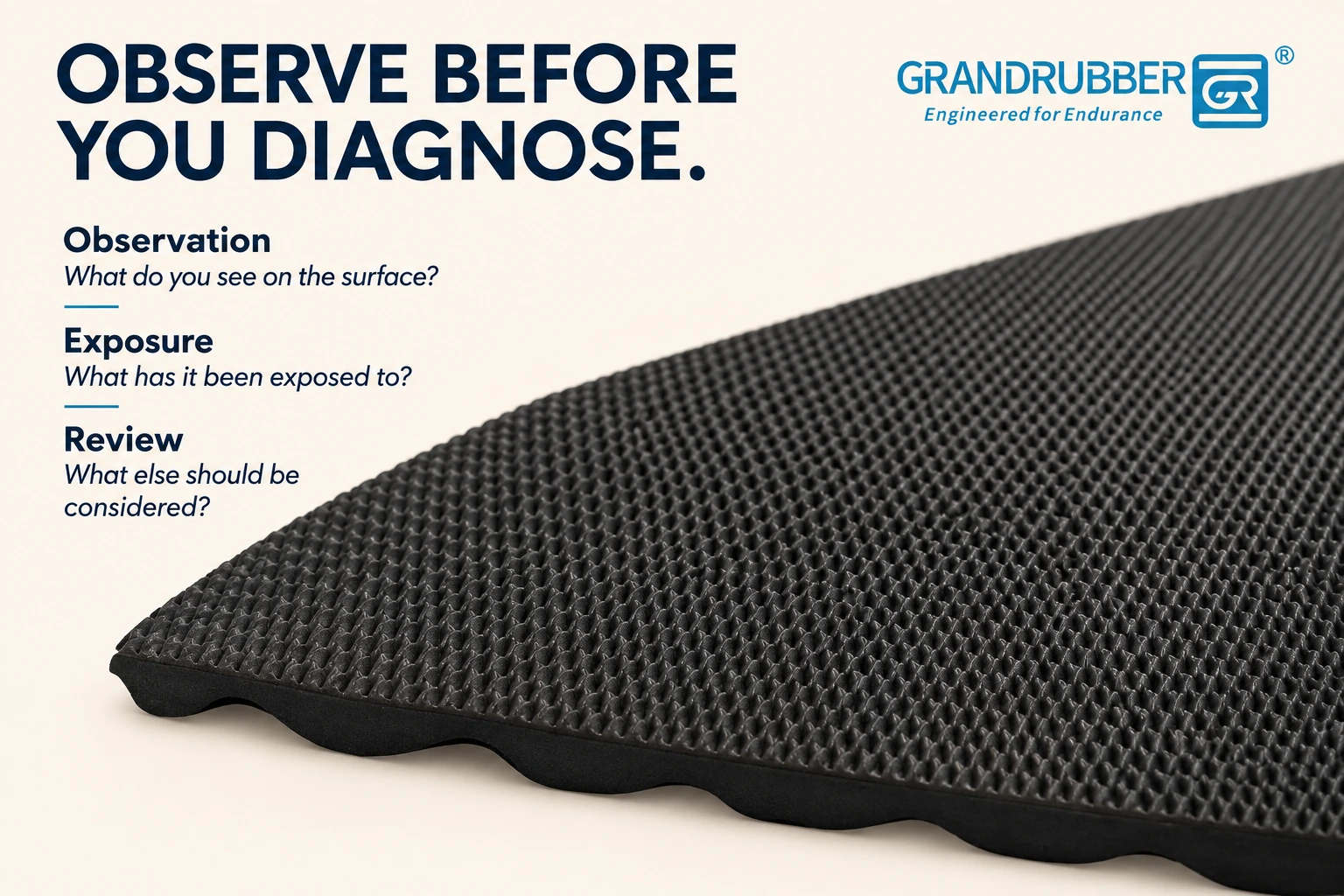
Record what is actually on or happening to the surface before changing the mat specification or cleaning exposure. Deposits and material-condition findings are different review subjects and can require different responsible responses. A photograph or cleaning-product label alone does not identify the cause or approve a remedy.
On this page
 Open full-size image ↗
Record what is actually on or happening to the surface before changing the mat specification or cleaning exposure. Deposits and material-condition findings are different review subjects and can require different responsible responses. A photograph or cleaning-product label alone does not identify the cause or approve a remedy.
Describe the surface finding before deciding what failed
A report that a mat looks different can describe several kinds of observation. Material may be sitting on the surface, an identified surface layer may have changed, or the rubber itself may show a condition finding. These are not interchangeable descriptions, and more than one can be present in the same area.
KRAIBURG’s June 2021 milking-parlour cleaning document distinguishes coarse, organic and mineral soiling and separately asks users to consider material compatibility and product instructions. This supports recording the actual soil/exposure context. It does not provide a cleaning recipe, performance guarantee or approved chemical for a GR mat.
The buyer’s first task is to preserve the observation without turning it into a diagnosis. A patch of discolouration or a coated-looking surface should not automatically be labelled rubber degradation, and a damaged-looking region should not automatically be dismissed as dirt.
Record location, appearance and the actual material identity
Identify the mat product if known, the floor area and the location of the finding. Use dated contextual and close photographs where safe records are available. Record the actual description and whether the observation has changed, without inventing a mechanism or claiming the image shows hidden material properties.
Keep the material identity separate from a broad floor label. A product sold for one use area is not automatically identical to every cow mat or sheet. If the old item cannot be identified, state that limitation and ask the responsible supplier what information can help narrow the subject.
The first table provides an observation record rather than a diagnostic test or cleaning instruction. It does not tell a worker to scrape, mix chemicals or expose the material experimentally. Any investigation method must come from the site’s applicable competent process and the actual product scope.
| Record | Actual input | Avoid assuming |
|---|---|---|
| Product/area | Mat identity and located floor reference | Every mat has the same material |
| Surface finding | Dated factual description and context | Appearance identifies the cause |
| Exposure | Actual cleaning agent and known use history | A purchase invoice proves conditions |
| Material response | Applicable product-specific assessment | Deposit removal proves compatibility |
| Other outcomes | Separate actual friction/hygiene requirements | A clean appearance proves every outcome |
Reconstruct actual cleaning and exposure history
Provide the actual cleaning-product identity and applicable documents, together with the available record of exposure and any relevant changes. Distinguish what was specified from what is known to have occurred. An invoice for a chemical does not prove every condition of its actual use.
Ask the cleaning-system and material parties to identify which information they need. Chemical suitability for a task and rubber compatibility are separate questions. Do not infer that a product effective on a deposit is suitable for the actual mat, adjacent equipment or use arrangement.
This article gives no acid/alkaline selection, concentration, contact time, cleaning frequency or pressure. The external document’s recommendations belong to its named flooring and context. Borrowing those conditions for an unidentified GR product would create an unsupported operating recommendation rather than a useful evidence record.
Worked review: a visible film triggers a harder-mat request
Consider a hypothetical parlour where a visible surface film is reported and the replacement enquiry asks for harder rubber. The record contains a general photograph but no identified deposit, actual product or cleaning-history reference. No real cause, slip measurement or GR case is represented.
A hardness change does not answer those missing questions. Record the surface observation and obtain the applicable responsible assessment of deposit/exposure and material condition. If a material change is later proposed, ask what actual requirement and evidence support it instead of using hardness as a generic corrective action.
A second offer may propose a stronger cleaner without confirming the mat or adjacent materials. That is another unreviewed assumption, not a resolved surface diagnosis. Keep its intended task and compatibility scope explicit for the responsible cleaning and material parties.
The second table separates the findings and proposed actions. It avoids claiming that cleaning restores a damaged mat or that every visible layer means the rubber is defective. The actual response needs the real product, observations and exposure context.
| Record/proposal | Unresolved question | Follow-up |
|---|---|---|
| Film visible in photograph | Deposit and material subjects unidentified | Record product, location and exposure context |
| Harder mat requested | Basis of material change absent | Ask what requirement and evidence justify it |
| Stronger cleaner proposed | Compatibility and actual task unconfirmed | Obtain applicable cleaning/material review |
| Surface looks clean afterwards | Performance not measured | Keep any other required outcomes separate |
Keep friction, hygiene and material condition as separate outcomes
A clean-looking surface does not establish a measured slip response, hygiene outcome or sound material condition. Each claim needs its actual subject and applicable evidence. Do not turn an appearance improvement into a certification of the whole floor.
Likewise, a material-compatibility statement is not a complete cleaning plan. The site must assign the actual system responsibilities and preserve relevant instructions and findings. If use, cleaning product or mat changes, ask which earlier responses remain applicable.
Where the site identifies a condition requiring action, use its competent responsible process. This guide does not authorize continued use, select a chemical remedy or assess animal or worker health. Its purpose is to prevent an incomplete surface description from becoming an unsupported product or operating decision.
Send an observation-and-exposure pack for review
For a GRAND RUBBER enquiry, provide the actual mat identity if available, use area, located observations and relevant cleaning/exposure documents. Ask what material or product form GR can offer and which supporting information is available. No universal cleaning-agent compatibility or surface-performance result is asserted.
Use the cow-flooring area guide for layout/use requirements and the cleaning-media evidence guide for the separate discipline of documenting an actual exposure. Here the distinctive question is whether surface soiling and material condition have been confused before selecting a replacement or treatment.
The next action is one factual record separating observed deposit, observed material condition, exposure history and responsible assessment. Retain unknowns and proposed remedies as such until the appropriate parties address the actual evidence.
Buyer FAQ
Does a visible film prove rubber damage?
No diagnosis follows from appearance alone. Record the actual observation and obtain the applicable product/exposure assessment.
Will harder rubber solve a deposit problem?
That outcome is not established by hardness. Identify the actual finding and the reason for any proposed material change.
Can the source’s cleaning routine be copied to a GR mat?
No product-specific applicability is established. Use the actual material and cleaning documents with the responsible review.
Does deposit removal prove the mat is slip-safe?
Appearance alone is not evidence of every friction, condition or hygiene outcome. Keep the applicable requirements separate.
Should an unidentified cleaning agent be guessed?
Record it as unknown and obtain the actual product reference where possible. Do not invent an exposure history.
Does this guide prescribe a chemical or pressure?
No recipe, application setting or operational remedy is supplied.
What should the next supplier enquiry contain?
Product/area identity, located surface observations, actual exposure documents and the specific unresolved material question.
Sources
Related technical resources
Related products
 Cow Mats & Mattress Covers
Document and page references
- KRAIBURG — Cleaning Recommendation for Milking Parlour Mats: PDFpp1–2 soil categories and material/product-instruction context. Use dirt/deposit versus material condition distinction only. No cleaning recipe, agent selection, pressure, frequency, mix, compatibility guarantee or GR hygiene/slip outcome.
- Editor-derived evergreen purchasing analysis; hypothetical examples are not real cases, field results or approved operating procedures.
Download the reference tables
Source-labelled review extract. Historical references remain historical; this is not a formal TDS, certificate or current availability confirmation.
Download guide tables CSV