
Can Vehicle Weight Alone Qualify Traffic Over Rubber Cow Flooring?
Vehicle weight alone is not a complete compatibility specification. Identify the actual flooring product, vehicle, tyres, intended use and applicable site requirements, then obtain the responsible manufacturer/system assessment. A traffic statement for another named floor is not permission for a GR product or the supporting structure.
On this page
 Open full-size image ↗
Vehicle weight alone is not a complete compatibility specification. Identify the actual flooring product, vehicle, tyres, intended use and applicable site requirements, then obtain the responsible manufacturer/system assessment. A traffic statement for another named floor is not permission for a GR product or the supporting structure.
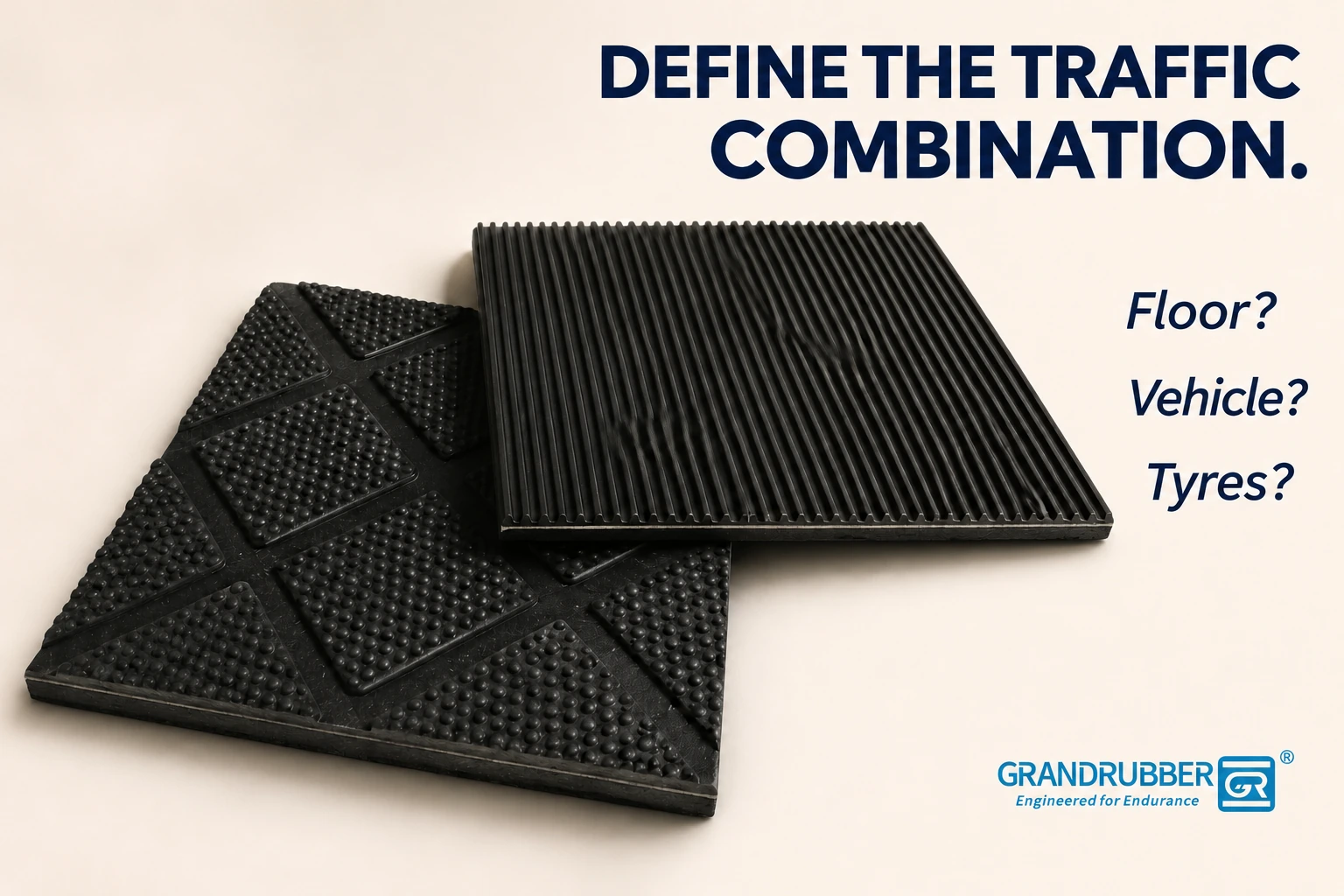
A traffic statement belongs to a defined combination
A vehicle’s total weight is one input to a floor-use review. It does not identify the tyres, actual manoeuvring context, mat arrangement or supporting floor. A buyer asking only whether a mat carries the tractor has not yet defined the complete product-use question.
KRAIBURG’s October 2026 traffic specification identifies named flooring products and relates vehicle weight to tyres, with separate use conditions and a requirement for vehicle-manufacturer approval of tyre adaptations. This is evidence of conditional manufacturer guidance, not a universal set of rules for all rubber floors. No numeric limits or driving instructions from that document are transferred here.
The practical purchase action is to obtain the actual combination and its applicable response. Keep the flooring supplier’s scope separate from vehicle approval and the site’s supporting-structure assessment. One party’s limited statement should not silently cover all three.
Identify the actual vehicle and tyre configuration
Provide the vehicle model and relevant documented configuration requested by the responsible reviewers, including the actual tyre identification and intended loaded/use context. Do not replace an unknown configuration with a tyre pressure or capacity taken from another floor manufacturer’s document.
Identify the intended route and use from the actual site layout. Straight passage, turning, parking and contact with cleaning equipment can represent different questions for the responsible parties. This guide asks that those intended activities be declared; it supplies no driving technique or permission for any activity.
The first table organizes the inputs. It is not a vehicle operating instruction, tyre-adjustment recommendation or traffic-capacity calculation. If a configuration change is proposed, obtain the applicable vehicle and flooring review instead of making the change solely to match a generic table.

| Input | Actual reference | Separate question |
|---|---|---|
| Vehicle | Model and relevant documented use/load context | Does the response cover this vehicle? |
| Tyres | Actual configuration and requested documentation | Is any proposed change approved by its responsible party? |
| Route/use | Actual layout and intended activities | Which product-use conditions apply? |
| Flooring | Offered product and arrangement | Does the evidence concern this actual floor? |
| Supporting structure | Site-specific structural references/review | Is underlying capacity separately established? |
Define the flooring arrangement and supporting-floor boundary
Identify the actual offered mat or flooring product and its intended arrangement, including relevant route and interface drawings. A broad cow-mat category or photograph does not establish compatibility with a particular vehicle. Ask which documents apply to the specific proposed product.
Keep the underlying structural question separate. A product-level traffic response cannot establish the condition or load-bearing suitability of an existing slab or slatted element. The site’s competent responsible party needs to address that scope independently for the proposed use.
Likewise, edge or transition details should be identified through the actual applicable system review. Do not improvise a protection design or installation method from a marketing image. The buyer’s job is to request a defined arrangement and responsible response, not to invent the missing engineering detail.
Worked quote: the same vehicle, an unrecorded tyre change
Assume a hypothetical farm compares rubber-flooring proposals for an identified vehicle. The purchase record retains only vehicle weight, while a proposed tyre configuration changes during the discussion. No real vehicle approval, tyre value or GR traffic result is represented.
A prior response based on one configuration should not automatically be applied to the revised one. Ask the responsible parties to identify which actual combination their statement covers and whether the change requires reassessment. The unchanged vehicle name does not resolve the tyre/interface difference.
Another proposal may cite traffic guidance for a different named flooring product. Retain that document as evidence for its own subject, not as approval of the offered mat. Ask for the applicable product-specific response and list any unresolved site requirements.
The second table turns those gaps into separate questions. It does not decide a safe load, specify tyre settings or approve vehicle access. It helps the buyer avoid comparing a scoped technical answer with a generic yes that omits the actual combination.
| Submission/change | Gap | Clarification |
|---|---|---|
| Vehicle weight only | Combination incomplete | Identify actual tyres, floor and use |
| Tyres revised | Prior response may concern another arrangement | Obtain applicable reassessment |
| Other manufacturer’s named floor guidance | Offered-product link absent | Request evidence for the actual proposed product |
| Product traffic statement used for slat capacity | Different responsible subject | Obtain separate structural/site disposition |
Control route, equipment and product changes after selection
If a vehicle, tyre, flooring product or intended route changes, ask whether the accepted response still applies. Retain the final configuration and actual scope rather than treating a single past email as perpetual permission for all traffic.
Assign responsibility for obtaining the relevant vehicle information, flooring response and structural/site assessment. A mat supplier may need inputs from the farm and vehicle owner before giving its own product response. Missing inputs should remain explicit rather than being hidden in a short delivery promise.
No GR traffic rating, slope limit, load capacity or service-life result is established by this guide. A named external manufacturer’s technical conditions cannot be copied into a GR quotation to create a missing capability or approval.
Send a combination-specific flooring enquiry
Provide the actual flooring area/route, vehicle and tyre configuration, intended use and available structural/layout references. Ask GRAND RUBBER to identify the proposed product and available documents, with the product, vehicle and site decisions assigned to their actual responsible parties.
Use the existing-slat guide if underlying supporting elements need a separate structural review, and the cow-flooring area guide for use zones. Here the decision is whether the product-use combination has been defined beyond vehicle weight alone.
The next action is a traffic-scope sheet identifying the final floor, vehicle/tyres and intended activities with the applicable responsible responses. Leave unreviewed changes visible before treating a general traffic label as a completed site approval.
Buyer FAQ
Does total vehicle weight settle mat compatibility?
No. Identify the actual vehicle/tyres, product and intended use for the applicable responsible assessment.
Can another manufacturer’s tyre pressure be used for a GR floor?
No such transfer is established. Obtain the actual vehicle and flooring response; this guide supplies no tyre setting.
Does a traffic-compatible mat prove the underlying slats are adequate?
No. The supporting elements require their own applicable competent structural review.
What if the vehicle name stays the same but tyres change?
Treat the actual configuration as revised and ask which prior responses remain applicable.
Can a photograph approve a turning or edge arrangement?
No arrangement is approved by this article. Provide actual layout inputs for the responsible product and site review.
Does GR’s cow-mat category guarantee vehicle access?
No product-specific traffic approval is asserted. Ask for the actual offered product and available applicable evidence.
What should the next enquiry contain?
The real floor/route, vehicle and tyres, intended activities and responsible site requirements, with unknowns and changes shown explicitly.
Sources
Related technical resources
Related products
 Cow Mats & Mattress Covers
Document and page references
- KRAIBURG — Vehicle Traffic Specifications: PDFp1: vehicle/tire relationship, driving mode and named flooring scope. Actual maker-specific conditions illustrate combined inputs only. No numeric limits, tire adjustment/driving instructions, GR traffic approval or structural capacity inferred.
- Editor-derived evergreen purchasing analysis; hypothetical examples are not real cases, field results or approved operating procedures.
Download the reference tables
Source-labelled review extract. Historical references remain historical; this is not a formal TDS, certificate or current availability confirmation.
Download guide tables CSV