
What must a chevron mould drawing show?
Confirm the mould drawing and the actual pattern arrangement, not merely a similar chevron photograph. Match pattern dimensions and margins to the identified basebelt and duty before treating a quoted pattern as equivalent.
On this page
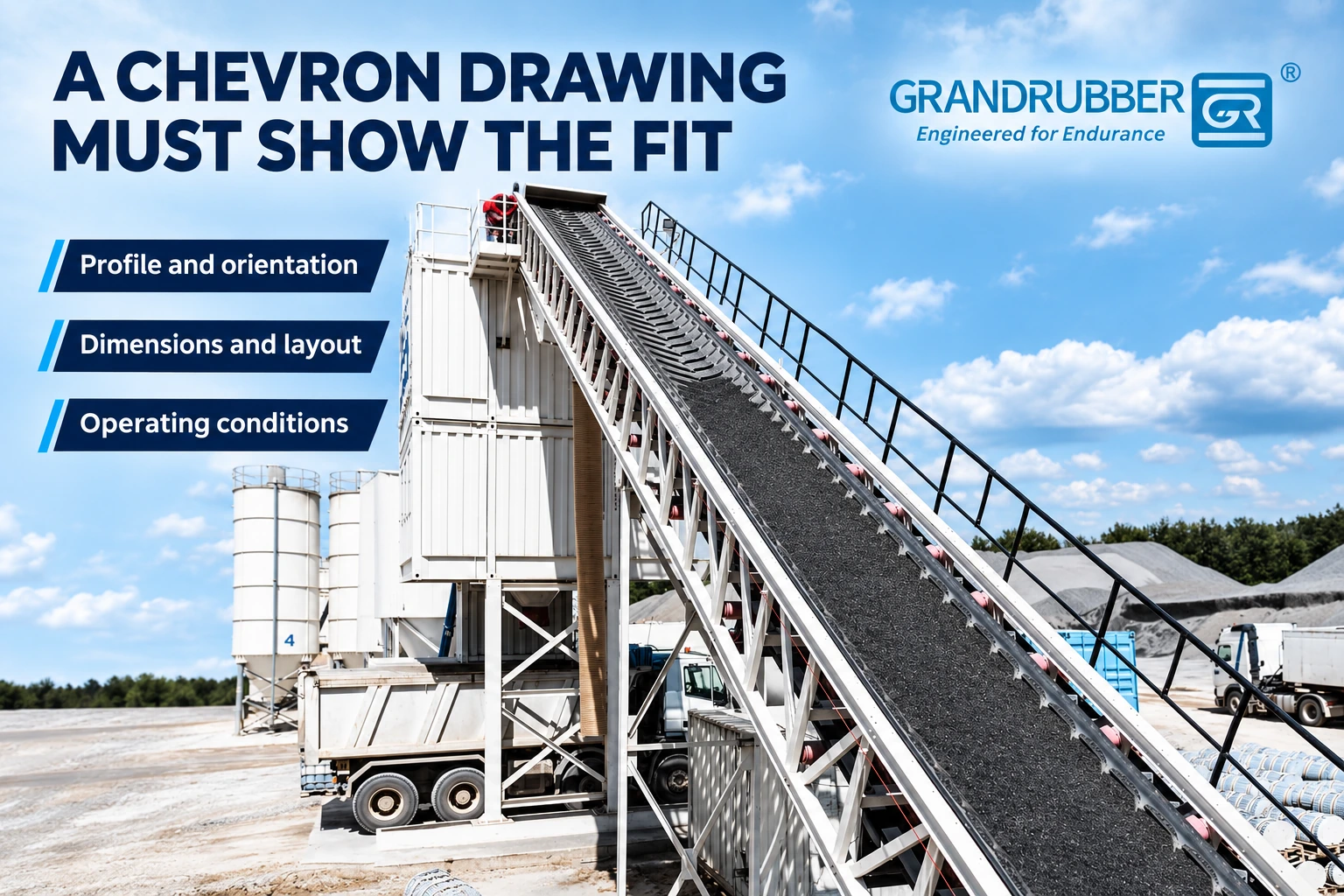 Open full-size image ↗
A chevron belt order needs the applicable pattern drawing, basebelt construction and dimensions. A familiar V or U outline does not establish cleat height, pitch, width or edge margins. Use catalogue codes to locate drawings, not as proof that two photographed belts share the same geometry.
Separate a pattern picture from a controlled drawing
The dedicated chevron catalogue lists several pattern families and codes, and explicitly treats its patterns as references subject to the mould drawing. The belt manual also shows pattern-specific width, height and pitch entries.
Identify the actual mould or drawing reference and revision for the offer. Keep the source page alongside it, but do not transfer a dimension from a neighbouring pattern because the pictures look similar. An image can illustrate a question without becoming the approved geometry.
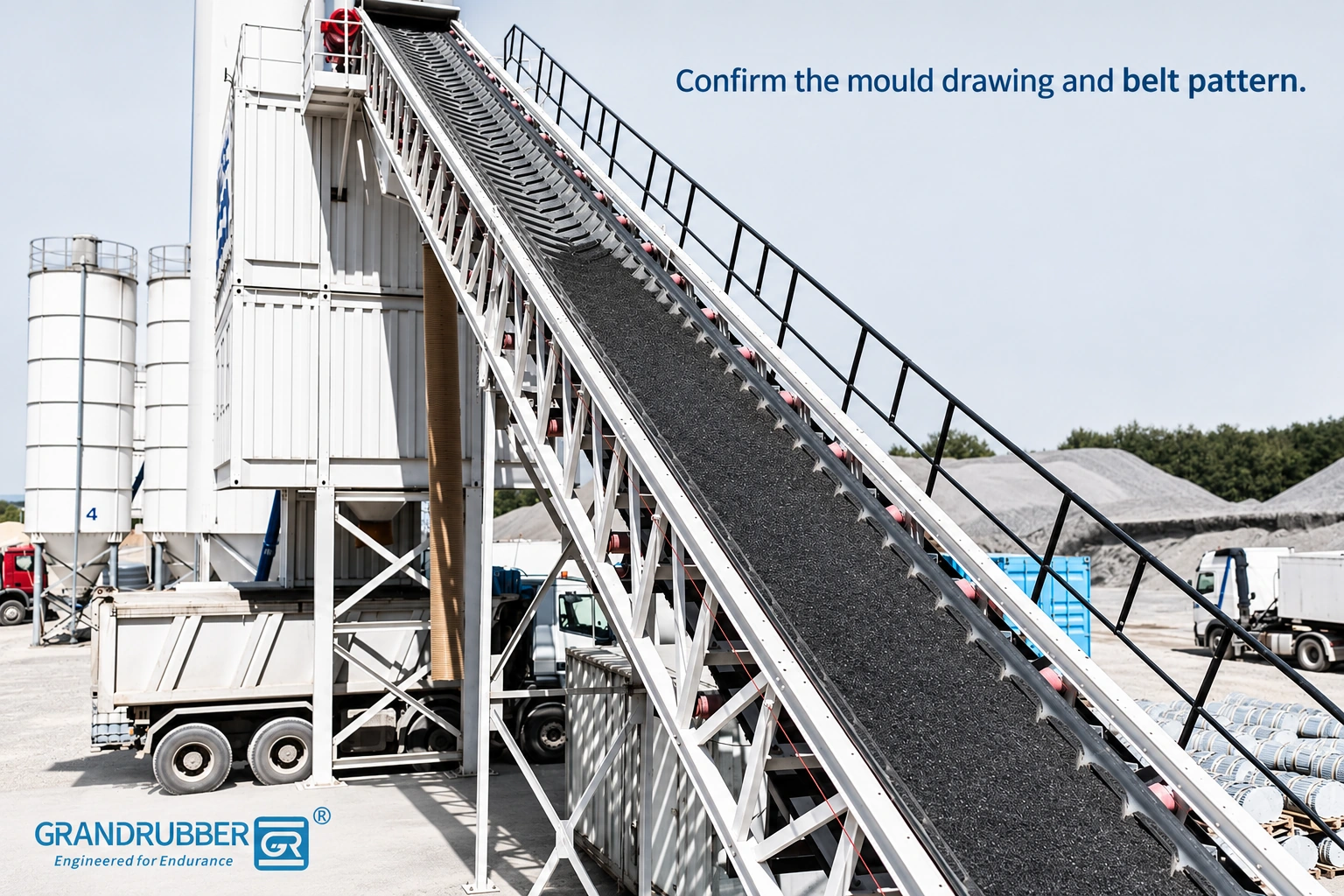
Check both the profile and the basebelt
Record overall belt width, effective pattern width, cleat/profile height, pitch and unpatterned margins using the drawing’s definitions. State basebelt construction, covers, supply form and relevant material/incline conditions separately.
The first table divides pattern identity from belt identity. If a special pattern is proposed, ask what drawing defines it and which dimensions remain provisional. Do not assume that a particular height approves the duty or conveying angle for every material.
| Area | Identify | Do not substitute |
|---|---|---|
| Pattern | Code, mould drawing and revision | A similar V/U photograph |
| Geometry | Height, pitch, effective width and margins | Height alone |
| Basebelt | Construction, covers, width and supply form | A pattern name |
| Application | Material, incline and loading conditions | A catalogue maximum angle |
Worked example: equal profile height, different pitch
Assume a hypothetical replacement enquiry identifies the old profile height and supplies a photograph, while the new offer uses another pattern code. Pitch and edge margins are missing. No dimensions or allowable angle are invented.
Ask for the old and proposed pattern drawings, with unresolved geometry clearly marked. Matching height alone does not show that the pattern fits the same belt or handles the same material arrangement. Do not read a catalogue’s pattern-family summary as a complete mould specification.
The second table records the dimensional clarification and prevents a photograph-based substitute from being released as a confirmed match.
| Available evidence | Missing decision | Required reply |
|---|---|---|
| Photo and height | Which exact geometry? | Referenced drawing |
| Different pattern code | Which dimensions depart? | Marked comparison |
| Catalogue summary | Does this offer use that mould? | Offer-specific identity |
| Duty description | What needs technical assessment? | Conditional proposal and gaps |
Send one marked pattern-and-belt record
Use the related chevron enquiry to send the pattern drawing, basebelt specification and duty information together. Ask the supplier to state the exact proposed mould reference and all deviations from the existing arrangement.
Keep the drawing identity in the order description and any acceptance record. Source width ranges differ between catalogues; they are not a combined current production range. No slip, capacity or life guarantee follows from the pattern illustration or from this guide.
Buyer FAQ
Can a photograph establish cleat pitch?
Not unless the required measurement basis is available and accepted. Request the drawing or an authorized dimension record; perspective and wear can obscure the nominal arrangement.
Are all open-V patterns equivalent?
No complete equivalence follows from the family name. Compare the actual mould, dimensions and basebelt.
Can I combine the widest range from several catalogues?
No. Identify the actual offered pattern and current applicable drawing; do not build a new range from different source schedules.
Does a higher cleat establish a greater approved incline?
No universal rule is given here. The actual material and conveyor conditions require review with the proposed construction.
What if the old code cannot be identified?
Provide the available drawings and authorized observations, mark the unknown identity and request a fresh defined proposal rather than inventing a code match.
Related technical resources
Files and media
Chevron catalogue reference drawing · physical page 2
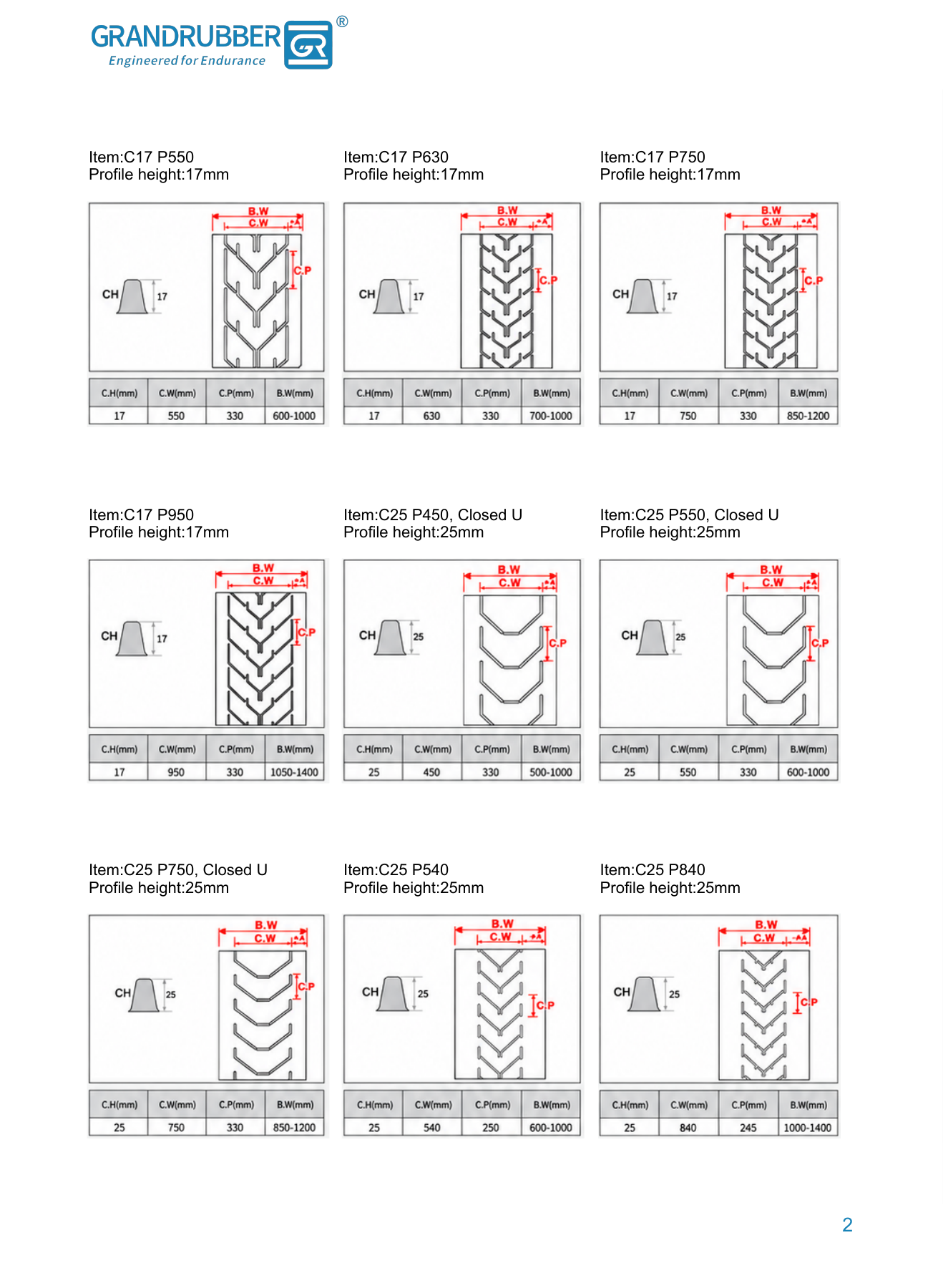
Chevron belt geometry reference. Confirm actual dimensions against the approved mould drawing and check different versions separately. The herringbone width relationship requires confirmation; this drawing does not establish stock availability or conformity.
View in technical resourcesChevron catalogue reference drawing · physical page 3
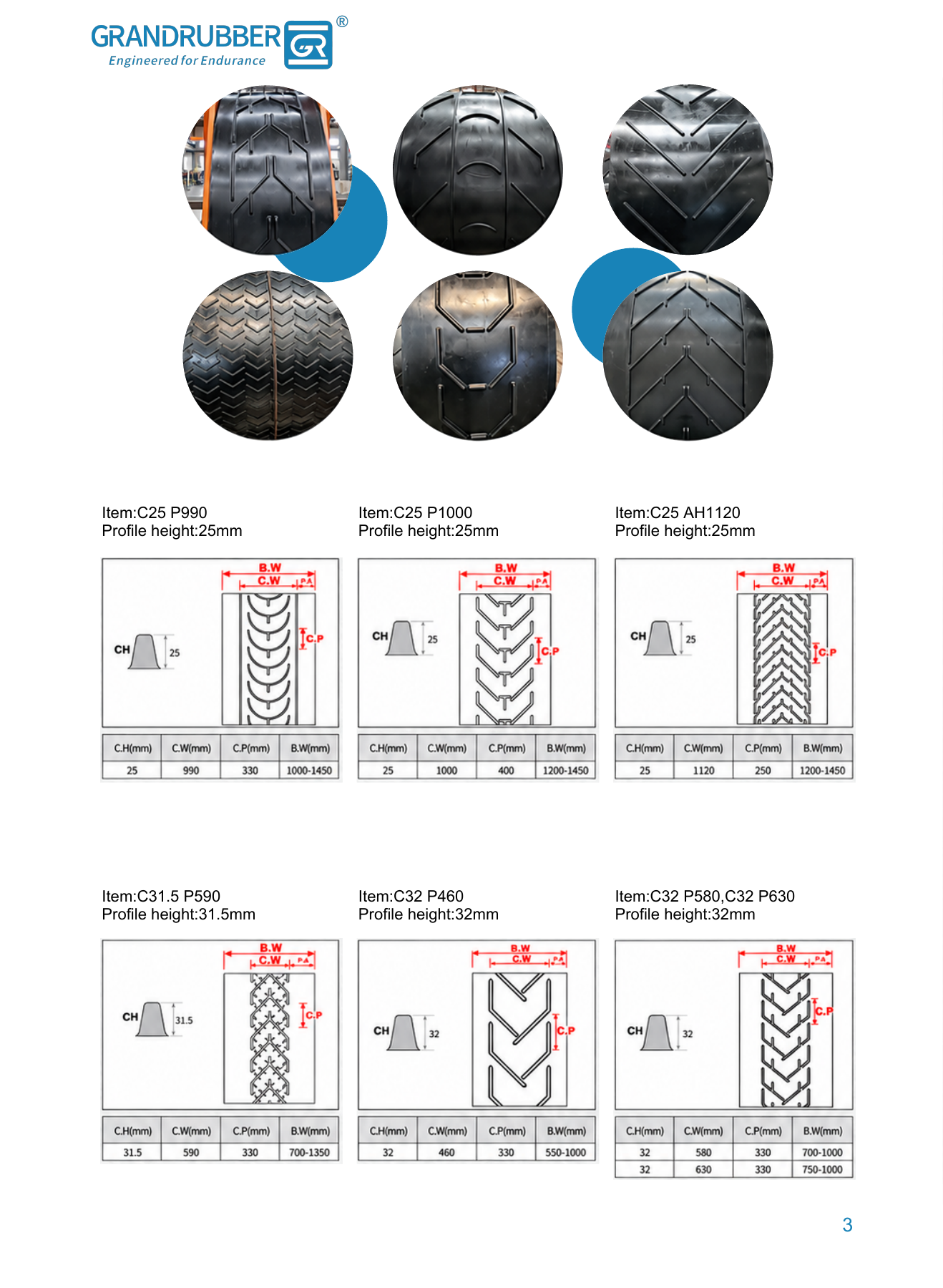
Chevron belt geometry reference. Confirm actual dimensions against the approved mould drawing and check different versions separately. The herringbone width relationship requires confirmation; this drawing does not establish stock availability or conformity.
View in technical resourcesChevron catalogue reference drawing · physical page 4
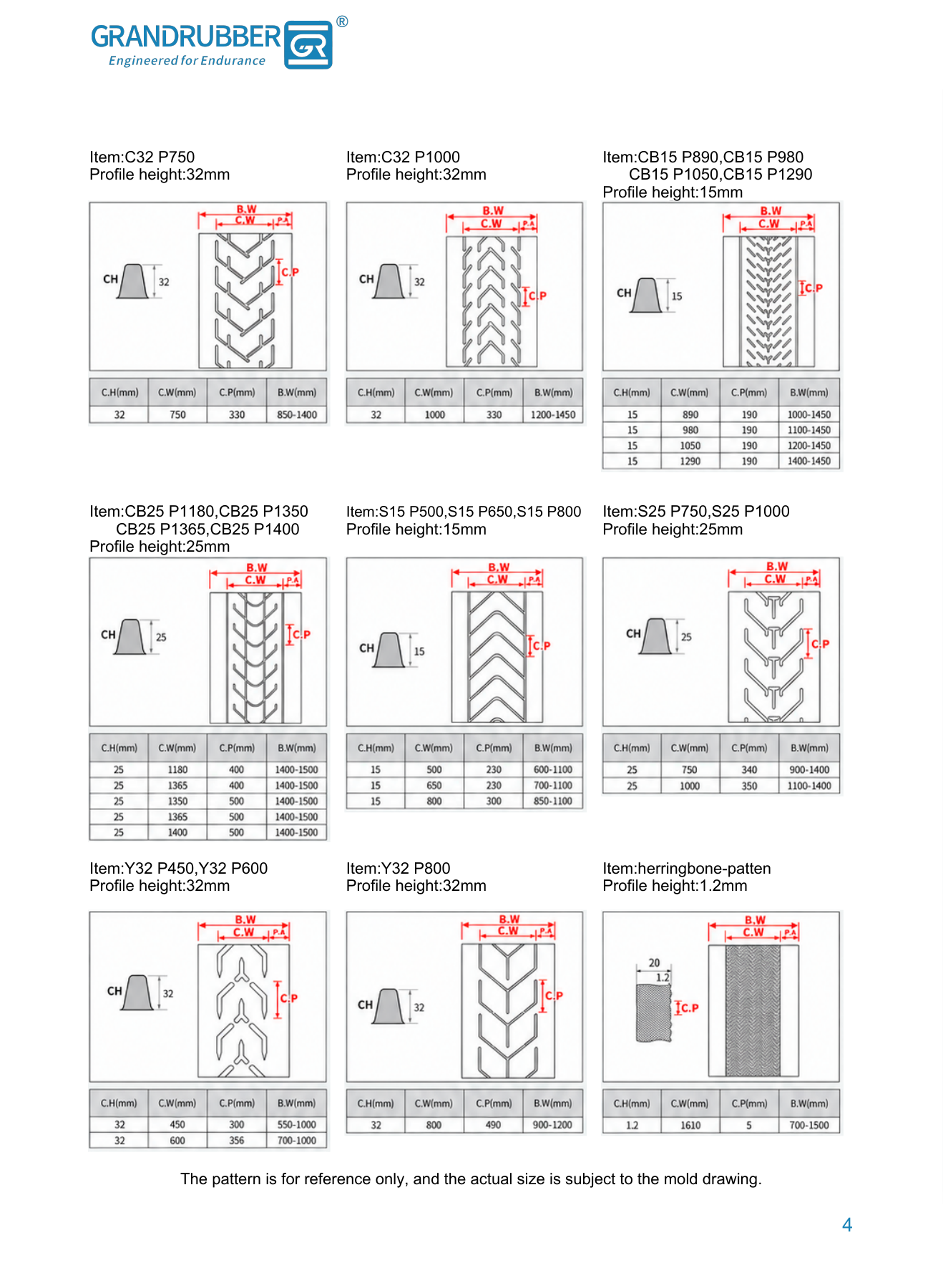
Chevron belt geometry reference. Confirm actual dimensions against the approved mould drawing and check different versions separately. The herringbone width relationship requires confirmation; this drawing does not establish stock availability or conformity.
View in technical resourcesRelated products
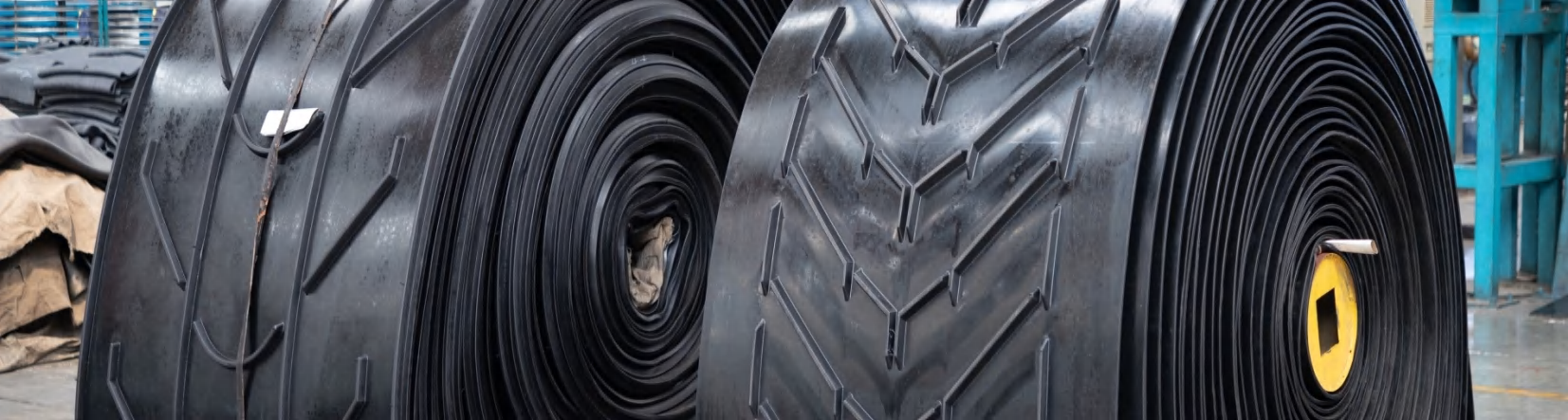 Chevron Conveyor Belts
Related buyer question
What must a chevron mould drawing show?
Match the actual pattern width, height, pitch and margins to the belt and conveyed material.
Document and page references
- GRAND_RUBBER_Chevron_Belt.pdf, PDF pp1,2,3,4: Pattern references and actual-size subject-to-mould-drawing note; no ranges adopted as current supply.
- GRAND_RUBBER_Conveyor_Belts.pdf, PDF pp29,30: Pattern-specific entries; no maximum inclination or performance claim adopted.
- Decision tables, hypothetical examples and follow-up questions are editorial purchase-review aids; they are not customer cases, site instructions or technical approval.
Download the reference tables
Source-labelled review extract. Historical references remain historical; this is not a formal TDS, certificate or current availability confirmation.
Download guide tables CSV