
Rubber Wear Indicators: How Can Buyers Verify a Layer’s Function?
A wear indicator is a documented feature of an identified lining construction. A coloured back, bonding layer or reinforcement does not establish that function. Before ordering, identify the intended signal, inspection access and responsible response for the actual offered item.
On this page
 Open full-size image ↗
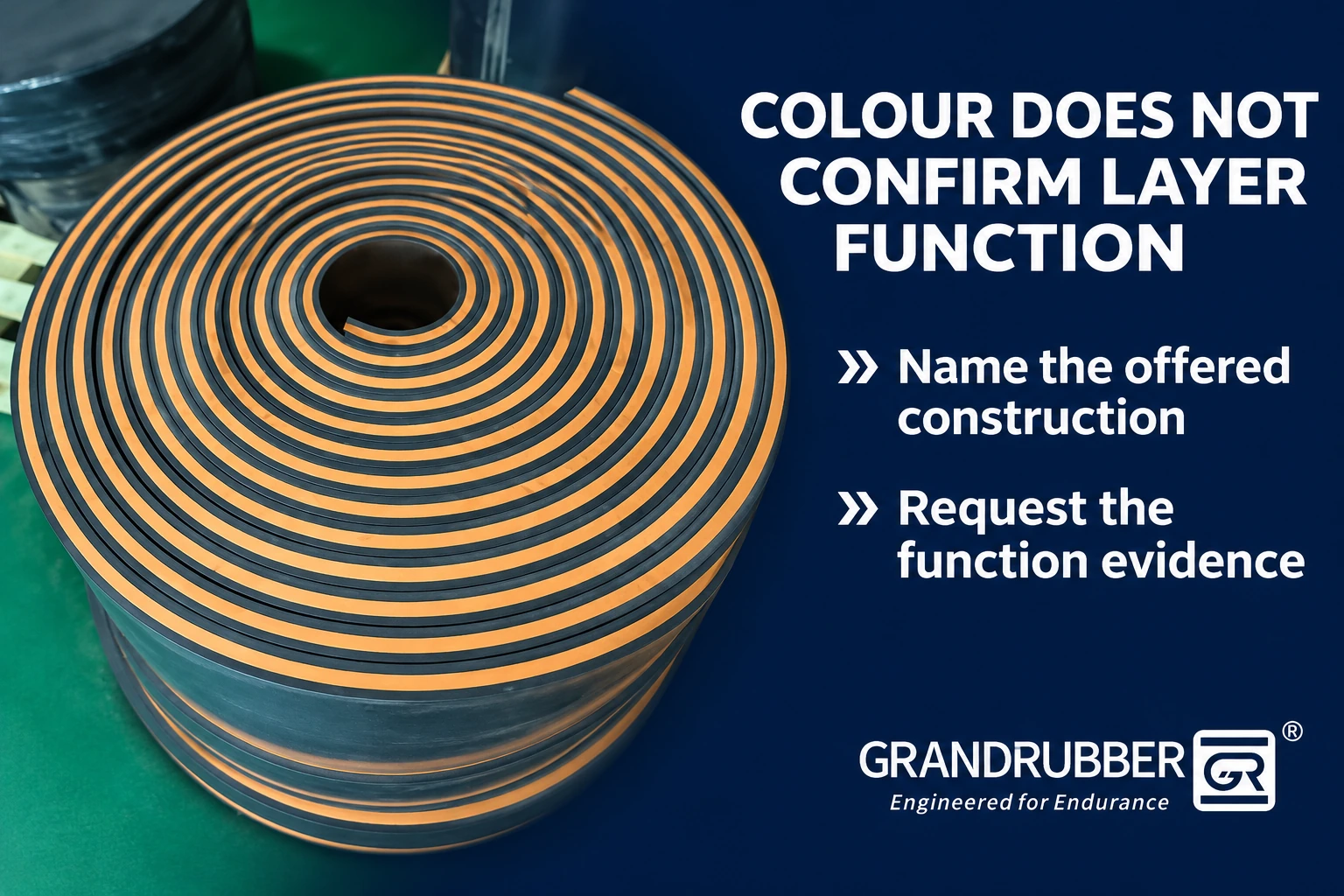
Ask for the offered product’s construction and the stated job of each relevant layer before treating a visible colour as a wear indicator. The useful buying question is what observation the specified feature is intended to support and how the responsible owner will act on it. A material photograph alone cannot establish a replacement threshold or remaining service life.
This guide concerns wear-sheet and liner enquiries. GRAND RUBBER’s current evidence has not established an offered wear-indicator construction, so that requirement must be checked explicitly rather than inferred from the brand’s general rubber-sheet range.
Identify the function before interpreting a layer’s appearance
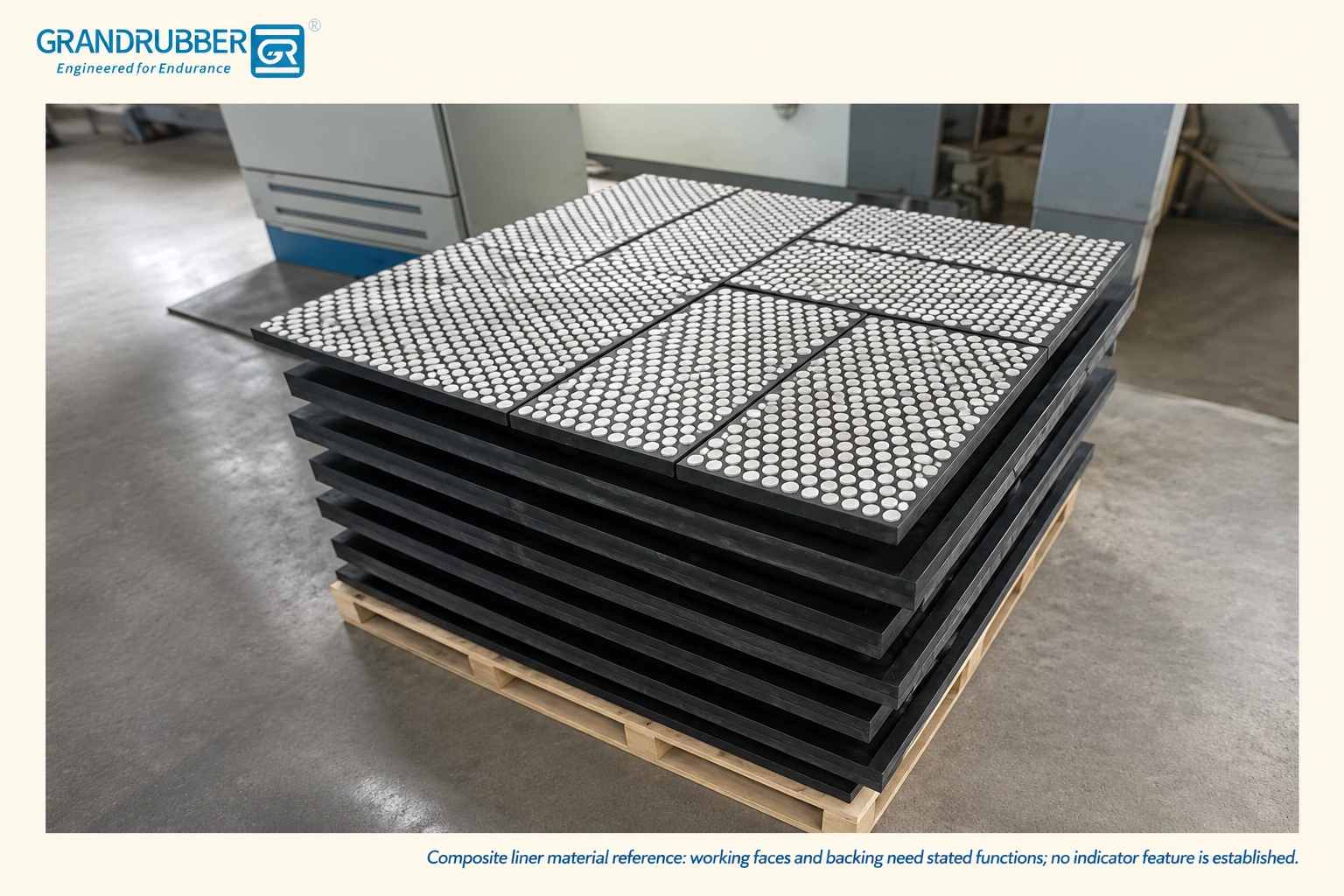
Keep the working face, any declared indicator, the bonding interface and backing or reinforcement separately identified. Some constructions may combine roles; the applicable product document or drawing must say so. The presence of several colours or a visible back does not establish the intended role of each part.
A working layer is part of the material exposed to the stated duty. A bonding layer concerns the specified attachment system. Reinforcement or a backing component belongs to the construction defined for the item. Calling one of those parts an indicator requires a documented monitoring function, rather than a buyer’s interpretation of a photograph.
The first table is a function checklist. It is not a standard layer stack, and it does not prescribe a material, layer order, thickness or inspection method. Use it to ask which roles are actually present in the proposed sheet or prepared liner.
| Role to identify | Evidence to request | Unresolved if absent |
|---|---|---|
| Working material | Actual material and duty basis | Suitability for the location |
| Declared wear indicator | Named construction and intended cue/response | Whether the feature is supplied |
| Bonding interface | Applicable attachment-system identity | Compatibility of the offered combination |
| Backing or reinforcement | Drawing and stated structural function | Whether appearance has been misinterpreted |
Read the manufacturer example within its named product scope
REMA TIP TOP’s REMALINE page identifies a wear-indicator feature for REMALINE 40 Maintenance Pro and separately describes the wear and indicator layers. That is a specific manufacturer statement for that named product. It does not turn an arbitrary black backing into an indicator or establish an equivalent GRAND RUBBER item.
When a supplier uses a similar phrase, ask for the document naming the actual offered construction and explaining the feature. Check the product identifier, revision and any stated relationship between the observed cue and the intended response. If the offer is for a different sheet or a cut component, have that applicability established.
Keep the supplier example as a reason to ask a precise question. No competitor formulation, hardness, strength, dimensions, colour system or service-life outcome is transferred into this enquiry guide.
Plan access and response with the feature requirement
A monitoring feature is only useful to the purchasing decision when the responsible equipment owner can explain how it will be observed within the actual arrangement. Identify the locations of interest, any areas concealed by the installation and who will define the applicable inspection and response plan. This article supplies no inspection interval or permission to approach operating equipment.
Ask how observations will be linked to locations and the identified construction. A cue observed in one accessible patch is not a record of every other area. Likewise, absence of a visible cue in the returned photographs does not establish the remaining condition of concealed material.
The buyer should keep the intended response explicit: who assesses the observation, what applicable document is used and how a replacement or other disposition is authorized. Do not calculate operating hours from a colour change or turn a general product description into a universal discard rule.
Worked enquiry: two similar backs are assigned different jobs
Consider a hypothetical request for a wear sheet with an indicator feature. One proposal identifies a backing intended for its bonding system. Another describes an indicator but omits the offered product reference and observation basis. The photographs appear similar. No layer dimensions, remaining life or material equivalence are assumed.
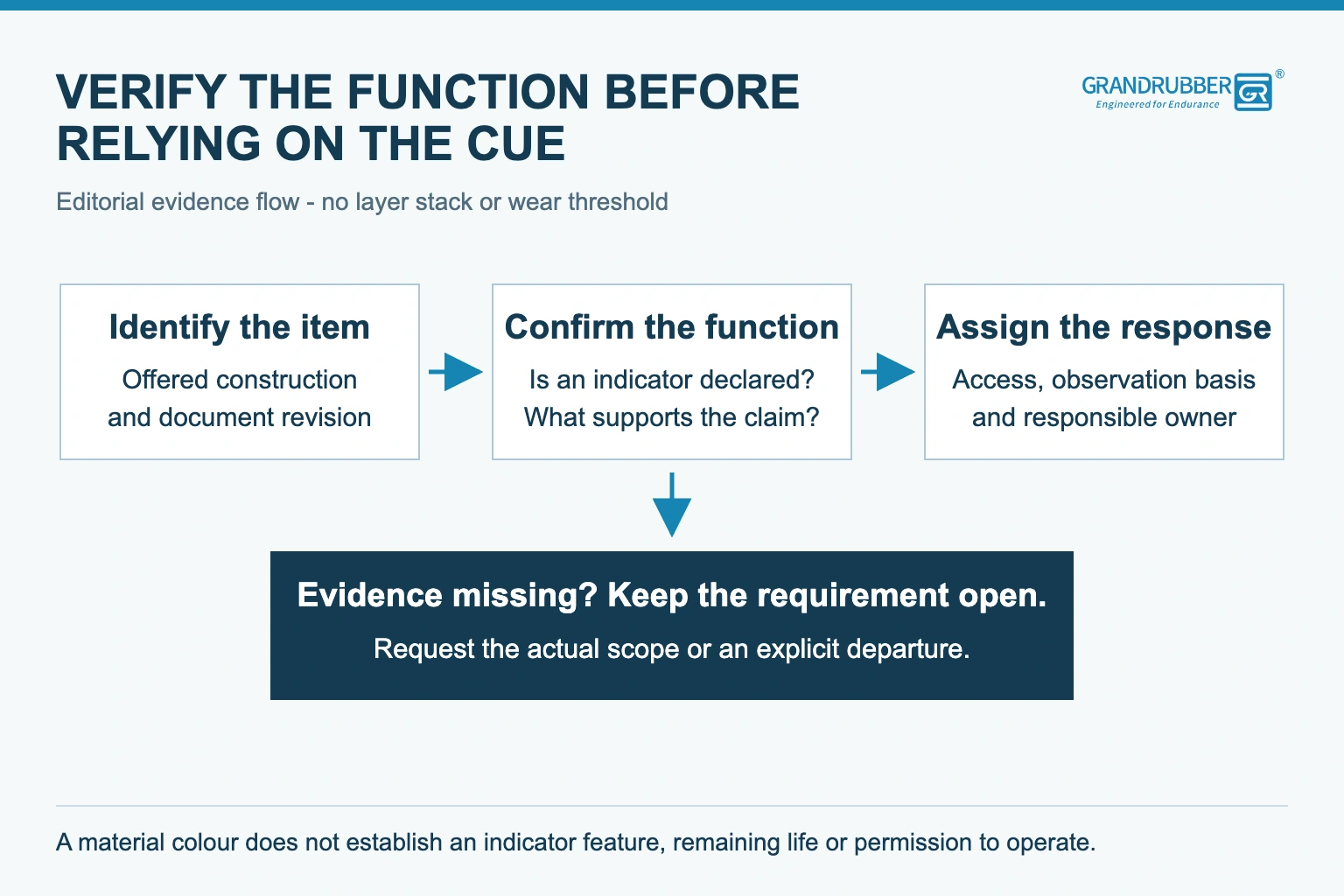
Keep both offers open for clarification. Ask the first supplier whether the requested monitoring function is included or excluded; do not relabel the backing in the buyer’s spreadsheet. Ask the second supplier to connect the claimed feature to the exact construction and its supporting document.
The second table records what each response must resolve. The enquiry can then be amended, accepted with an explicit confirmed scope or left unresolved by the responsible purchaser. A familiar colour is not evidence that either proposal fulfils the original requirement.
| Offer or information gap | Specific supplier reply | Buyer record |
|---|---|---|
| Only a bonding back is identified | Is the indicator requirement included or excluded? | Actual function and any departure |
| Indicator claimed, product unspecified | Which offered construction and document support it? | Matched item/revision or remaining gap |
| Observation basis missing | Which applicable cue, access and response are defined? | Responsible review rather than assumed life |
| Overall thickness only | Which dimensions belong to which functions? | Construction schedule with defined thicknesses |
Compare the complete lining requirement
An indicator requirement sits alongside the working material, drawing and attachment requirements. Ask for the actual wear and impact context, the intended material form, total construction definition and any prepared-piece or fixing scope. A monitoring feature does not itself prove that the base material or mounting is suitable for the equipment.
Keep the thickness definitions separate. Overall panel thickness can include parts whose functions differ from the exposed working material. An indicator description should not be converted into additional usable wear allowance unless the applicable construction and response basis explicitly establish that meaning.
If a seller offers a different construction, request a clear departure statement. The purchaser and responsible technical parties can then evaluate it against the stated need. Do not conceal a missing feature by substituting a photograph, another brand’s name or an unrelated property result.
Send a function-based wear-sheet enquiry
For a GRAND RUBBER mining-sheet enquiry, send the part or location reference, duty description, attachment information and required layer functions in one schedule. State explicitly whether a wear-indicator feature is required. Ask for the actual offered construction, applicable evidence and any exclusions; availability of that feature remains to be confirmed.
The listed mining-sheet range provides a product-discussion route, not evidence that every optional monitoring feature is supplied. Use the related drawing guide to separate working layers, backing and the installed interface, and the hardness guide to keep material-property comparisons on their own basis.
The next action is one construction-and-function schedule. It should allow the supplier to identify what it proposes and the equipment owner to identify the remaining inspection and response questions, without making a service-life prediction from the sheet’s appearance.
Buyer FAQ
A dark layer has become visible on an old liner. Is that enough to call it an indicator?
Record the location and identify the original construction. The exposed material may have another function. Obtain the applicable product and condition-review basis before calling the observation a designed indicator or assigning a replacement threshold.
Can a bonding layer also be an indicator?
Only the applicable construction evidence can establish the declared functions for the offered item. Do not assume a second role from appearance, a similar name or another supplier’s product description. Ask the supplier to state each relevant function explicitly.
Does a visible cue show the number of operating hours remaining?
No remaining-life calculation is established here. Keep the observation with its location, construction and actual duty, then obtain the responsible disposition under the applicable review basis. A colour change alone supplies no operating-hours forecast.
What if the offered sheet has no confirmed indicator feature?
Ask for an explicit exclusion or departure and refer it to the responsible purchaser and technical reviewer. The requirement may need clarification or another proposal. Do not amend the order to say indicator-equipped while the feature is unverified.
Can a sample prove the function for every delivered piece?
Use the sample for the identification work it supports, with its traceability. Confirm the ordered construction and the relevant delivered-item evidence separately. Similar-looking pieces do not by themselves establish the same layer functions or document coverage.
What if the proposed indicator cannot be viewed in the installed position?
Ask the equipment owner and material supplier to address access and the applicable observation basis before relying on the feature in the purchase decision. This guide provides no inspection method, interval or authorization to access operating equipment.
Does this article confirm that GRAND RUBBER supplies an indicator-layer liner?
That construction has not been established by the current evidence. Put the required function explicitly in the enquiry and request confirmation of the actual offered item and documents. The general mining-sheet listing should retain its own stated scope.
Sources
Related technical resources
Related products
 Mining Rubber SheetsRubber sheets with catalogue 10 MPa and 15 MPa grades for mining wear-protection locations. Compare abrasion, impact, dimensions and attachment conditions before choosing a grade.
 Ceramic & Rubber Composite LinersCeramic and rubber composite liners in separate two-in-one and three-in-one formats. Specify tile layout, substrate, fixing, temperature and impact conditions before choosing the assembly.
Document and page references
- REMA TIP TOP, REMALINE40 Maintenance Pro product section: named product feature only; no equivalent GR indicator-layer offer established.
- Editorial decision tables, hypothetical comparisons and follow-up questions are purchasing aids, not customer cases, measured outcomes or approved operating procedures.
Download the reference tables
Source-labelled review extract. Historical references remain historical; this is not a formal TDS, certificate or current availability confirmation.
Download guide tables CSV