
How do you compare industrial rubber sheet materials?
Compare a sheet against its actual contact, mechanical duty and installed form. FKM, closed-cell EPDM sponge, TPE and silicone names identify different material families; hardness or colour alone does not establish a suitable replacement.
On this page
 Open full-size image ↗
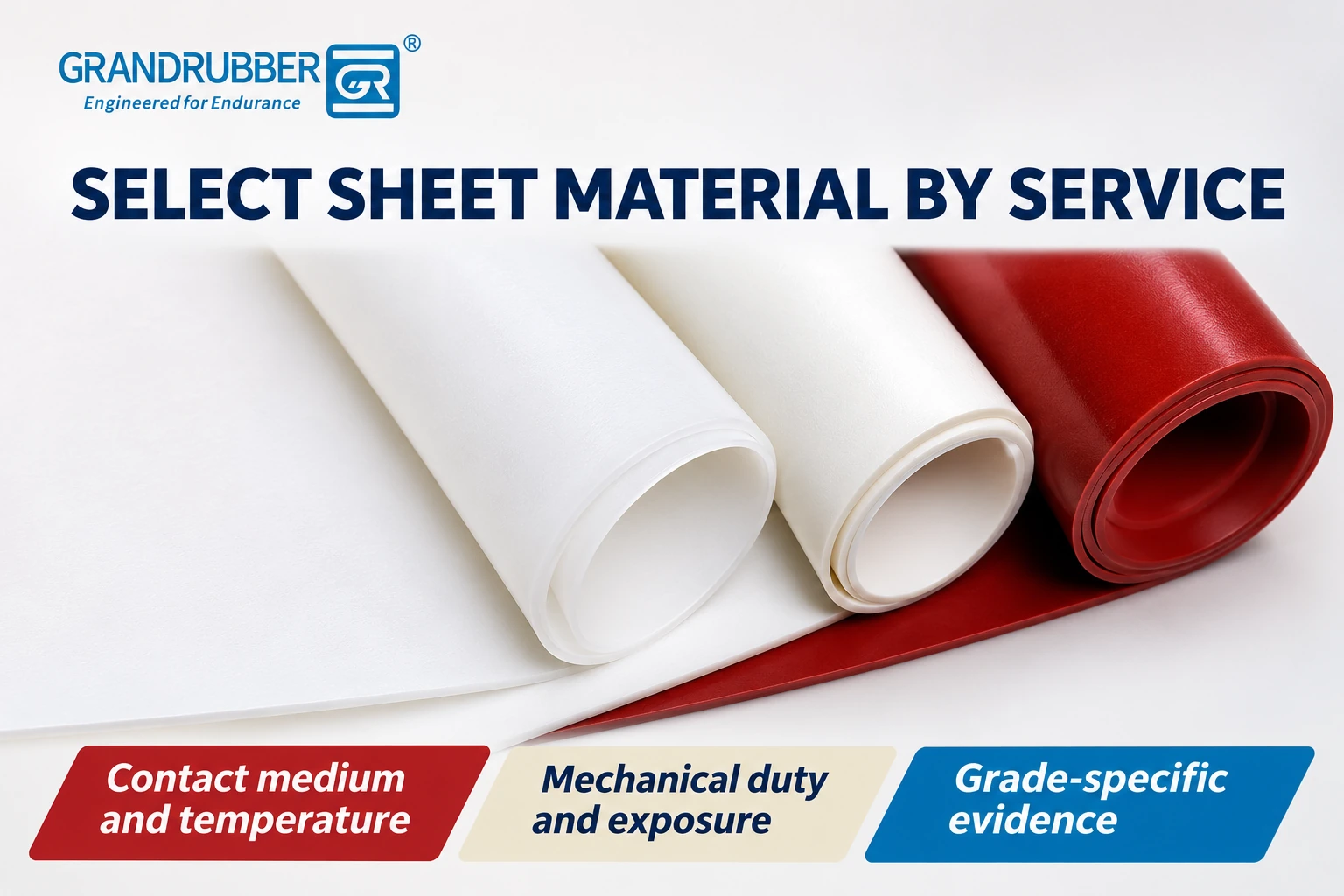
Selecting industrial sheet begins with what it must withstand and how it is used. A solid sheet, a sponge product and a patterned flooring sheet can have similar dimensions while serving different tasks. This guide structures a comparison, without supplying universal chemical compatibility or temperature limits.
Identify the function and the offered material together
Describe whether the sheet forms a seal, cushions a contact, protects against wear or covers a walking surface. Then identify the actual offered compound or product, including solid or cellular construction and any backing or reinforcement. A family name narrows the conversation; it does not describe every formulation or manufacturing option.
The general catalogue places FKM and closed-cell EPDM sponge in separate sections on p21, and TPE and silicone separately on p22. Their proximity does not make their property columns interchangeable. A request for black rubber sheet is especially incomplete when the function depends on compression or exposure.
Compare properties on the same basis
Record the medium and concentration where relevant, normal and exceptional temperature conditions, contact duration, movement, compression and required dimensions. For a property comparison, retain the test method, unit and specimen/product identity.
The first table asks which information makes each functional question comparable. Hardness, density and tensile data answer different questions. A single number should not silently stand in for wear behaviour, sealing recovery or chemical suitability.
| Function | Evidence to identify | Do not substitute |
|---|---|---|
| Seal/cushion | Form, contact and required compression response | Hardness alone |
| Chemical barrier | Medium, temperature and exact compound | Family name alone |
| Wear surface | Wear mode and applicable test basis | Tensile value alone |
| Floor/contact surface | Pattern, support and actual use | Colour or appearance |
Worked example: a solid-sheet offer against a sponge requirement
Assume a hypothetical buyer requests a replacement for a compressible strip and receives a solid-sheet option of the same nominal thickness. The quotation names a rubber family but does not identify compression behaviour or the installed gap. No formulation or compression allowance is selected here.
Ask what the existing strip does, which features are established and what response the assembly requires. Match the offered construction and evidence to that requirement. Equal thickness is a geometric match, not proof of equivalent response.
The second table records why the option remains incomplete. This approach also applies when a supplier suggests silicone for a contact application or FKM for a chemical exposure: request evidence for the exact product and conditions rather than accepting a material-family reputation as an approval.
| Offer feature | Check | Decision boundary |
|---|---|---|
| Same thickness | Same installed function and form? | Dimensions do not establish response |
| Different family | Evidence for actual exposure? | No universal ranking |
| Sponge versus solid | Relevant assembly response? | No assumed equivalence |
| Contact claim | Applicable item-specific documents? | No blanket approval |
Turn the comparison into an item-specific request
Send the function, exposure, drawing and required evidence through the relevant rubber-sheet product enquiry. Ask the supplier to identify the offered grade and any departure from the requested form, dimensions or acceptance basis. Keep optional adhesive backing, surface pattern and cut shape visible in the line item.
Where food contact or another regulated use matters, state the actual requirement and request the appropriate complete evidence for the intended article and conditions. Catalogue labels do not establish that every colour, formulation or supplied sheet has the same documentation. Do not release a substituted product while a critical exposure or construction question remains unanswered.
Buyer FAQ
Can colour identify the rubber compound?
No. Confirm the offered product identity and supporting documents; coloured examples in a catalogue do not establish composition.
Are Shore hardness values automatically comparable across sheet types?
Identify the scale, method and specimen context before comparison. Cellular and solid products should not be treated as equivalent from a hardness label alone.
Does an adhesive backing come as standard?
Confirm the actual offered construction and scope. A listed option is not evidence that it is included in every sheet.
Can I use a general resistance chart as the final decision?
Use it only within its stated scope. The offered formulation and actual contact conditions still require the appropriate review.
Should the strongest tensile result win?
Only if that property addresses the requirement on a comparable basis. It does not replace the other functional and exposure checks.
Related technical resources
Related products
 Mining Rubber SheetsRubber sheets with catalogue 10 MPa and 15 MPa grades for mining wear-protection locations. Compare abrasion, impact, dimensions and attachment conditions before choosing a grade.
 FKM Rubber SheetFKM rubber sheet for material-compatibility and sealing review. Specify the fluid, concentration, temperature and sealing geometry before selecting a grade and supporting test requirements.
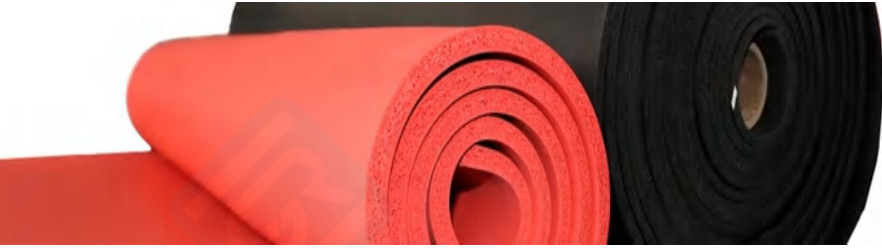 Closed-cell EPDM Sponge RubberClosed-cell EPDM sponge rubber in catalogue roll and piece formats. Match compression, recovery, thickness and exposure to the drawing and selected material grade.
 TPE SheetTPE sheet listed for indoor-use applications. Specify thickness, floor layout, cleaning and exposure conditions, and define any required slip-test or compliance evidence.
 Silicone Rubber SheetSilicone rubber sheet with separate catalogue material designations. Select hardness, thickness and exposure conditions, then verify any direct-contact, flame or antistatic requirement with applicable evidence.
Document and page references
- Catalogue_GRAND_RUBBER.pdf, PDF pp18,19,20,21,22: Distinct sheet categories and property tables; no universal resistance, contact, compression or temperature approval adopted.
- Decision tables, hypothetical examples and follow-up questions are editorial purchase-review aids; they are not customer cases, site instructions or technical approval.
Download the reference tables
Source-labelled review extract. Historical references remain historical; this is not a formal TDS, certificate or current availability confirmation.
Download guide tables CSV