
Hardness alone does not select a wear lining
Hardness is one material property, not a wear-lining selection rule. Compare the actual damage and mounting duty with identified material evidence measured on a compatible basis before choosing a lining.
On this page
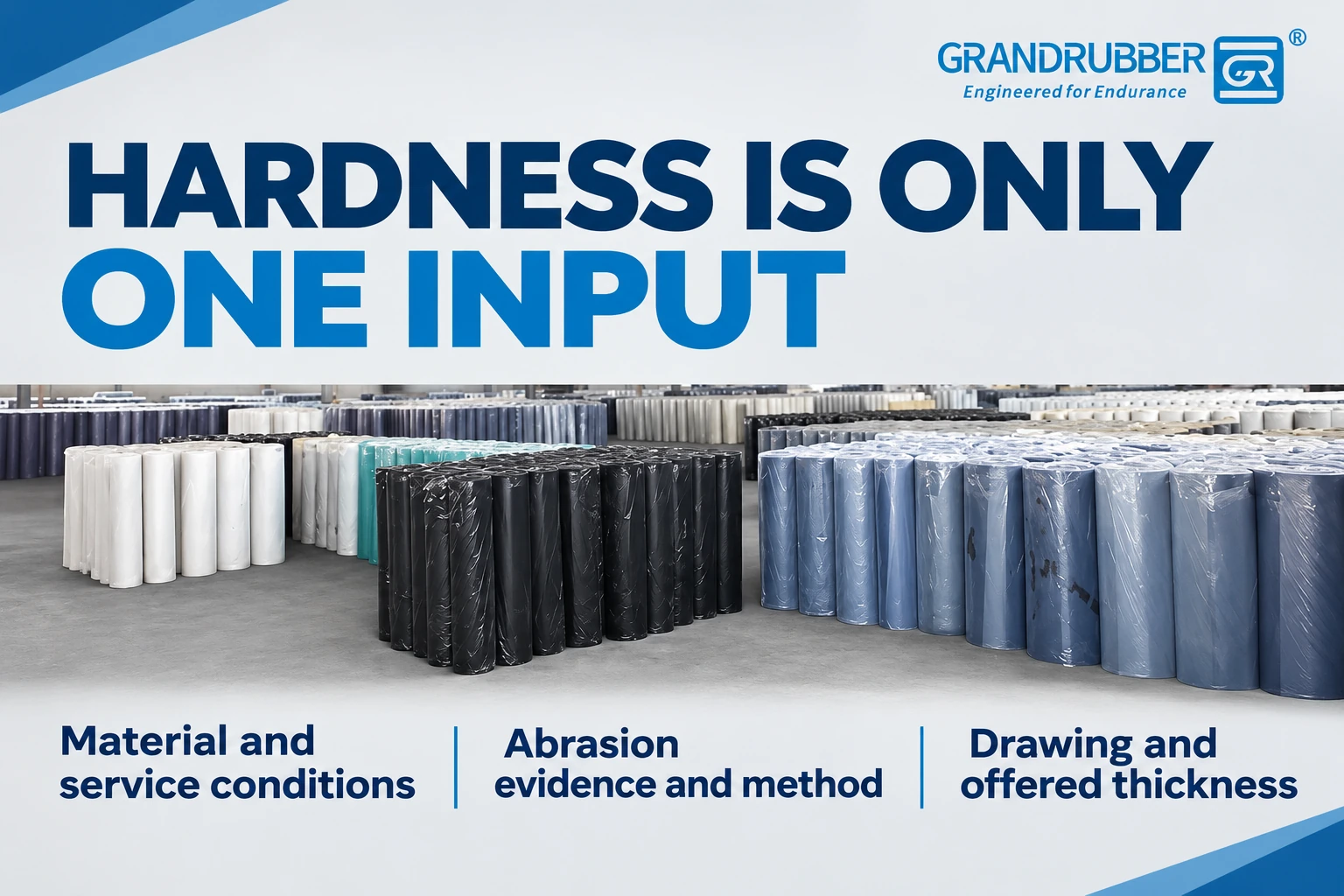 Open full-size image ↗
Do not choose a wear lining from hardness alone. Describe the damage, material movement, exposure and support, then compare the properties and installation interface relevant to that duty. A softer or harder catalogue entry does not, by itself, prove longer life. This guide concerns the assessment of wear-lining candidates, not a universal ranking of rubber grades.
Name the wear problem before choosing a property
Distinguish reported sliding wear, impact marks, cutting or tearing, and possible chemical or thermal exposure. Record where each occurs and preserve authorized photographs with location context. These are observations for assessment, not diagnoses made from an image.
The general catalogue’s NR40 and mining-sheet pages list hardness alongside other properties and surface/supply options. That structure supports a multi-property discussion. It does not show that one value or colour is correct for an unidentified chute, liner or moving-material contact.
Compare evidence under the same stated conditions
Ask which material and specimen each result describes, the method, units and relevant test conditions. Keep hardness, abrasion, tensile and tear information in separate entries. A catalogue value and a batch result are different evidence statuses even where the printed numbers look alike.
Identify which failure mechanism the proposed material change is intended to address. If the seller cites abrasion while the unresolved issue is a torn fixing area, ask how the cited evidence addresses that location. The first table prevents one favourable test property from silently answering every question.
| Recorded issue | Evidence question | Avoid this shortcut |
|---|---|---|
| Sliding contact | Which applicable abrasion basis and material identity? | Hardness equals service life |
| Impact or edge damage | Which loading and tear/structural assessment? | An abrasion value proves impact suitability |
| Exposure | Which actual substance and temperature conditions? | Colour identifies compound |
| Fixing-area problem | Which support and attachment drawing? | Changing sheet grade resolves the mounting |
Worked example: the hardness changed, but the attachment did not
Assume a hypothetical buyer compares two sheets for the same liner shape. One offer emphasizes a different hardness, but neither establishes the support, fixing or loading at the damaged edge. No property values, service-life estimate or successful repair is assumed.
The next question is not which hardness wins. Ask for the evidence relevant to the observed damage and the mounting arrangement. Confirm whether the proposal covers plain sheet, prepared pieces or a lining system. A material can be quoted without the fixing detail being defined.
The second table separates the material review from the drawing and installation inputs. Acceptance of a material description does not establish an approved bonding system or replace the responsible site assessment.
| Scope | Input | Decision |
|---|---|---|
| Sheet material | Candidate identity and comparable data | What property is being evaluated? |
| Prepared part | Shape, holes, backing and revision | What exactly is supplied? |
| Attachment | Bonding/fixing system and substrate | Who confirms compatibility? |
| Site work | Inspection, preparation and acceptance scope | What is outside the material quote? |
Send a location-based lining review
Send the part drawing, damage-location record, conveyed material and contact conditions with the candidate material references. Ask for a written explanation of which requirement each proposal addresses and what remains unresolved.
Use the mining-sheet or NR40 related enquiry for the actual material scope. If cutting, backing preparation or installation is required, identify that work explicitly. Do not promise a wear reduction or choose a replacement thickness from this article; those decisions require the offered material and equipment basis.
Buyer FAQ
Can the same hardness describe different materials?
Yes; a hardness entry does not identify the complete compound or establish chemical, tear or abrasion behaviour. Ask for the actual material identity and the relevant evidence rather than treating the number as a material code.
Are abrasion results from different methods directly comparable?
Do not assume so. Identify the method, load and conditions before ranking results. If those bases differ, ask for a common comparison or keep the results separate.
Does red rubber prove NR40 suitability?
No. Colour is an identification aid only when tied to an actual product record. It is not evidence of composition, grade or suitability for the proposed duty.
Should a damaged edge be replaced with thicker sheet?
Record the damage and its interface first. Ask the responsible reviewer whether thickness addresses the documented issue and what fixing or support questions remain. Do not infer a design change from a photograph.
Can a quoted sheet include installation by implication?
No. Identify prepared-part, adhesive, fixing and site-work scope explicitly. A sheet description does not establish an installation service or an accepted substrate-preparation procedure.
Related technical resources
Related products
 Mining Rubber SheetsRubber sheets with catalogue 10 MPa and 15 MPa grades for mining wear-protection locations. Compare abrasion, impact, dimensions and attachment conditions before choosing a grade.
 NR40 Natural Rubber LiningNR40 natural rubber lining for fine-particle abrasive service. Review the medium, temperature, substrate and bonding arrangement to specify sheet thickness and the required supporting documents.
Document and page references
- Catalogue_GRAND_RUBBER.pdf, PDF pp18,19: NR40 and mining-sheet property categories and supply surfaces only; no numerical performance copied.
- Decision tables, hypothetical examples and follow-up questions are editorial purchase-review aids; they are not customer cases, site instructions or technical approval.
Download the reference tables
Source-labelled review extract. Historical references remain historical; this is not a formal TDS, certificate or current availability confirmation.
Download guide tables CSV