
What belongs on a rubber, polymer or PTFE liner drawing?
A liner enquiry needs both a material requirement and an installation drawing. Keep rubber, ceramic-rubber, polymer and PTFE proposals separately identified; one liner photograph or a neighbouring catalogue paragraph cannot establish another material’s suitability.
On this page
 Open full-size image ↗
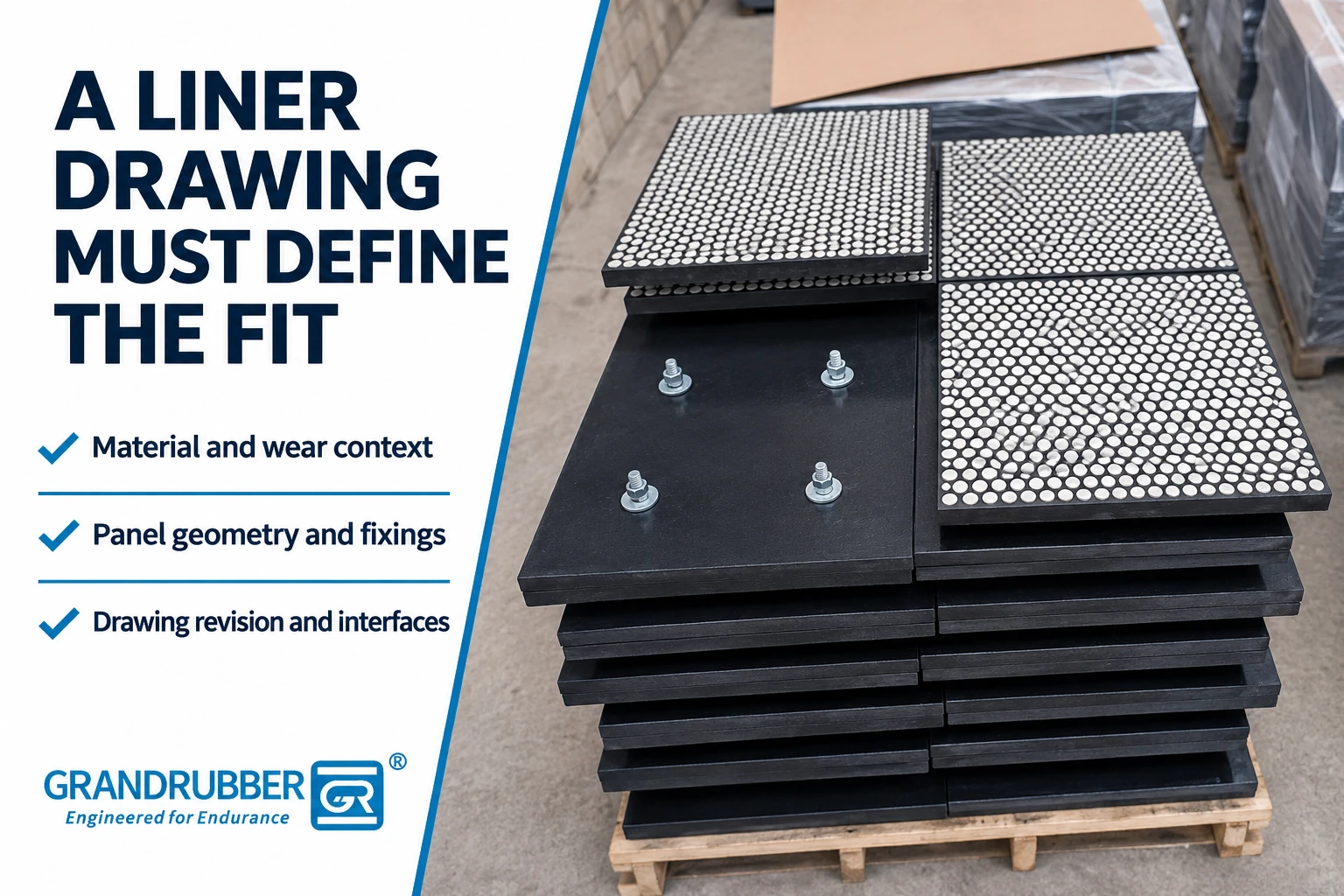
Prepare a liner drawing around the surface being protected, the material contacting it and the proposed attachment. A dimensioned rectangle is insufficient when holes, edges, backing plates or exposed fixing heads affect the installed interface. This guide defines an enquiry package; it does not design anchors or prescribe site installation.
Describe the protection task before selecting a material
Identify the equipment zone and what happens there: material slides, strikes, accumulates or contacts a chemical environment. Record the handled material and any known temperature or cleaning exposure. Distinguish an observed wear pattern from an assumed cause. A smooth liner selected for flow behaviour is not automatically the answer to a concentrated impact problem.
The components manual separates ceramic-rubber arrangements from polymer lining and a separate PTFE section. These are distinct proposals, with different material identities and mounting questions. A category description establishes what to ask about, not a universal ranking of service life.
Make the drawing describe an installed interface
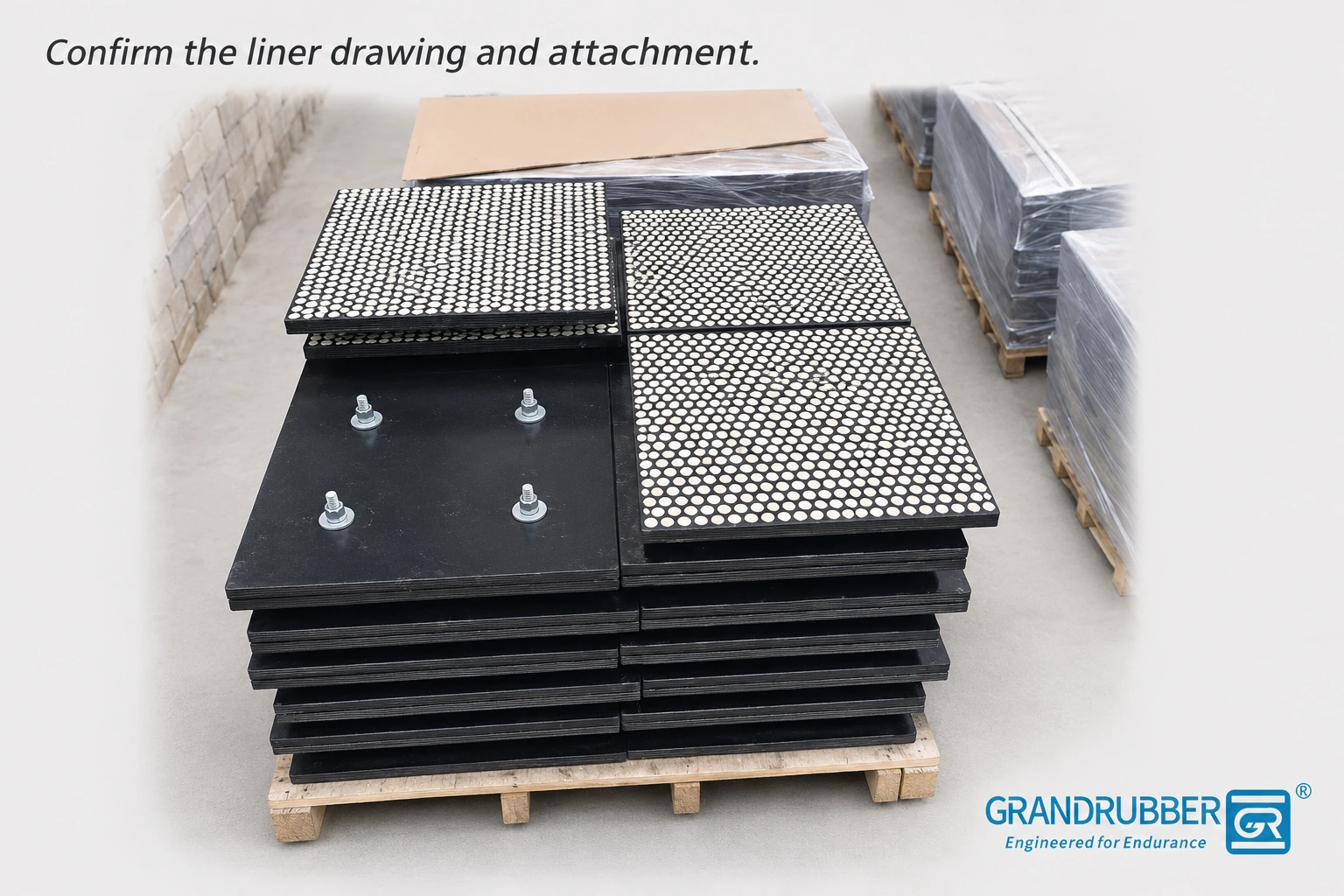
Include the substrate reference, available space, panel layout, thickness definition, holes or slots, orientation and edge treatment. Identify backing plates and proposed fixing components separately from the wear face. State whether dimensions come from an approved drawing or an unverified field record.
The first table is a drawing completeness check. If an existing installation is being copied, identify which worn dimensions remain reliable and which nominal dimensions require confirmation. Do not reconstruct an original profile solely from its worn remnant.
| Drawing area | Record | Why it matters |
|---|---|---|
| Protected zone | Equipment and substrate reference | Identifies the actual interface |
| Panel construction | Wear face, backing and total thickness | Separates material from assembly |
| Attachment | Holes, slots, fixtures and included parts | Exposes installation differences |
| Layout | Orientation, seams, edges and clearance | Shows installed boundaries |
Worked example: matching a panel does not match its duty
Assume a hypothetical buyer sends a photograph of a ceramic-rubber panel and asks for a polymer alternative with the same outline. The substrate and hole layout are known, but the impact location and permissible protrusions are not. No material, thickness or attachment is approved in this example.
Keep the geometry match and the duty assessment as separate decisions. Ask the supplier to identify the actual offered polymer and explain which duty information supports that proposal. Review the fixing interface and what changes at edges, seams and exposed fasteners.
The manual p19 visibly separates Polymer Lining and Teflon Anti-stick Lining. Its polymer paragraph prints 196°C; that text must not be given an invented minus sign or transferred to the separate PTFE product. Obtain controlled material-specific evidence for any temperature claim rather than converting a catalogue sentence into a design rating.
| Question | Required response | Open issue if absent |
|---|---|---|
| Material identity | Exact offered material and evidence | Category-only proposal |
| Duty | Impact/sliding/exposure record | Unknown suitability |
| Geometry | Marked outline and fixing differences | Nominal size only |
| Supply scope | Included components and review responsibility | Unassigned interface |
Request one marked drawing and an explicit supply boundary
Send the drawing, exposure record and material proposal through the relevant lining enquiry. Request a marked drawing identifying offered construction, attachment scope, exclusions and unresolved dimensions. The second table helps keep substitution questions attached to the actual item.
Ask who supplies plates, fasteners, bonding materials and any site work. A supply quotation alone should not be treated as an installation design or approval of the substrate. Keep the final accepted drawing revision with the order so a later panel cannot be supplied from an obsolete outline.
Buyer FAQ
Can I send a worn sample instead of a drawing?
It can support identification. Label worn or uncertain features and ask how the nominal geometry will be established; the sample alone does not confirm the original dimensions.
Does PTFE mean the panel can be mounted like rubber?
No mounting equivalence is established by the material name. Review the actual panel, substrate and attachment with the responsible parties.
Can a product picture establish the backing thickness?
No. Obtain the dimensioned construction or other item-specific evidence rather than measuring a photograph.
Must a supplier include fasteners in the panel price?
Only if included in the agreed scope. Identify quantities, types and responsibility separately; do not infer inclusion from catalogue illustrations.
Is a general chemical-resistance description enough?
Provide the actual medium, concentration, temperature and contact conditions. Request an assessment for the offered material; this guide supplies no compatibility rating.
Related technical resources
Related products
 NR40 Wear-resistant Rubber LiningsNR40 rubber lining sheets for fine-particle abrasive applications. Review material exposure, sheet thickness and surface options to define the lining and installation scope.NR40 Natural Rubber LiningNR40 natural rubber lining for fine-particle abrasive service. Review the medium, temperature, substrate and bonding arrangement to specify sheet thickness and the required supporting documents.
 Ceramic & Rubber Composite LinersCeramic and rubber composite liners in separate two-in-one and three-in-one formats. Specify tile layout, substrate, fixing, temperature and impact conditions before choosing the assembly.
 Polymer & PTFE LinersSeparate polymer and PTFE liner options for sliding and material-release interfaces. Confirm the exact material grade, medium, temperature and fixing arrangement before comparing properties.
Document and page references
- GRAND_RUBBER_Conveyor_Components.pdf, PDF pp16,17,18,19: Separate liner categories, constructions and p19 polymer/PTFE headings; no performance multiplier or temperature approval adopted.
- Decision tables, hypothetical examples and follow-up questions are editorial purchase-review aids; they are not customer cases, site instructions or technical approval.
- Polymer p19 printed 196°C retained as a source-clarification issue, not a verified service rating; PTFE claims kept separate.
Download the reference tables
Source-labelled review extract. Historical references remain historical; this is not a formal TDS, certificate or current availability confirmation.
Download guide tables CSV