
What must be checked for a pipe conveyor belt?
A pipe belt must be matched to the machine’s forming, overlap, route and opening interfaces as well as its nominal diameter. Review the existing design and offered construction together rather than deriving belt width from one remembered dimension.
On this page
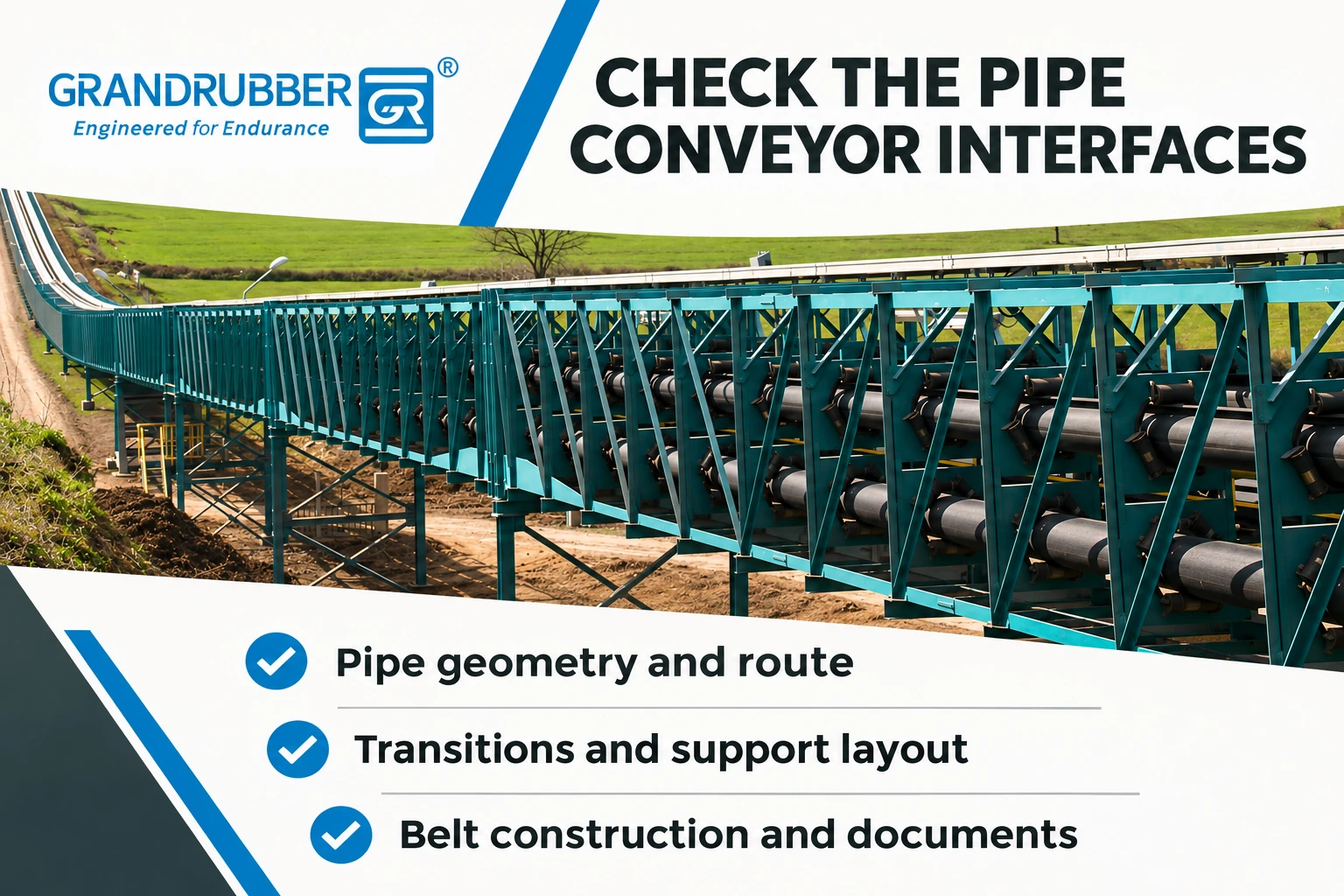 Open full-size image ↗
Check a pipe conveyor belt as part of an identified machine arrangement. Pipe diameter and belt width alone do not define how the belt forms, overlaps, follows the route and opens for loading or discharge. This is an interface-review guide, not a pipe-belt design formula or a conversion approval for a flat-belt conveyor.
Identify the closed and open portions of the system
The source manual describes a tailored carcass and transverse rigidity for the pipe section, with different behaviour needed near the overlapping edges. Its pipe-belt pages therefore belong with the actual forming and transition arrangement, not a width-only purchase line.
Provide the machine model or equipment drawing and identify loading, closing, curved route, opening and discharge portions where applicable. A route photograph may show context without establishing pipe diameter, overlap or hidden reinforcement.
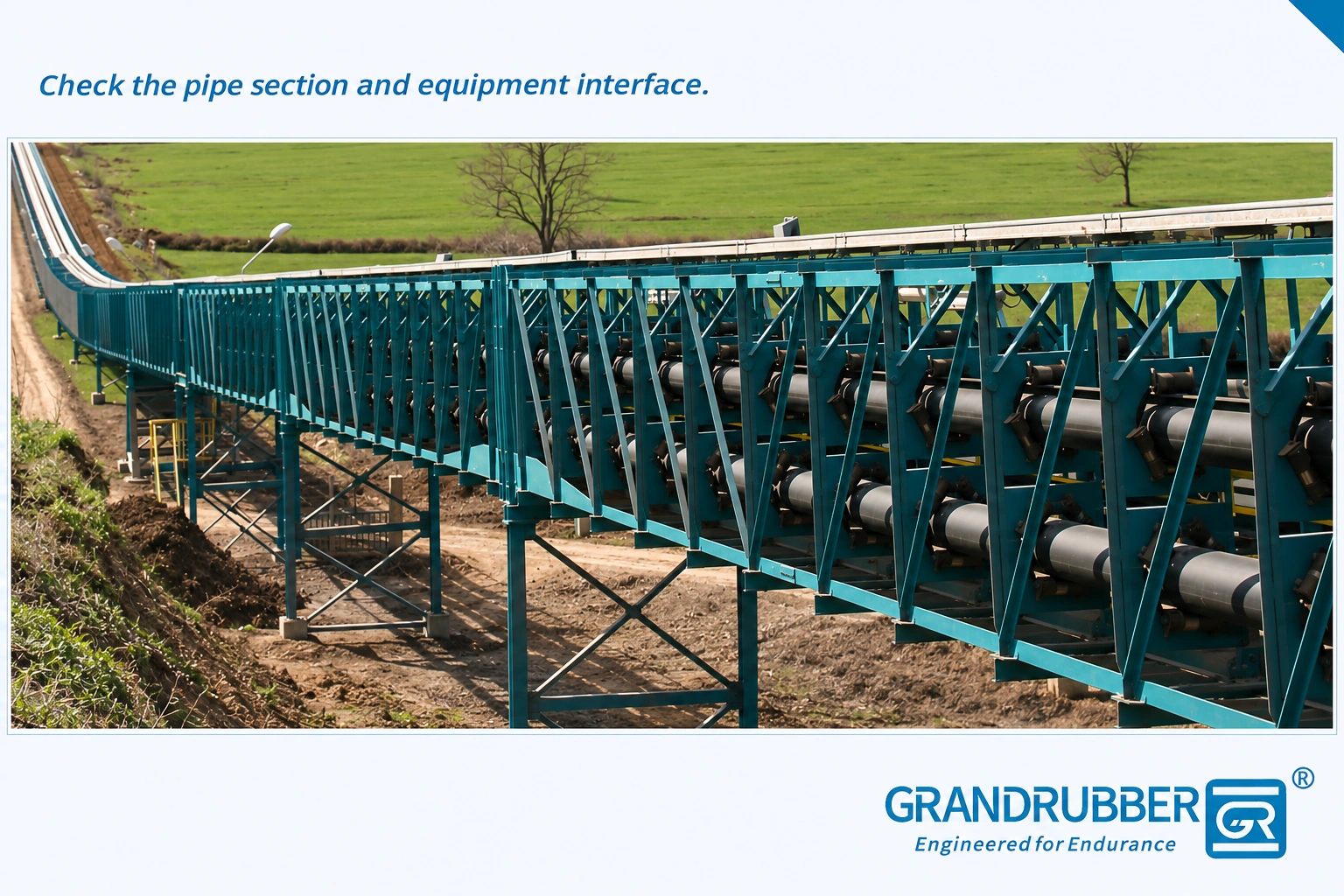
Keep geometry and construction in one interface sheet
Record the nominal pipe diameter and its reference, belt width, overlap definition, transition geometry and pulley arrangement from the equipment information. State the existing carcass and complete offered construction, including cover requirements and duty.
The first table lists interfaces to be reviewed, not default dimensions. If the existing construction or overlap basis is unknown, ask the design authority and supplier what evidence is needed. Do not substitute a generic width-to-diameter rule for the machine’s actual requirements.
| Interface | Reference needed | Question |
|---|---|---|
| Pipe section | Diameter and forming arrangement | What defines the required closed section? |
| Overlap | Drawing definition and orientation | How is the overlap specified? |
| Transitions | Opening/closing layout and pulleys | What construction response is required? |
| Route | Curves, length and actual duty | Which design assumptions must match? |
Worked example: a diameter match leaves the transition open
Assume a hypothetical replacement enquiry names a pipe diameter but lacks the forming/opening arrangement. A seller supplies a nominally related belt width and material description. No dimensions or allowable curve are approved in this example.
Ask for the applicable equipment reference and construction proposal, then identify which transitions and route constraints require review. A diameter label cannot confirm that the proposed belt closes and opens as required.
The second table makes the unresolved interfaces explicit. The first purchasing result may be an evidence request or a conditional proposal, rather than a declaration that the belt fits.
| Known item | Unresolved item | Next evidence |
|---|---|---|
| Nominal diameter | Forming geometry | Equipment drawing |
| Proposed width | Overlap and transition fit | Supplier construction/interface response |
| Route photograph | Actual design constraints | Controlled arrangement reference |
| Cover label | Complete belt and joining | Offer-specific specification |
Request an equipment-linked proposal
Send the current pipe-belt identity, route and interface drawings through the related pipe product enquiry. Ask the supplier to identify the actual proposed carcass and the engineering information its review assumes.
Keep any machine modifications and joining work separately assigned. A catalogue property such as rigidity is a discussion category, not a verified value for your equipment. No minimum curve, overlap dimension or installation adjustment is prescribed here.
Buyer FAQ
Can an ordinary belt be converted to a pipe belt by changing width?
No conversion is established by that change. Ask the responsible designer to evaluate the complete construction and machine; this guide does not approve such a conversion.
Does a similar pipe-conveyor photo identify the carcass?
No. Obtain product and construction records. A visible route cannot establish the internal reinforcement or its mechanical response.
What if the existing overlap is undocumented?
Record that gap and ask the equipment authority which drawing or authorized inspection can establish it. Do not assume another installation’s overlap applies.
Does a heat-resistant cover prove pipe-duty suitability?
No. Cover exposure and pipe-forming requirements need a combined review of the actual construction.
Can a catalogue dimension approve a curve?
Not by itself. Identify the actual route, operating conditions and design basis; no universal curvature limit is provided here.
Related technical resources
Related products
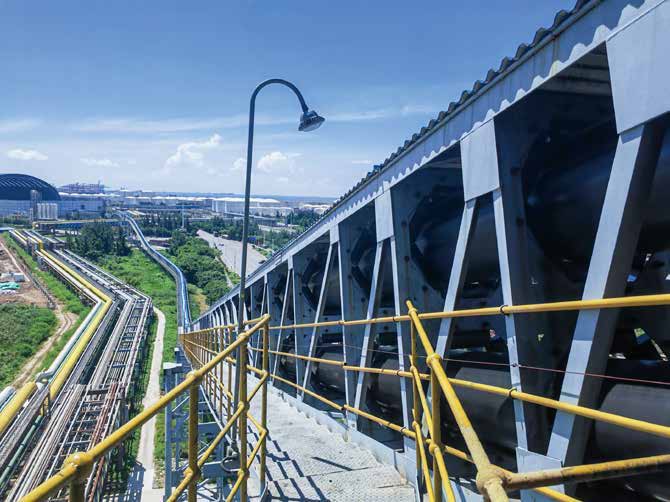 Pipe Conveyor Belts
Document and page references
- GRAND_RUBBER_Conveyor_Belts.pdf, PDF pp31,32: Pipe carcass/overlap and source schedule context; no design formula or dimensions recommended.
- Decision tables, hypothetical examples and follow-up questions are editorial purchase-review aids; they are not customer cases, site instructions or technical approval.
Download the reference tables
Source-labelled review extract. Historical references remain historical; this is not a formal TDS, certificate or current availability confirmation.
Download guide tables CSV