
What should a rubber filter belt drawing include?
Specify the drainage geometry and machine-contact interfaces together with the overall belt dimensions. Hole and groove layout, support, joining and slurry exposure need a common drawing basis before a filter-belt offer can be evaluated.
On this page
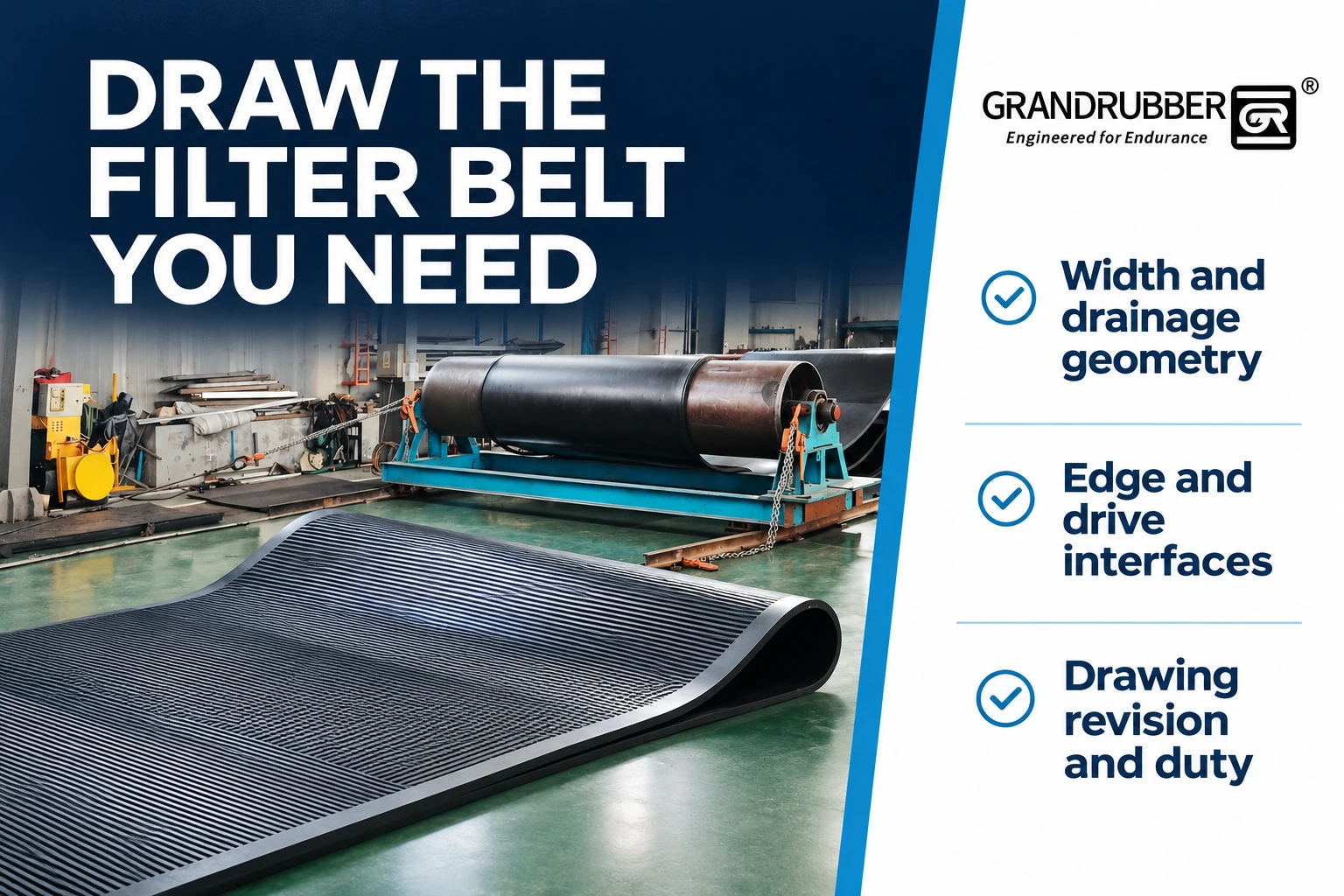 Open full-size image ↗
A rubber filter belt is not defined by overall width and length alone. Identify its drainage grooves and holes, machine support/sealing interfaces, construction and joining arrangement. This guide prepares a drawing review; it does not approve filtration capacity or choose a material from a catalogue limit.
Distinguish the belt outline from its working geometry
The source filter-belt pages identify the product family and construction/supply context. Their overall dimensional ranges do not define the hole or groove arrangement needed by a particular machine.
Supply the machine reference and a drawing showing the drainage pattern, direction and contact surfaces. Keep total thickness and individual covers distinguishable where specified. An apparently similar grooved photograph can identify a category while leaving the critical working geometry unknown.
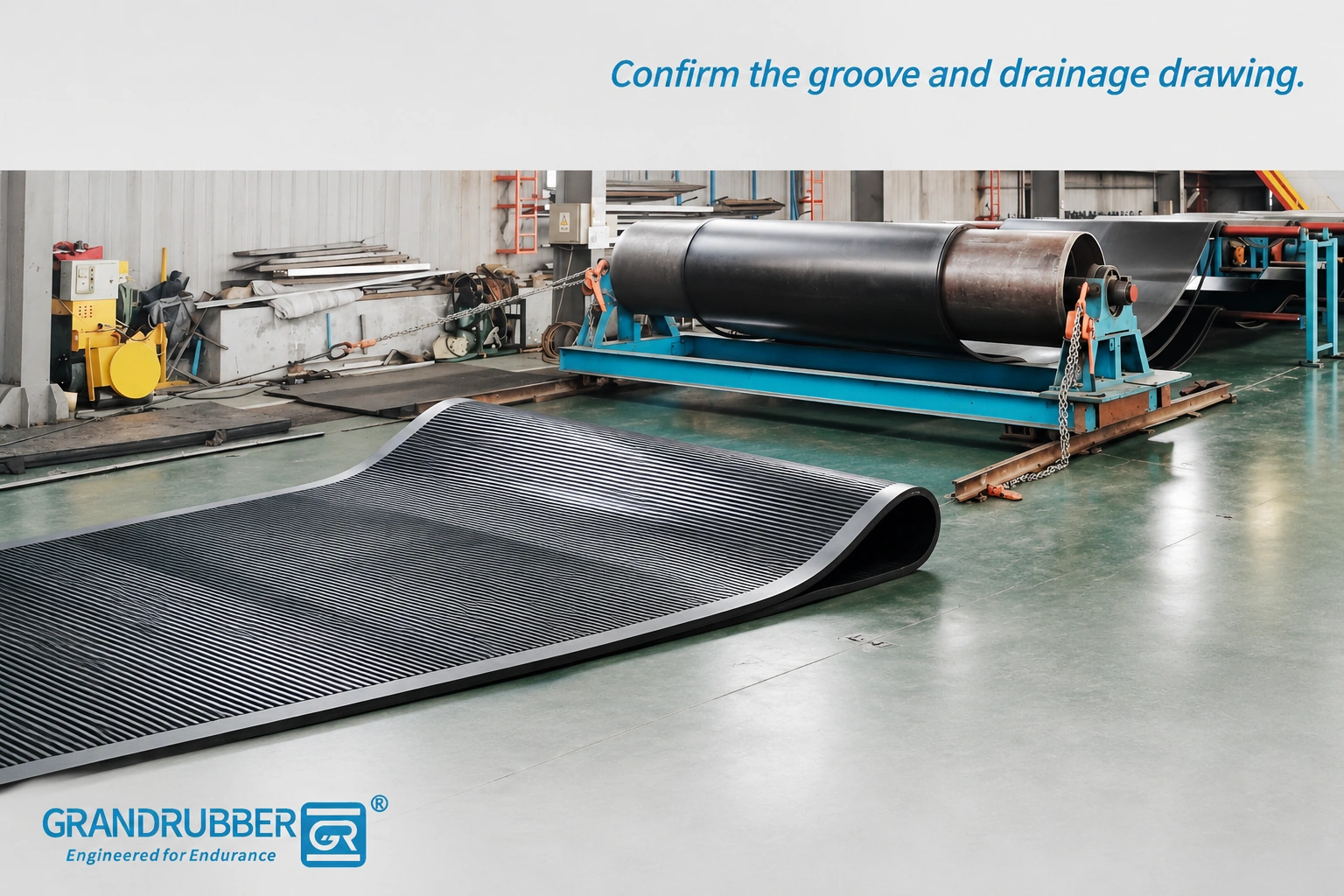
Record drainage, support and exposure interfaces
Provide groove pitch and form, hole pattern and position, edge details, vacuum-box or support interfaces and the finished length/joining basis. State the required tolerances through the controlling drawing rather than inserting catalogue-derived defaults.
Add slurry identity, solids condition, temperature and cleaning exposure with their known/unknown status. A general chemical-resistance option does not confirm compatibility with the actual mixture. The first table links the geometry and operating inputs so neither disappears inside a short product description.
| Area | Identify | Why overall size is insufficient |
|---|---|---|
| Drainage | Groove and hole layout/reference | Pattern registration remains unknown |
| Machine contact | Vacuum/support/sealing interfaces | A plain outline does not define fit |
| Construction | Covers, reinforcement and joint/supply form | Similar appearance can hide differences |
| Exposure | Slurry and cleaning conditions | A generic resistance label is incomplete |
Worked example: same outline, missing hole registration
Assume a hypothetical buyer supplies overall dimensions and a photograph but no hole layout or machine interface drawing. The seller identifies a filter-belt category. No hole dimensions, filtration result or chemical approval is assumed.
Request the working drawing and the meaning of the finished length, then ask how the proposed belt matches the support and drainage arrangement. Do not reproduce visible grooves from perspective photography and call the result an approved pattern.
The second table identifies the first evidence needed before a firm comparison. If source catalogues differ in size range, resolve the offered construction separately instead of combining their maxima.
| Available record | Do not infer | Request next |
|---|---|---|
| Photograph | Approved groove dimensions | Working drawing |
| Overall length | Finished loop/joining basis | Defined measurement and supply form |
| Catalogue range | Current offered size capability | Offer-specific confirmation |
| Material label | Actual mixture compatibility | Applicable material evidence |
Send a single machine-and-belt drawing pack
Use the related rubber filter-belt enquiry to send the controlled drawing, existing item identity, slurry/cleaning record and proposed supply form. Ask for a marked interface comparison and a list of open material or dimensional questions.
Keep the filtration-system performance assessment separate from the belt material quote. Catalogue descriptions do not establish a particular vacuum-system design, production rate or chemical compatibility; request the applicable current supporting documents for the actual offer.
Buyer FAQ
Can a photograph replace the hole pattern drawing?
Not as an unqualified approved definition. Use it to locate questions, then obtain the controlled geometry or an authorized measurement record accepted by the responsible team.
Are two overall-matching belts interchangeable?
No conclusion follows without checking drainage, support, construction and joining interfaces.
Can the widest catalogue range be used for the order?
Identify the actual offered construction and source revision first. Do not combine ranges from different documents.
Is slurry temperature enough for material selection?
Also identify the substance, mixture, contact and cleaning conditions. This guide gives no universal chemical or temperature approval.
Does a belt quote establish filter capacity?
No. The machine and process performance require their own assessment. The quote must state what belt and interfaces it actually supplies.
Related technical resources
Related products
 Rubber Filter Belts
Related buyer question
What should a rubber filter belt drawing include?
Define the drainage geometry and machine interfaces together with the overall dimensions.
Document and page references
- GRAND_RUBBER_Conveyor_Belts.pdf, PDF pp33: Filter-belt construction/application and source size context only.
- Catalogue_GRAND_RUBBER.pdf, PDF pp17: Actual visible filter-belt section on left; adjacent PVC/PVG material must not be mixed into the specification.
- Decision tables, hypothetical examples and follow-up questions are editorial purchase-review aids; they are not customer cases, site instructions or technical approval.
Download the reference tables
Source-labelled review extract. Historical references remain historical; this is not a formal TDS, certificate or current availability confirmation.
Download guide tables CSV