
Will a More Wear-Resistant Chute Liner Also Solve Material Build-Up?
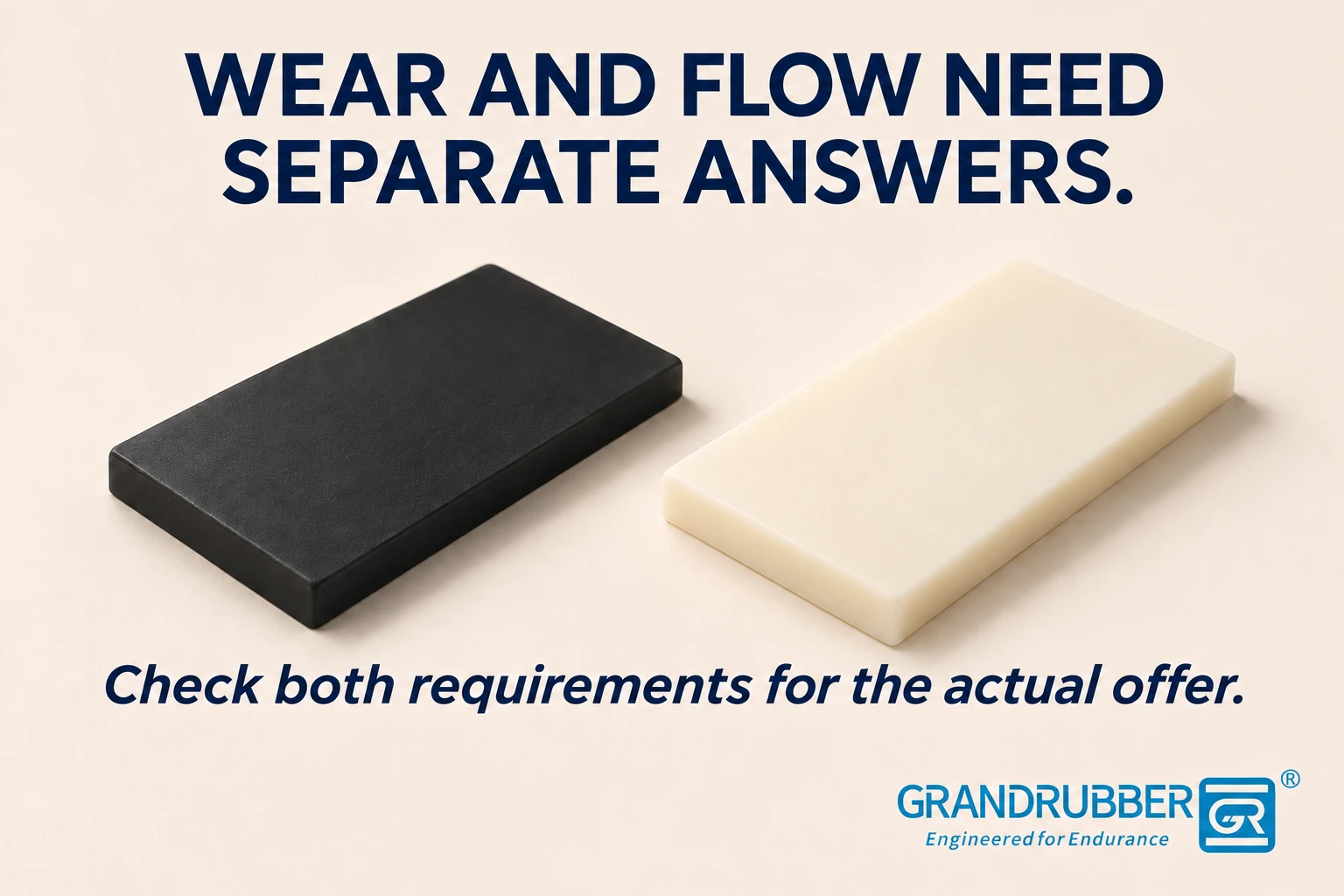
Do not assume improved abrasion evidence proves better discharge. Wear and material build-up are separate requirements that can involve different material and equipment inputs. Record the actual flow problem, conveyed material and geometry, then ask the responsible parties to assess the proposed lining against both requirements.
On this page
 Open full-size image ↗
Do not assume improved abrasion evidence proves better discharge. Wear and material build-up are separate requirements that can involve different material and equipment inputs. Record the actual flow problem, conveyed material and geometry, then ask the responsible parties to assess the proposed lining against both requirements.
Wear loss and retained material describe different problems
Wear concerns a change or loss in the liner under its actual exposure. Build-up concerns material retained where the process expects it to move. A low wear result and an observation of clear discharge are therefore not the same evidence, even when both matter to the same chute purchase.
Metso’s chute-lining guide discusses poor flow separately from wear and identifies adhesion/friction, inclination and moisture-related issues in its flow discussion. That supports asking separate questions about the actual problem. Its proprietary solutions, modelling capabilities and performance claims are not GR evidence.
Avoid a one-property corrective request. More wear resistant or harder may be a material requirement, but those words do not identify why material accumulates. Record the flow finding before assuming that a different abrasion grade will resolve it.
Describe the actual build-up and material context
Identify the location and form of the reported accumulation with dated site records where available. Keep the conveyed material description, known moisture/exposure information and relevant operating state connected to that observation. Do not infer a universal cause from a photograph of a blockage.
Provide actual chute/transfer drawings and any documented change in material or equipment relevant to the review. An input can be important without establishing a cause. The responsible system reviewer should decide what additional evidence is needed for the actual flow assessment.
The first table separates wear observations from flow observations and their inputs. It does not prescribe chute angles, water addition, heating, clearing methods or operating changes. Those are equipment/process decisions that cannot be chosen from a generic material-supply article.
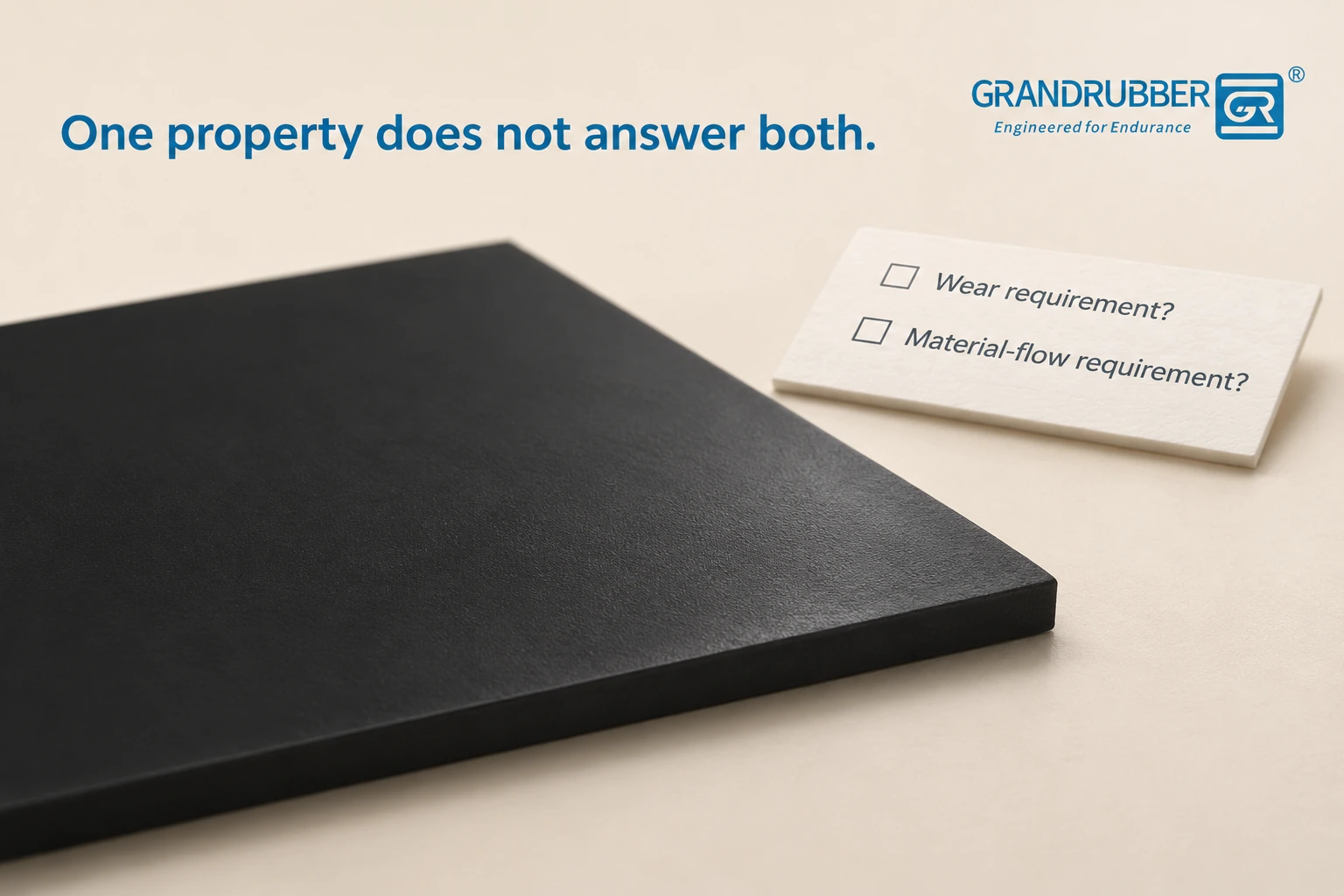
| Review line | Actual input/evidence | Does not establish alone |
|---|---|---|
| Wear | Located condition and applicable material evidence | Clear discharge |
| Build-up/flow | Actual accumulation, material and operating context | Long-term wear life |
| Geometry | Identified chute/transfer drawings | A universal material remedy |
| Proposed product | Actual grade/form and interface scope | All polymer or rubber categories are equivalent |
| Assessment | Responsible response to both requirements | One favourable property closes the whole duty |
Ask what each proposed material response actually addresses
For a wear claim, identify the actual material, evidence subject and applicable conditions. For a flow-related claim, ask what real material/geometry/exposure basis supports it. An abrasion number cannot simply be copied into an anti-stick or discharge-performance field.
A low-friction or polymer category is likewise not a complete chute solution. The actual offered material, attachment/interface and duty require their relevant assessment. GR’s category entry does not establish every polymer grade, a measured friction coefficient or a guarantee against blockage.
Keep both requirements visible where they coexist. Addressing one zone’s build-up should not silently discard its wear or impact requirement. Conversely, a successful wear proposal should not be represented as an answer to an unassessed flow issue. The competent parties need the complete actual duty before recommending a configuration.
Worked replacement: a wear certificate closes the discharge question
Assume a hypothetical chute enquiry reports material build-up as well as worn liner areas. One offer submits abrasion evidence and a harder-material description, and the comparison marks both wear and flow complete. No real performance figure, GR trial or customer case is represented.
The wear document should stay attached to the actual property it addresses. Reopen the flow requirement and ask what evidence or responsible assessment relates the proposed liner to the actual accumulation, material and geometry. The missing answer is not supplied by increasing the hardness heading.
Another offer may propose a low-friction material but leave the wear and impact requirements unanswered. That is the opposite gap, not automatic proof of a better complete solution. Ask the same structured requirements of both proposals and preserve their actual limitations.
The second table organizes those clarification paths. It avoids a universal rubber-versus-polymer ranking and makes the trade-offs visible for the actual equipment review, without claiming a particular proposal will improve throughput.
| Proposal | Supported subject | Remaining clarification |
|---|---|---|
| Abrasion evidence and harder material | Actual stated wear property | Applicable build-up/flow assessment |
| Low-friction description only | A proposed material direction | Actual grade, duty and wear/impact evidence |
| Clear-discharge photograph | One visible operating observation | Comparable context and separate wear basis |
| Trial with changed feed/geometry | Changed system context | Which outcome can actually be attributed to what? |
Evaluate trials or changes against defined and comparable observations
If the project uses a trial, define through its responsible process what is being compared and which actual material, equipment and operating state are represented. Keep a change in feed or geometry visible rather than attributing every observed difference to the liner.
Record wear and flow outcomes separately with their actual basis. A clean-looking photograph does not establish long-term wear, and a wear measurement does not establish uninterrupted discharge. Do not invent percentage improvements or turn a limited observation into a lifetime guarantee.
Where a proposed change affects the chute system, retain the competent equipment assessment and actual scope. GR material supply is not confirmation of DEM modelling, site redesign or blockage-clearing service. The commercial scope should reflect the true supplied product and separately assigned responsibilities.
Send a two-requirement lining enquiry
Provide the actual material/geometry references, located wear and build-up observations and available exposure context. Ask GRAND RUBBER what material forms and relevant documents it can supply, with the flow/system assessment assigned to its actual responsible parties.
Use the liner-drawing guide for part/interface identity and the rock-box guide for its distinct transfer-arrangement question. Here the decision is whether evidence of wear resistance has been used to close a separate material-flow requirement without a basis.
The next action is one comparison with separate wear and flow lines for the same proposed material and equipment context. Retain unassessed requirements and any changes explicitly before treating an abrasion-grade upgrade as a complete discharge solution.
Buyer FAQ
Does better abrasion resistance guarantee less build-up?
No separate flow outcome is established by an abrasion result alone. Assess the actual flow requirement and duty.
Will harder rubber always improve discharge?
No universal relationship is asserted. Identify the actual accumulation and applicable material/system response.
Is a polymer category automatically an anti-blockage solution?
No. The actual grade, interfaces and duty need review, and no GR blockage guarantee is given.
Can moisture or angle be changed from this guide?
No operating or geometry change is prescribed. Obtain the actual competent process/equipment assessment.
Does a clear chute photo prove wear life?
No. Retain the actual observation and assess wear with its own applicable evidence.
Does GR material supply include modelling or site redesign?
Those capabilities and services are not established here. Define the actual supply and system-review scopes separately.
What should the next comparison show?
Separate wear and flow requirements linked to the same actual material proposal, equipment context and responsible responses.
Sources
Related technical resources
Related products
 Mining Rubber SheetsRubber sheets with catalogue 10 MPa and 15 MPa grades for mining wear-protection locations. Compare abrasion, impact, dimensions and attachment conditions before choosing a grade.
 Polymer & PTFE LinersSeparate polymer and PTFE liner options for sliding and material-release interfaces. Confirm the exact material grade, medium, temperature and fixing arrangement before comparing properties.
Document and page references
- Metso — Three Common Chute Lining Challenges: Printedpp6–8 / PDFpp6–8 poor flow, adhesion/inclination/moisture versus wear. Conceptual separation of flow and wear requirements only. No proprietary products/images, DEM capability, numeric friction/flow guarantee, remedial chute modification or GR anti-blocking claim.
- Editor-derived evergreen purchasing analysis; hypothetical examples are not real cases, field results or approved operating procedures.
Download the reference tables
Source-labelled review extract. Historical references remain historical; this is not a formal TDS, certificate or current availability confirmation.
Download guide tables CSV