
What bucket-elevator drawing and capacity details should you send?
A bucket-elevator belt enquiry needs the complete equipment interfaces, duty and offered construction. A lifting-height/capacity illustration is not a project calculation, and a belt-width match does not establish the bucket-hole or joining arrangement.
On this page
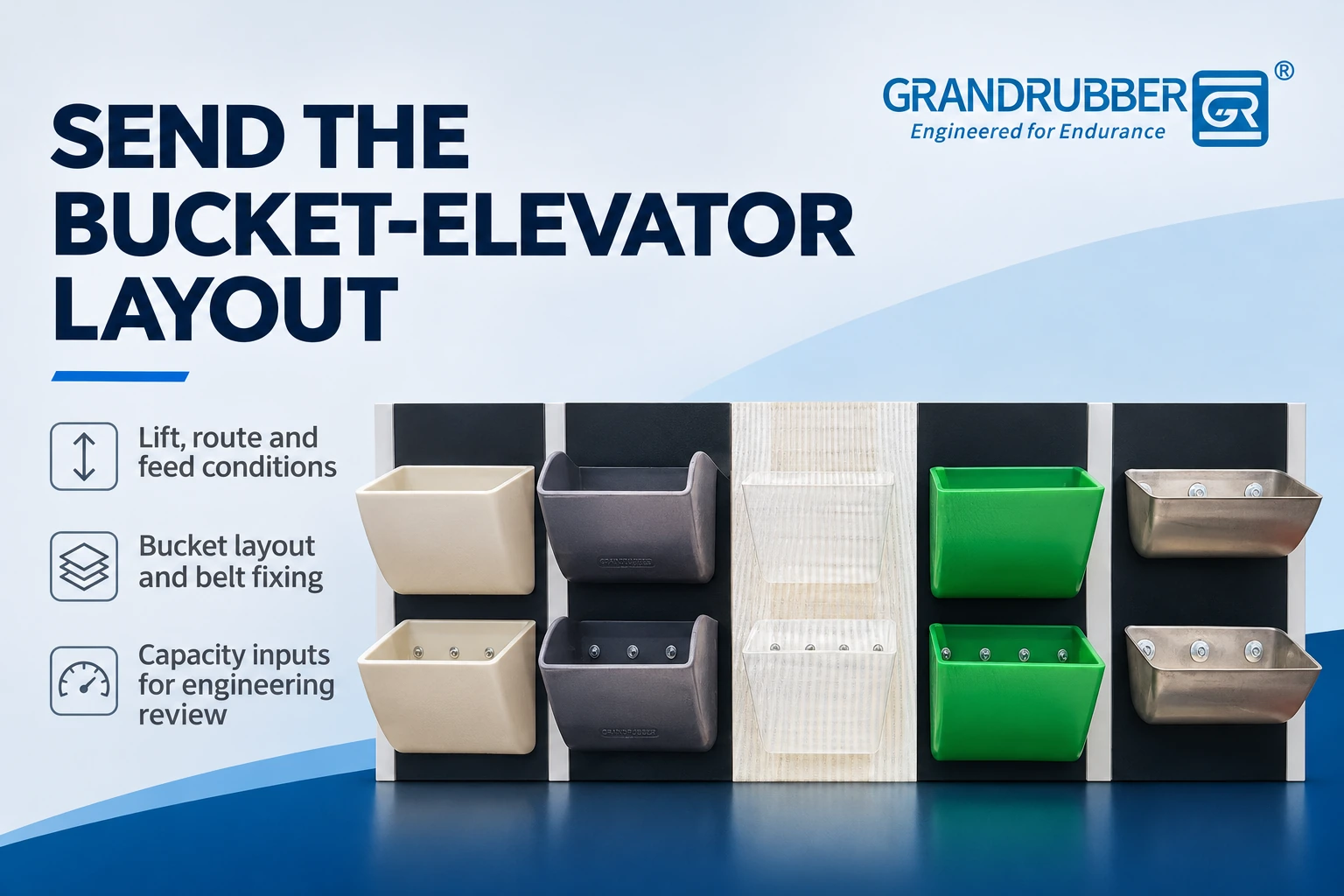 Open full-size image ↗
Identify the elevator and its bucket, attachment, pulley and joining interfaces before requesting a replacement belt. State the required throughput with its material and operating basis. This guide prepares a layout handoff; it does not size the elevator or approve a capacity or drilling pattern.
Identify the machine and the complete belt task
Provide the equipment reference, route/lift information, existing belt identification and reason for the enquiry. Distinguish a replacement that retains buckets from a proposal that changes buckets, attachment or belt construction. Similar nominal width does not establish an unchanged assembly.
The conveyor manual p34 visibly identifies dedicated bucket-elevator belt constructions, a lifting-height/capacity chart and a construction table. These are catalogue references, not an equipment-specific design. Request the actual offered construction and the responsible equipment review.
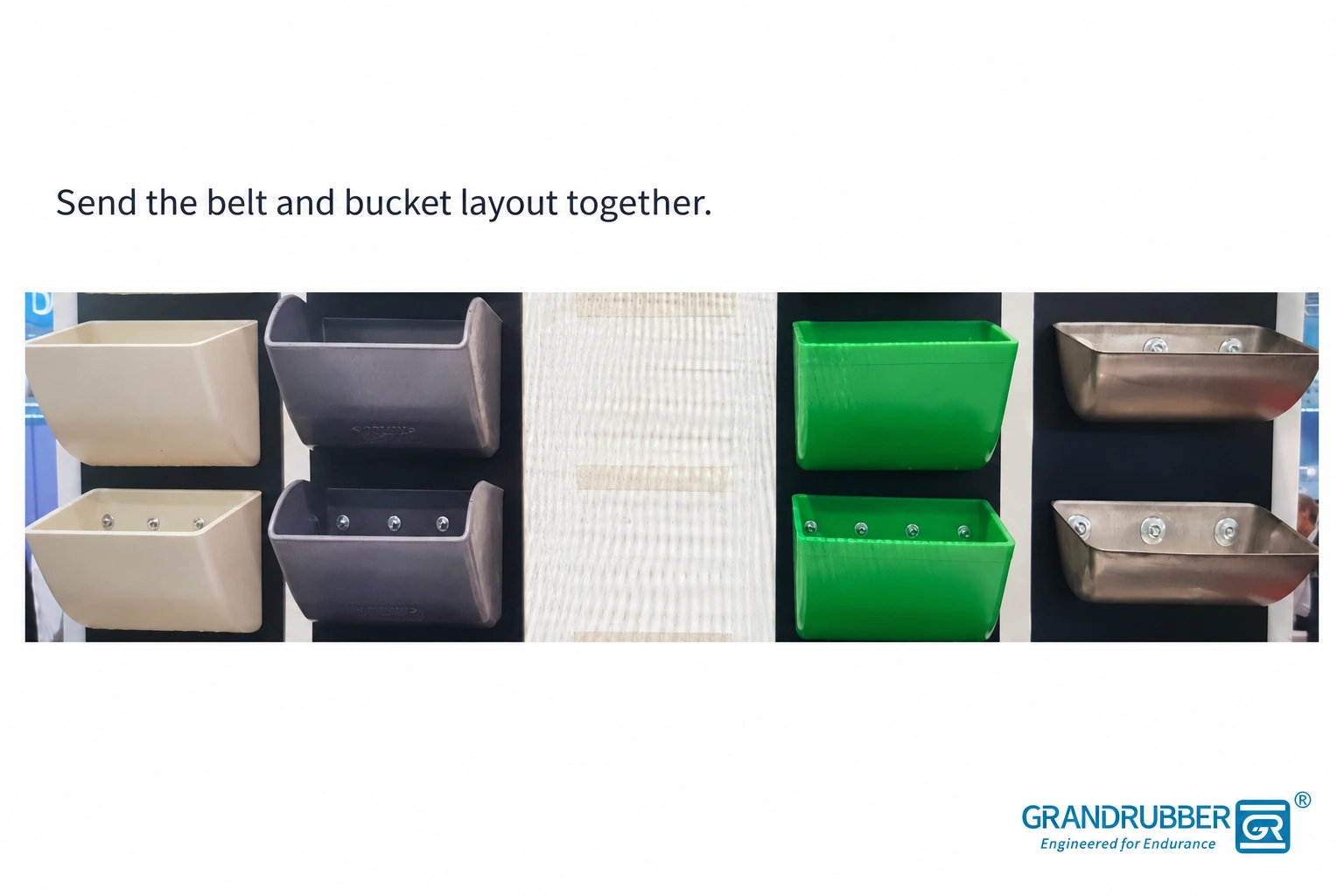
Keep duty and attachment geometry together
Send the actual material, required throughput and operating basis with the equipment drawing, bucket layout, hole pattern and joining reference. Identify dimensions by their drawing definitions rather than translating every lift figure into an assumed shaft distance.
The first table lists the interface record. A capacity request needs its actual units and assumptions. A supplier’s general chart does not fill missing density, operating or equipment information, and a catalogue picture cannot establish hole centres.
| Decision | Existing source basis | Buyer input to supply |
|---|---|---|
| Throughput | Lifting-height / conveying-capacity reference chart; not a project calculation | Required throughput, material and operating basis |
| Geometry | Dedicated elevator construction table; no bucket-hole drawing established | Actual belt width, bucket drawing, hole layout and equipment dimensions |
| Construction | Regular/reinforced construction categories | Existing full designation, reinforcement, covers, splice and accessory scope |
| Duty | Vertical bulk-material handling | Material temperature, density, duty and acceptance requirements |
Worked example: a width match leaves the hole layout unresolved
Assume a hypothetical replacement offer matches the stated belt width and names an elevator-belt category. It does not identify bucket pitch, attachment holes or joining scope. No dimensions, filling ratio or capacity are assigned.
Request one marked construction/layout proposal against the equipment reference. Confirm which existing buckets and accessories remain and who verifies compatibility. A belt-only offer can be valid commercial scope while still leaving a critical interface pending.
The second table records the required replies. If construction changes, ask how the responsible parties will assess the complete assembly. Do not copy an attachment detail from another machine or let a general lifting chart become proof of the proposed installation’s throughput.
| Interface | Required response | Open if absent |
|---|---|---|
| Duty | Actual throughput/material basis | Unverified capacity |
| Buckets/holes | Applicable drawing and retained parts | Width-only match |
| Belt/joining | Complete offered construction and interface | Category-only proposal |
| Supply/acceptance | Included parts and responsible review | Unassigned assembly boundary |
Release a layout-linked supply schedule
Send the equipment drawings and duty record through the bucket-elevator belt enquiry. Request the offered belt construction, attachment/joining references, included accessories, departures and unresolved design inputs. Keep the accepted drawing revision linked to the order.
Hole manufacture, installation and commissioning need their own agreed responsibilities and controlled documentation. This article gives no drilling instructions or operating settings. If an equipment dimension is unknown, obtain it from a reliable design record or responsible assessment rather than infer it from the catalogue graphic.
Buyer FAQ
Can a general capacity chart approve my elevator?
No. Obtain the equipment-specific assessment using the actual material and operating basis.
Does matching belt width establish matching holes?
No. Confirm the applicable bucket attachment drawing and hole layout separately.
Are buckets and clamps included with a belt?
Only if included in the agreed offer. Identify belt, accessories and site tasks as separate scope entries.
Can the existing buckets be reused automatically?
No such approval follows here. Identify their condition and interface and request the responsible compatibility assessment.
What should I send if the original drawing is missing?
Provide reliable equipment identification and available authorized records, mark uncertain dimensions and ask what further assessment is needed. Do not reconstruct a critical pattern by guesswork.
Related technical resources
Related products
 Bucket Elevator Belts
Document and page references
- GRAND_RUBBER_Conveyor_Belts.pdf, PDF pp34: Actual visible elevator section, construction table and lifting-height/capacity illustration; no project design approval.
- Decision tables, hypothetical examples and follow-up questions are editorial purchase-review aids; they are not customer cases, site instructions or technical approval.
Download the reference tables
Source-labelled review extract. Historical references remain historical; this is not a formal TDS, certificate or current availability confirmation.
Download guide tables CSV