
Conveyor skirting or dust curtains: what should you specify?
Choose belt-edge skirting and transfer-point dust curtains by their different jobs and mounting interfaces. A strip that seals near the belt is not automatically a substitute for a curtain controlling the transfer opening.
On this page
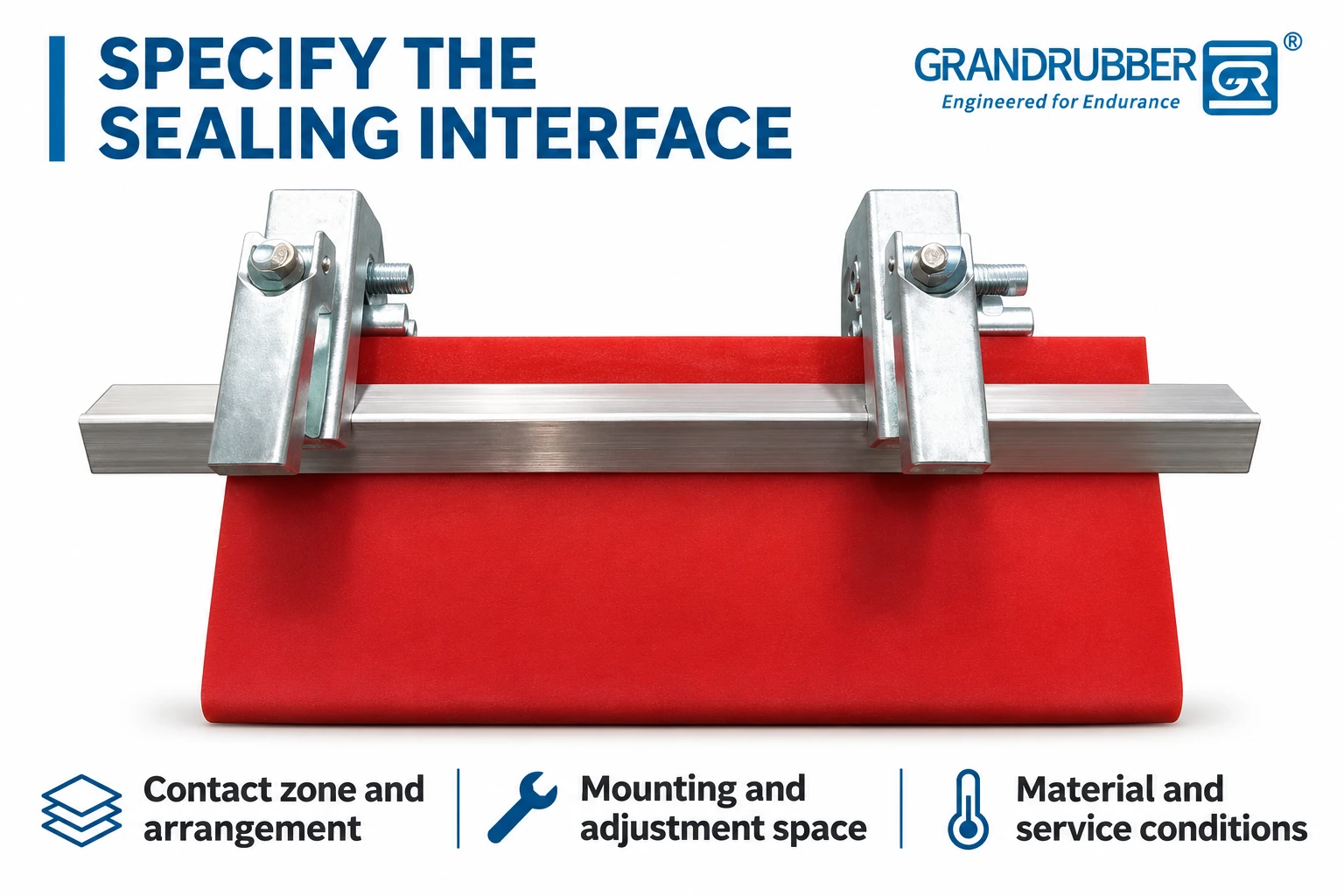 Open full-size image ↗
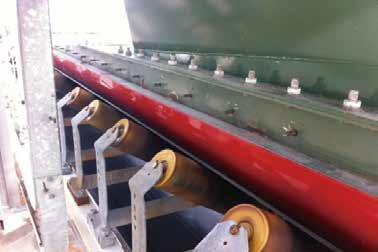
First identify whether the requirement concerns leakage at a belt edge, containment across a transfer opening, or both. Then define the actual skirting profile or curtain form and its mounting arrangement. Product names and a photograph of rubber strips do not establish which assembly is needed.
Name the containment task and the product form
The components catalogue separates skirting products from dust curtains. Its curtain page lists slit, solid and strip forms; the skirting pages show profiles and material options. These are distinct retrieval categories, not interchangeable solutions with proven site performance.
Record where material or dust is observed and what the existing assembly is intended to do. A dusty transfer can have several evidence gaps; do not conclude from a photograph that adding a particular seal or curtain resolves the cause.
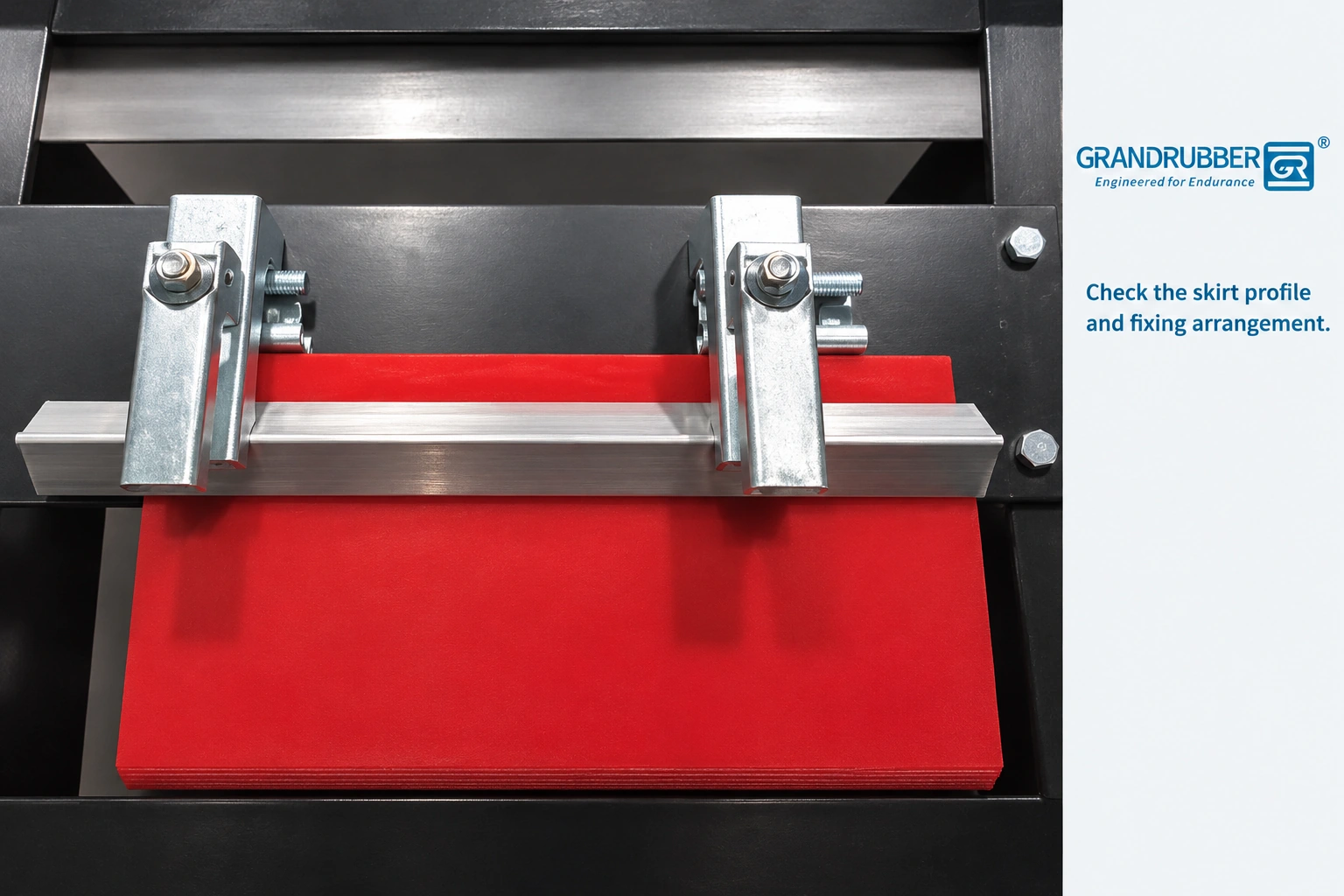
Define the mounting and working interfaces
For skirting, identify profile, width/thickness, free length and retaining arrangement from the drawing. For curtains, identify form, drop length, opening and fixing. Supply belt support/loading information where it affects the reviewed interface.
State material, temperature, dust/spillage observations and any specified grade or safety requirement as actual inputs. The first table keeps the two product definitions separate. Catalogue options such as flame-retardant or anti-static wording require identification and evidence for the offered product, not a blanket assertion.
| Product task | Identify | Do not assume |
|---|---|---|
| Belt-edge seal | Profile/free length and retainer | Any curtain fits the same mounting |
| Transfer curtain | Slit/solid/strip, drop and fixing | A skirting strip defines the opening |
| Material duty | Substance/exposure and required grade | All listed options apply together |
| Assembly scope | Rubber, hardware and site tasks | Material supply includes installation |
Worked example: a curtain is offered against a seal request
Assume a hypothetical enquiry says dust rubber while its drawing shows a belt-edge retaining assembly. A supplier proposes a curtain product. No dimensions or containment improvement are assumed.
Ask the buyer to confirm the task and the depicted interface, then have the supplier identify the matching product form. If both a seal and curtain are needed, create separate supply lines rather than replacing one silently.
The second table turns the ambiguous name into a reviewable scope. It does not prescribe a contact pressure, gap or installation adjustment.
| Evidence | Question | Result to record |
|---|---|---|
| Existing drawing | Which task/interface is shown? | Seal or curtain line identified |
| Observed leakage | What is known about location? | Observation, not a diagnosis |
| Supplier proposal | Which product and fixing? | Defined scope/departures |
| Grade label | Which product evidence applies? | Open or supported requirement |
Send one task-and-interface sheet
Use the appropriate skirting or dust-curtain product enquiry with the labelled transfer drawing, existing arrangement and unresolved observations. Ask which material, profile and fixing items the offer includes.
Separate rubber supply from retaining hardware, preparation, installation and performance assessment. A catalogue drawing cannot confirm the condition of an existing belt support or prove dust compliance at the site. Request the applicable technical and site review rather than a generic containment guarantee.
An impact curtain is a different task from a dust curtain
Before pricing a rubber curtain, ask whether it controls airborne dust at an opening, seals alongside the belt or is deliberately placed in the material stream to receive impact. The word curtain does not establish interchangeable construction or support requirements.
Reglin’s discharge-chute case describes a flexible impact curtain with a localized rubber block for the impact zone. It is a supplier-specific example of a different task, not a GRAND RUBBER impact-curtain model or a performance result for another site. Its material code, life claims and local installation capability are not adopted. The distinction supports a scope question before any product is offered.
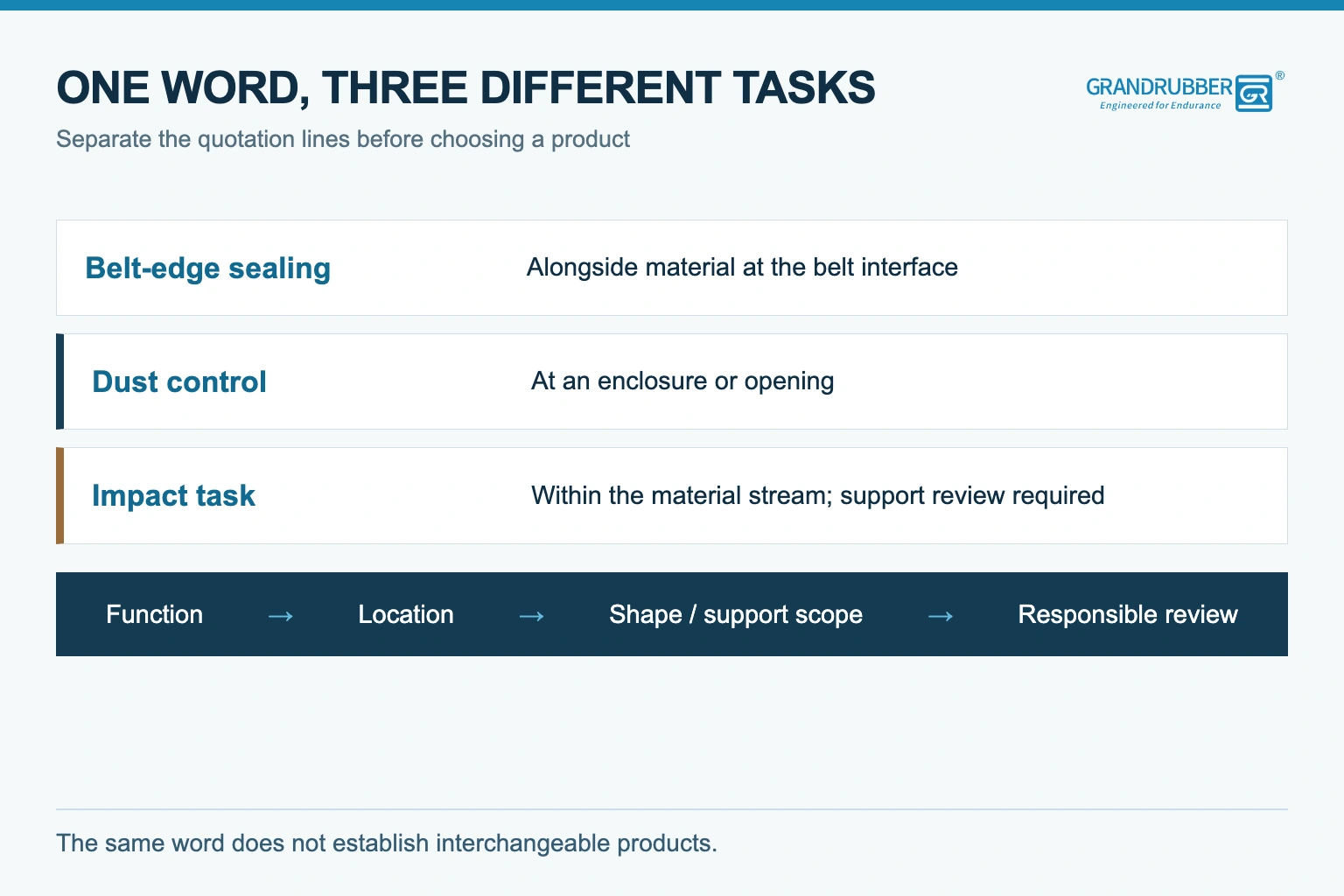
Worked quotation: the same word hides two installation positions
Assume a hypothetical request calls for a rubber curtain but shows one location at an enclosure opening and another in the discharge stream. One bidder offers a light dust-control form. No material thickness, mass, support load or approved design is assigned.
Split the request into task-labelled lines and obtain the proposed shape, position and support/interface information for each. If impact is intended, ask the responsible equipment reviewer what loading, attachment and access assessment is needed. Do not present a dust curtain or skirting strip as an accepted impact structure because it is also made from rubber.
The added table keeps function and supply scope visible. A material supplier may be able to discuss a sheet or custom part while the complete impact-curtain assembly remains outside verified supply. State that boundary rather than implying that a generic catalogue product is an engineered chute solution.
| Task | Location/question | Do not substitute |
|---|---|---|
| Belt-edge sealing | Alongside material at belt interface | An opening curtain by name alone |
| Dust control | Enclosure/opening and clearance task | An unassessed impact structure |
| Impact curtain | Actual material-stream and support duty | Thin dust curtain or generic strip |
| Material-only scope | Sheet/part identity and drawing | Complete designed assembly |
Request the shape and support scope with the material line
For each proposed item, identify the actual drawing revision, material identity, mounting/retaining components and who accepts the equipment interface. Keep the material mass and any support design question with the responsible technical parties; this article calculates neither.
GRAND RUBBER’s listed skirting and dust-curtain categories remain material starting points. Availability of a specific impact-curtain assembly or block arrangement requires separate confirmation. Ask for a marked response against the defined task and retain unresolved items. The next purchase decision should compare identified proposals, not three different functions entered under one curtain code.
Buyer FAQ
Can I order just from strip width?
No. Identify the form, thickness/profile, working length and mounting drawing as well as the actual task.
Does a dust curtain eliminate the need for skirting?
Not as a general rule. They address different interfaces; the actual transfer arrangement needs assessment.
Are retainers included with skirting rubber?
Ask explicitly. A rubber-material line does not define hardware or installation scope.
Does black rubber establish the required compound?
No. Tie the material identity and relevant evidence to the offered product.
Can an anti-static catalogue option prove site approval?
No. Identify the actual requirement, product and supporting evidence. A category label is not a project acceptance record.
Does rubber curtain identify a single product category?
No. State the function, installation position and interface; dust control and impact protection can require different proposals.
Does a thick strip establish an impact-curtain design?
No. The complete shape, support, material duty and acceptance scope need the appropriate review.
Can I order the competitor’s material code as a GR equivalent?
No equivalence has been verified. Ask for the actual offered material and evidence against the defined task; do not transfer the other supplier’s code or claims.
Sources
Related technical resources
Related products
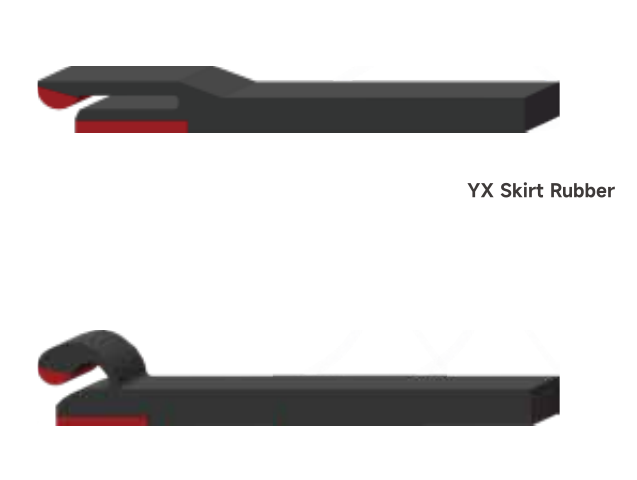 Rubber & PU SkirtingRubber and polyurethane skirting parts for conveyor transfer-point sealing. Match the profile, clearance and mounting arrangement to the belt surface and conveyed material.
 High-abrasion SkirtingCatalogue skirting grades for transfer-point dust and spillage-control review. Confirm thickness, width and retaining arrangement against belt contact and material conditions.
 Conveyor Dust CurtainsSlit, solid and strip curtains for conveyor transfer-point openings. Specify the opening, mounting and material flow, then review temperature and maintenance access.
 Rubber Skirtboard SheetRubber skirtboard sheet for conveyor transfer-point interfaces. Specify sheet dimensions, holder and contact conditions, then confirm the actual grade and property combination.
Document and page references
- GRAND_RUBBER_Conveyor_Components.pdf, PDF pp7,8,9,10: Skirting profiles and distinct curtain forms/options; no numeric service limits or site performance approved.
- Decision tables, hypothetical examples and follow-up questions are editorial purchase-review aids; they are not customer cases, site instructions or technical approval.
- Reglin: supplier-specific impact-curtain case: Project Overview/Solution: supplier-specific impact curtain and localized block, not dust curtain equivalence.
- New comparison/checklist entries and worked examples are editorial review aids, not measured results, approved specifications or real customer cases.
Download the reference tables
Source-labelled review extract. Historical references remain historical; this is not a formal TDS, certificate or current availability confirmation.
Download guide tables CSV