
Foam Gasket Closing Force: Why Is Density Alone Not Enough?
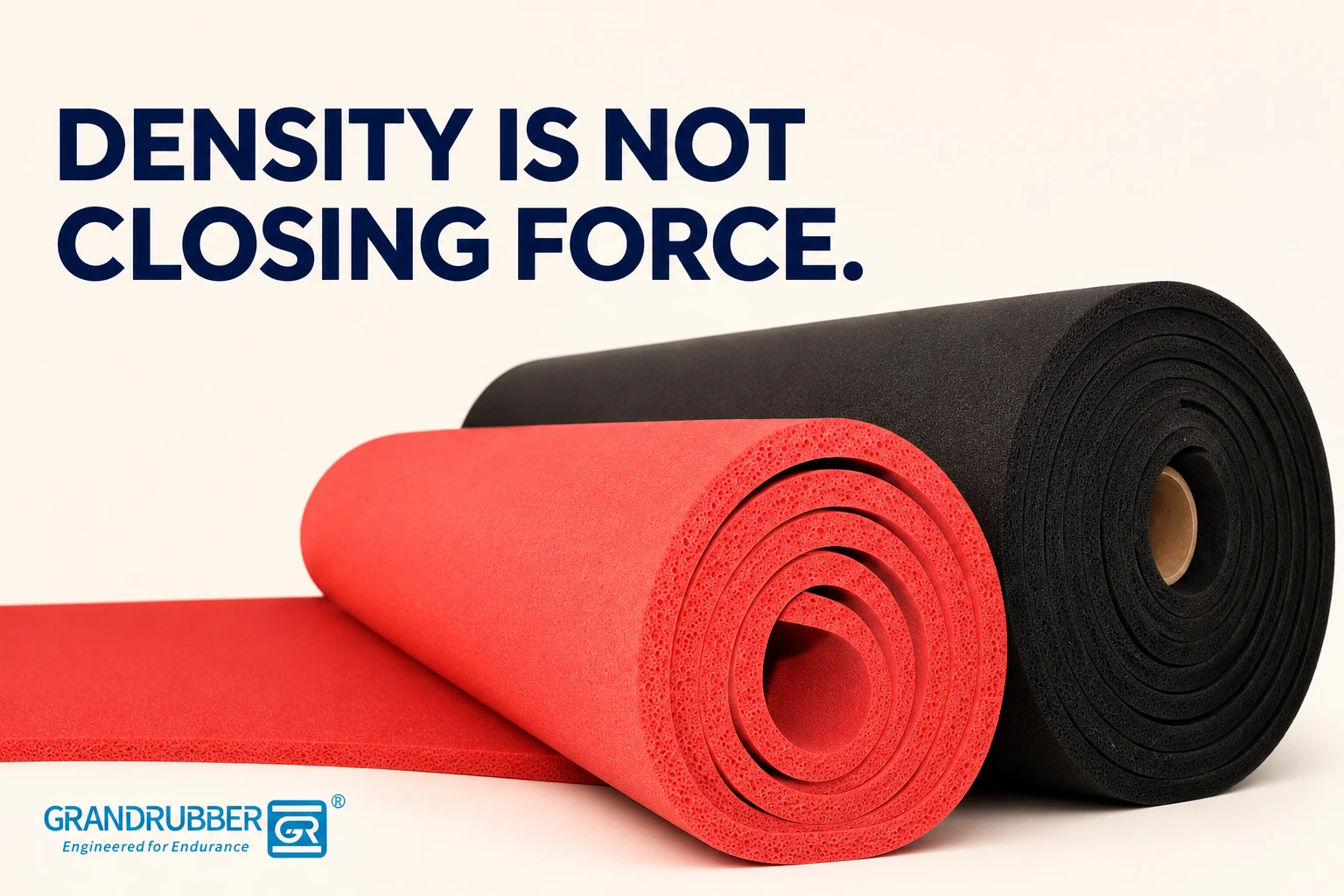
Density is not a closing-force specification. Ask for the offered foam’s compression-force-deflection data and the actual gasket geometry and assembly requirement. Keep material response, total gasket force and the equipment’s closing mechanism separate; a curve for another supplier’s foam is not data for the proposed sheet.
On this page
 Open full-size image ↗
Density is not a closing-force specification. Ask for the offered foam’s compression-force-deflection data and the actual gasket geometry and assembly requirement. Keep material response, total gasket force and the equipment’s closing mechanism separate; a curve for another supplier’s foam is not data for the proposed sheet.
Density and compression force have different meanings and units
Density describes mass relative to volume. A closing-force question concerns the mechanical response of the material and the actual assembly. Two foam offers with the same density entry have not, merely by matching that number, established the same compression response or equipment closing requirement.
Rogers’ sealing guide uses compression-force-deflection, CFD, curves to present its materials’ response at different compressions. The relevant lesson is to identify the response curve and its conditions, not to use density as a substitute. The guide’s data describe its named polyurethane and silicone products; they are not test curves for GR EPDM sponge.
Ask the supplier what quantity is actually reported. A graph labelled compression force may use stress or pressure units such as kilopascals, while an equipment requirement may be a force in newtons. The axes and reporting basis must be understood before anyone treats the graph as a complete answer to a latch or door question.
Specify the actual foam, specimen basis and gasket geometry
Identify the offered grade and supplied form, not only the polymer name. Request the applicable CFD data or other stated compression-response evidence and the conditions used. Keep specimen thickness, relevant material direction or form and the report’s actual basis visible where provided. An unlabelled curve copied from another material cannot identify the proposed sheet.
Provide the gasket drawing and the relevant assembly gap or closure requirement through the responsible equipment review. A narrow strip and a broad face gasket can involve different contact areas even when the material and nominal thickness match. The supplier needs to know what its material proposal is intended to serve.
The first table separates the material data from the assembled requirement. It does not choose a compression percentage or an acceptable closing force. If the relevant input is unknown, retain it as unknown and ask the equipment authority to establish it rather than filling the field with a catalogue example.
| Quantity | Required basis | Not interchangeable with |
|---|---|---|
| Density | Mass/volume and identified material | Closing force |
| Compression response | CFD or actual stated test data, axes and conditions | Another grade’s curve |
| Gasket geometry | Actual drawing, contact form and relevant gap | A specimen size from a brochure |
| Assembly force | Responsible assessment of material and geometry | An assumed handle force |
| Final disposition | Accepted material and equipment requirement | A softness or density adjective |
Understand pressure-to-force arithmetic without treating it as a latch design
A useful dimensional check is force equals pressure multiplied by area when the stated simplifying assumptions apply. As a purely hypothetical example, a uniform pressure of 100 kilopascals acting over 0.001 square metre corresponds arithmetically to 100 newtons. These are invented explanatory inputs, not a GR result, CFD recommendation or allowable equipment load.
That calculation is not the force a person necessarily applies at a handle or the rating a latch should have. The actual gasket response and assembly geometry, load distribution and mechanism need the responsible engineering assessment. Do not treat a point from an unrelated curve as a valid design input for the actual foam and joint.
The distinction also explains why a one-number material comparison is incomplete. A density value has no area or closure geometry attached to it. Even a properly identified material response must still be interpreted for the actual part and equipment, with its stated assumptions and limitations.
Worked comparison: matching foam density, different unanswered closure questions
Assume a hypothetical buyer requests a foam strip for an enclosure with an identified closing mechanism. One offer supplies density and thickness only. Another offers a CFD curve for a different named material without linking it to the quoted sheet. No actual product result or equipment outcome is represented.
The first offer lacks compression-response evidence relevant to the closing question. The second provides a relevant category of data but leaves applicability unresolved. Ask each supplier to identify the actual offered material, the appropriate response data and any missing part or equipment information.
The buyer should not fill the first gap using the second supplier’s curve or assume that matching density makes the materials equivalent. Instead, preserve the actual curve and its subject and obtain the responsible reviewer’s assessment against the gasket geometry.
The second table turns those gaps into focused clarifications. An offer can remain preliminary pending a documented response. This article does not set a latch load, gasket compression, closure torque or safe mechanism design.
| Offer input | Gap | Clarification |
|---|---|---|
| Density and thickness only | Compression response unknown | Which applicable data describe the offered foam? |
| Curve for another material | Offered-item relationship unknown | What identifies the sheet represented by that curve? |
| Pressure units treated as total force | Geometry and units missing | What area/basis and equipment assessment apply? |
| Initial data used for every service state | Use conditions not reconciled | Which further evidence is required for the actual duty? |
Separate initial closure from retention and repeated use
An initial compression response is not automatically a complete statement of behaviour throughout the assembly’s intended use. If long dwell, repeated opening or an exposure change is part of the actual requirement, identify it and ask which applicable evidence the material and equipment reviewers need. Do not invent a retained force or recovery value when only an initial curve is available.
Keep the requirements distinct. Closing force, material recovery, environmental compatibility and enclosure sealing can be related but should not be merged into a single density or softness claim. The evidence for one must retain its actual scope.
If the supplier changes grade, thickness or supplied form after the comparison, ask whether the earlier data still apply. Retain the final proposed identity with the engineering disposition rather than keeping a curve detached from the item eventually ordered.
Send a material-response and closure review pack
Use the closed-cell EPDM sponge enquiry with the actual gasket drawing, intended closure requirement, service/exposure context and applicable material evidence requested. Ask GRAND RUBBER to identify the offered sheet and documents it can supply. No GR CFD curve or closing-force performance is asserted here.
Use the rubber-sheet selection guide for broader material identity and the gasket-joint guide for the separate assembled sealing question. The present decision is whether the evidence addresses compression response and geometry well enough for the equipment reviewer, instead of relying on density alone.
The next action is one reconciled sheet showing material identity, curve/units, part geometry and the responsible closure assessment. Keep any unresolved input visible before release rather than converting a nominal density match into a completed design approval.
Buyer FAQ
Can two foams of the same density have the same closing force by definition?
No such equivalence follows from density. Obtain the actual material’s relevant compression response and the assembly geometry.
Is a CFD value in kilopascals the same as force in newtons?
They are different quantities. Pressure/stress and force need the appropriate area and assumptions; the actual equipment assessment remains separate.
Does the arithmetic example specify a GR product?
No. The inputs are explicitly hypothetical dimensional arithmetic, not material data, a recommended compression or a mechanism rating.
Can a Rogers curve be used for GR EPDM sponge?
It cannot be assumed to represent that different product. Keep the original curve’s material identity and obtain evidence applicable to the actual offer.
Does a CFD curve alone determine an enclosure latch?
No. The actual gasket geometry and closing mechanism require the responsible engineering review; this guide does not design the latch.
What if only density is on the data sheet?
Ask the supplier what compression-response evidence is available and identify the actual equipment input still needed. Keep the decision open rather than guessing a curve.
Should a revised foam grade use the previous review automatically?
Ask whether the data and disposition cover the revised material and form. Retain the final identity with its actual review basis.
Sources
Related technical resources
Related products
 Closed-cell EPDM Sponge Rubber
Document and page references
- Rogers — Sealing Design Guide for PORON Urethane and BISCO Silicone: PDFp6 / printedp5:Compression Force and CFD axes; scope of manufacturer grades. Use CFD concept and unit distinction only; Rogers compound curves and certification are not GR EPDM data. No compression recommendation or measured GR curve.
- Editor-derived evergreen purchasing analysis; hypothetical examples are not real cases, field results or approved operating procedures.
Download the reference tables
Source-labelled review extract. Historical references remain historical; this is not a formal TDS, certificate or current availability confirmation.
Download guide tables CSV