
Does Closed-Cell Sponge Make the Finished Enclosure Waterproof?
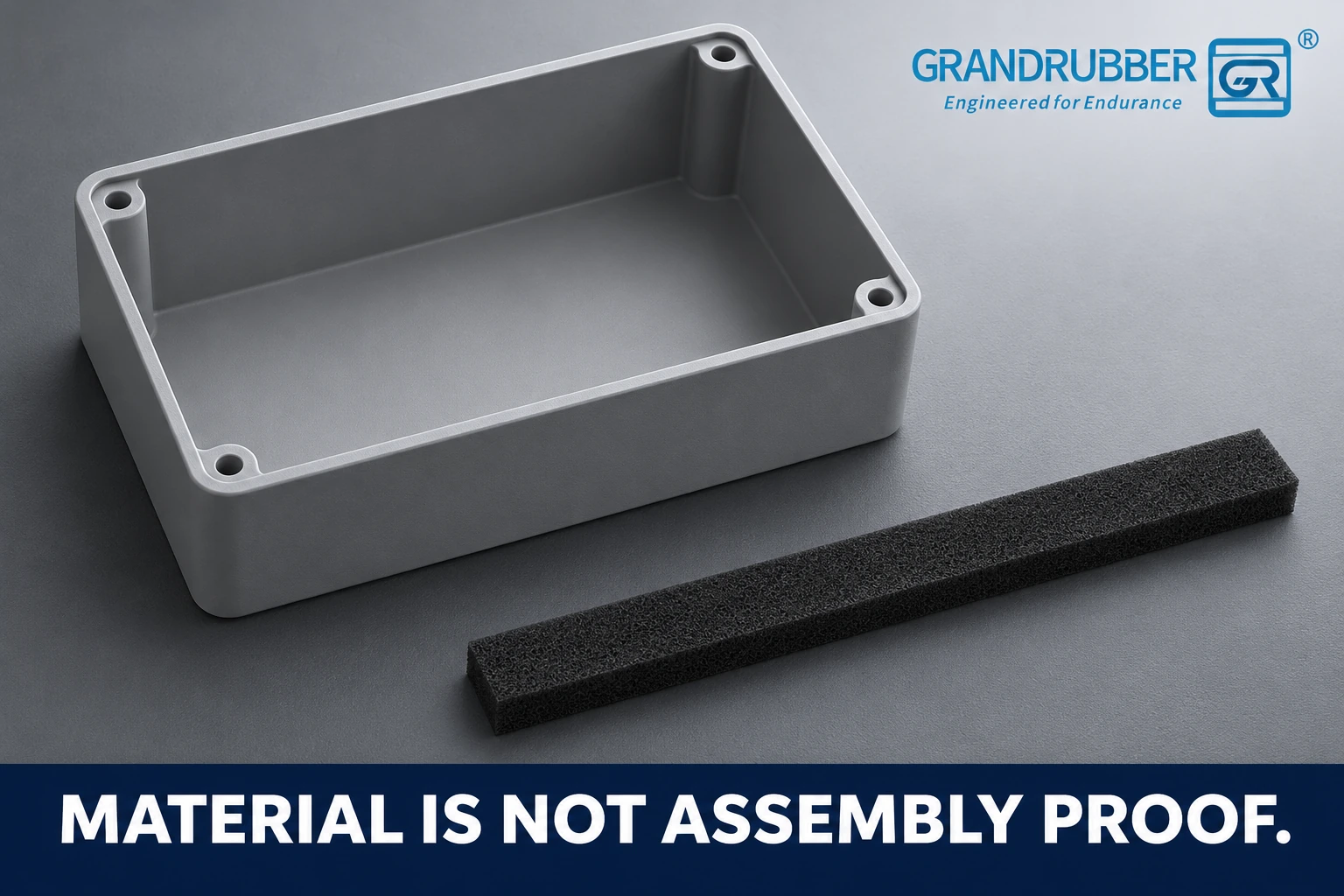
No assembled-enclosure claim follows from the cell-structure label alone. Identify the actual gasket material, joint geometry, interfaces and required ingress assessment. Material water absorption and the completed enclosure’s sealing performance are different evidence questions.
On this page
 Open full-size image ↗
No assembled-enclosure claim follows from the cell-structure label alone. Identify the actual gasket material, joint geometry, interfaces and required ingress assessment. Material water absorption and the completed enclosure’s sealing performance are different evidence questions.
Cell structure describes the material, not every path through the assembly
A closed-cell label describes a material structure. An enclosure’s water-sealing requirement concerns the assembled object with its actual joints and interfaces. A buyer should not treat these as the same subject merely because the gasket is one of the enclosure components.
Rogers’ sealing guide discusses cell structure separately from sealing performance and presents its water-sealing data with defined gasket geometry and test conditions. The useful distinction is between a material description and a conditioned test of a sealing arrangement. Its proprietary materials, curves and certifications are not GR product evidence.
A gasket can be well identified while the assembled enclosure requirement remains open. Equally, an enclosure result belongs to its tested configuration; it should not be extended to every size, joint or substituted material without an applicable basis. The purchase record needs to keep the subject of each claim visible.
Map the actual sealing path and the component boundaries
Obtain the enclosure and gasket drawings that define the proposed arrangement. Identify the sealing path, joins or terminations and adjacent parts as they appear in those records. If a cut part or strip is supplied, ask what the quotation includes and what assembly or joining work remains with another party.
State the actual ingress requirement and the conditions the responsible equipment authority wants assessed. A general phrase such as waterproof does not identify every pressure, exposure, acceptance or certification requirement. The buyer should request a defined basis rather than selecting one from an unrelated brochure.
The first table distinguishes material supply from assembled performance. It is not an IP-rating interpretation, a design calculation or an instruction for applying a gasket. This guide provides no universal compression percentage, test pressure, leak limit or certification conclusion.
| Evidence subject | What to identify | Does not establish alone |
|---|---|---|
| Cell structure | Actual product and stated material description | Every path through the enclosure is sealed |
| Absorption | Named specimen and actual test basis | Whole-enclosure ingress performance |
| Compression response | Offered material and conditions | The applicable water-sealing outcome |
| Gasket configuration | Actual shape, joins and assembly references | Equivalence to every tested configuration |
| Ingress requirement | Defined object, conditions and acceptance basis | A universal waterproof claim |
Keep absorption, compression response and ingress testing in separate fields
Water absorption data concern the material and test subject stated in that report. Compression-response information concerns another property under its own conditions. An assembled ingress result concerns a tested item or configuration. The existence of one should not silently close all the others.
Ask the supplier and equipment reviewer which evidence is needed for the actual requirement. A fully specified material can be an input to an assembly assessment without being a substitute for it. If a report concerns a different thickness, shape or configuration, identify the relationship or retain the applicability gap.
Do not rank open- and closed-cell products universally from the cell label. The cited guide’s discussion is about identified materials and conditions. The buyer needs a response for the actual offered product and assembly, not a general assertion that one cellular category guarantees every water-sealing task.
Worked enclosure quote: material evidence is copied into the waterproof line
Assume a hypothetical enclosure buyer receives a closed-cell foam data sheet and marks the whole enclosure’s waterproof requirement complete. The quotation identifies only a gasket material and contains no assembly-level evidence or agreed test scope. No actual certification or failed product is represented.
The material document should remain in the file with its actual scope. Reopen the assembled requirement and ask which configuration and evidence address it. If the requirement has not been defined, the equipment owner needs to establish the applicable basis before the supplier can give a useful response.
A second proposal might include an enclosure result for a different gasket or joint. That is a configuration-applicability question. It should not be solved by treating all closed-cell materials as interchangeable. Identify the changed components and obtain the responsible disposition.
The second table separates these gaps. It helps the buyer avoid rejecting a genuine material document for the wrong reason while also avoiding a false assembly-level completion claim.
| Available document | Retain as | Request separately |
|---|---|---|
| Closed-cell material sheet | Material description within its scope | Applicable assembly-level evidence |
| Absorption result | Result for its stated specimen/test | Defined enclosure requirement response |
| Test for a different configuration | Evidence for that actual configuration | Basis for applying it to the changed joint |
| Supplier waterproof wording only | A claim needing definition | Subject, assessment and responsible disposition |
Control substitutions and preserve the tested or accepted configuration
If the material, thickness, shape, closure or other relevant joint feature changes, ask whether the earlier response remains applicable. A nominal polymer match is not, by itself, a documented equivalence of the complete arrangement. Keep the final part and assembly references connected.
Also identify who controls the work at component boundaries. The material supplier, gasket converter and enclosure assembler may supply different parts of the evidence chain. Ask which party owns each question and what remains excluded from its quotation.
Do not borrow the source manufacturer’s water-sealing graph to issue a universal compression rule. The data have their own material, geometry and conditions. This guide does not establish that a GR sponge has achieved any stated ingress rating or that any untested enclosure is certified.
Send an assembly-linked sponge enquiry
Provide the actual gasket and enclosure references, intended environment and defined ingress requirement with the closed-cell EPDM sponge enquiry. Ask GRAND RUBBER to identify the material it offers and applicable documentation, while obtaining the assembly-level assessment from the responsible equipment parties.
Use the compression-force guide for the separate closure-load question. That response can be relevant to the design review without proving water sealing. The two guides address different purchasing decisions, and neither should be used as a shortcut to an untested rating.
The next action is one evidence map linking material records, gasket configuration and assembled requirement to their actual subjects. Retain open items until the applicable responsible review supplies the missing answer.
Buyer FAQ
Does closed-cell mean a whole cabinet has an IP rating?
No assembly-level rating is established by the material label alone. Identify the actual enclosure requirement and evidence for the tested configuration.
Is low water absorption the same as an assembled seal?
No. Keep the material-test subject separate from the actual joints and ingress requirement of the completed equipment.
Can a test for one gasket shape cover a different shape automatically?
Ask for the documented applicability basis and responsible disposition. Do not assume all configurations using similar foam are equivalent.
Does this guide prescribe a compression ratio for water sealing?
No. The cited manufacturer’s results have their own material and conditions. Obtain the applicable system review for the actual offer.
Can the converter’s cut-part certificate approve the whole enclosure?
Check the scope. Part identity or dimensions do not automatically establish the completed assembly’s required performance.
Does a closing-force curve also prove water tightness?
It addresses a different property. Obtain the separate applicable evidence needed for the assembly requirement.
What should the material enquiry include?
The actual part/assembly references, exposure and defined ingress requirement, together with requested material documents and clear responsibility for assembly assessment.
Sources
Related technical resources
Related products
 Closed-cell EPDM Sponge Rubber
Document and page references
- Rogers — Sealing Design Guide, cell structure and water-sealing context: PDFp3cell-structure discussion; p7water-sealing charts with stated pressure and gasket geometry. General distinction of material structure and assembled sealing only. No proprietary numeric curves/ratings, universal compression or IP certification transferred.
- Editor-derived evergreen purchasing analysis; hypothetical examples are not real cases, field results or approved operating procedures.
Download the reference tables
Source-labelled review extract. Historical references remain historical; this is not a formal TDS, certificate or current availability confirmation.
Download guide tables CSV