
Chevron Belt Profile Separation: Change the Pattern or Review the Interface?
Investigate the profile-to-base construction and the actual failure location before treating a different chevron pattern as the answer. Pattern geometry and the integrity of the belt/profile interface are separate questions. Record the observations and operating context for the responsible belt and equipment review; a photograph alone does not identify a root cause.
On this page
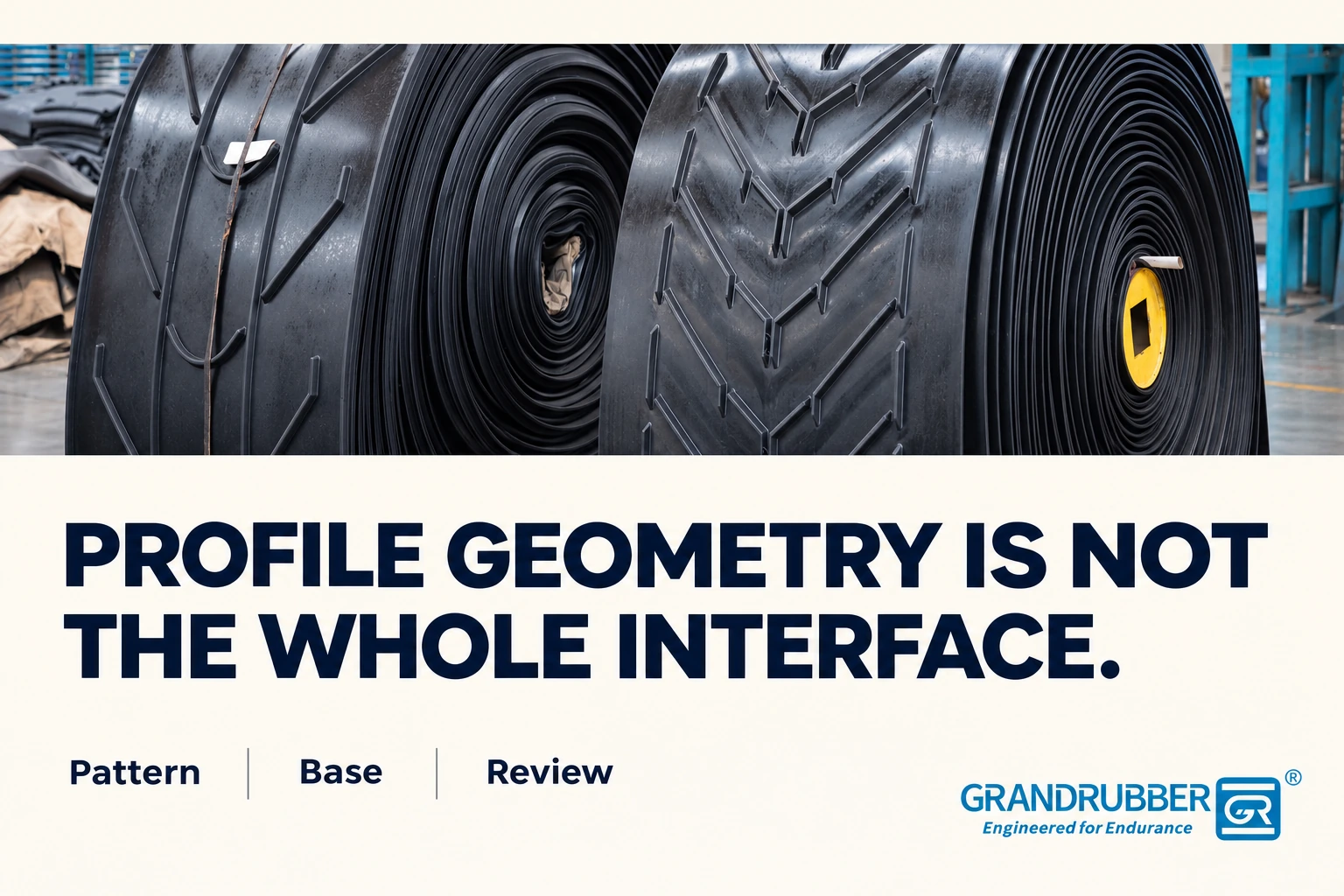 Open full-size image ↗
Investigate the profile-to-base construction and the actual failure location before treating a different chevron pattern as the answer. Pattern geometry and the integrity of the belt/profile interface are separate questions. Record the observations and operating context for the responsible belt and equipment review; a photograph alone does not identify a root cause.
Changing the pattern does not answer every profile failure question
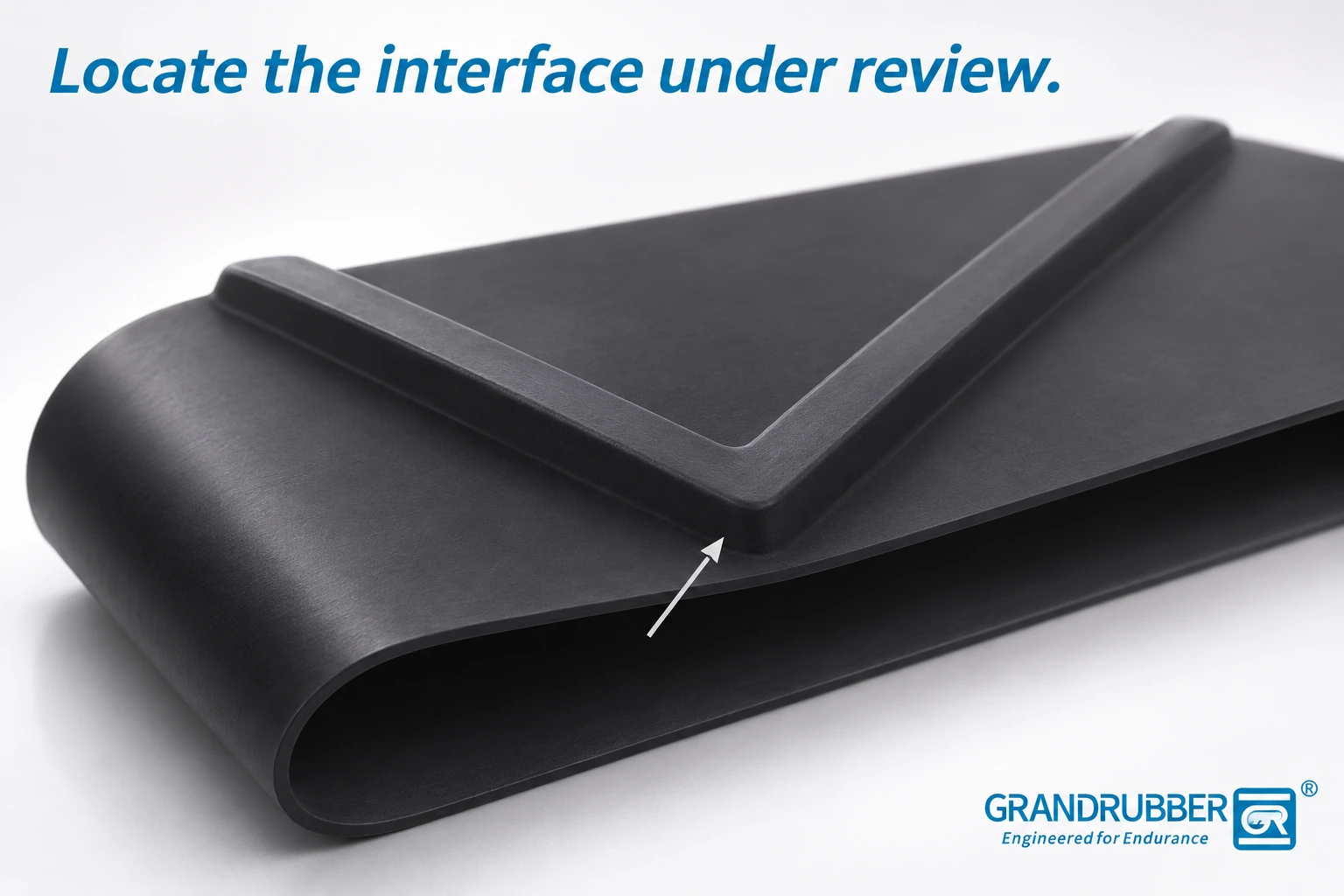
Chevron geometry describes the raised profile arrangement. A concern at the connection between that profile and the base belt asks a different question about construction, condition and duty. A drawing with a new pitch or height does not by itself explain an observed separation at the interface.
Fenner Dunlop’s profiled-belting bulletin discusses the profile/base relationship alongside repeated bending around pulleys. That makes the interface a relevant review object, separate from the pattern outline. The bulletin’s arguments about manufacturing methods cannot establish how GR’s offered belt is made or prove a universal ranking of competing designs.
First identify what was actually observed. A profile worn down at its top, a torn section, a crack in the base and material separating near the profile root are not interchangeable descriptions. Keep the observation factual and let the responsible technical review determine the mechanism and required response.
Locate the finding and preserve the construction identity
Record the affected belt and available markings, the location along and across its width, and dated photographs with context. Show the general profile arrangement and the particular affected region where safe records are available. Do not infer the extent of hidden damage from one close-up.
Ask the supplier what actual construction the belt and profile have and which documents identify it. Do not assume a manufacturing route solely because the visible profile resembles another product. If the old belt’s construction is unknown, retain that uncertainty rather than relabelling it to match a brochure.
Separate observations from explanations in the enquiry. For example, material detached along a described region is an observation; an assertion about a weak bond, compound fault or wrong pulley is a proposed cause requiring evidence. The first table supports that separation without diagnosing a failed belt or authorizing continued operation.
| Record | Useful content | Do not conclude from this alone |
|---|---|---|
| Finding location | Top, profile root, base or other actual region | Every defect has the same mechanism |
| Extent | Located observations and dated context images | A close-up defines all hidden damage |
| Old identity | Markings, drawings and available construction evidence | Appearance proves a manufacturing route |
| Duty context | Actual conveyor/contact/exposure references | One input establishes root cause |
| Technical disposition | Responsible review and applicable response | A new pattern drawing closes the failure review |
Give the reviewer the actual bending and contact context
Provide the relevant conveyor and pulley references, the belt orientation/route and any recorded changes requested by the responsible reviewer. Repeated bending makes geometry and duty relevant, but this guide gives no universal minimum pulley diameter or approval of a particular arrangement. The actual construction and equipment assessment are essential.
Also identify the conveyed material and actual exposure information. Where a scraper, transfer or other component is implicated by observations, include its reference and describe the observed contact or condition rather than asserting it is the cause. The competent equipment party must establish what the configuration requires.
A pattern change can then be evaluated for its own purpose, such as the intended material-handling geometry. It should not be used as a substitute for the unanswered construction/interface question. These may both require attention, but one drawing change does not silently resolve the other.
Worked replacement enquiry: taller profiles proposed after detachment
Consider a hypothetical buyer whose old profiled belt has visible detachment near several profile roots. The replacement request asks only for a taller chevron, and two offers are compared by height and price. No actual failure, GR case or performance result is represented.
Reopen the failure description and ask what the observations show about the location and extent of the finding. Obtain the old identity and equipment inputs that are available. Ask each bidder to identify the construction of its offered belt and the applicable technical response for that actual duty, instead of accepting a larger profile as proof that the earlier issue has been addressed.
If material rollback is a separate reported problem, keep that requirement in the review too. A handling-geometry concern and a separation concern need their own answers; combining them in one replacement order does not make them the same mechanism.
The second table shows how the enquiry can progress without a premature root-cause conclusion. It does not recommend a profile height, a manufacturing method or a change to the installed conveyor. The responsible parties need the real inputs before selecting an applicable response.
| Purchase input | Question it answers | Separate item still needed |
|---|---|---|
| Higher profile requested | Proposed handling geometry | Observed root/interface finding |
| Old failure photo | A located visible observation | Construction, extent and competent cause review |
| Offered pattern drawing | Defined profile arrangement | Actual belt/profile construction and relevant evidence |
| Different construction proposed | A changed product input | Applicability to actual equipment and duty |
Compare construction evidence and handling geometry separately
Ask suppliers to state what they actually offer rather than marking every profiled product as equivalent. Keep the agreed pattern drawing on one line and the belt/profile construction and relevant evidence on another. If a specific construction characteristic is required, request its actual confirmation and scope.
An attractive product photograph can help identify appearance, but it cannot demonstrate hidden interface integrity or service life. A test or inspection document must keep its actual subject, method and applicability. Do not adopt a competitor’s performance statement to fill a missing cell for the offered belt.
Retain any agreed changes and their responsible technical disposition with the final quotation. If the base construction, profile arrangement or equipment input changes during comparison, ask which earlier answers remain applicable. This prevents an approval for one proposed combination from being carried across to a materially different final order.
Send a failure-location and replacement-scope pack
For a chevron-belt enquiry, provide the old belt identification if available, the actual finding and location, relevant conveyor references and the intended material-handling requirement. Ask GRAND RUBBER to identify the offered product and available supporting documents, with unresolved construction or duty questions kept visible.
Use the chevron mould/drawing guide for the geometry-identification task. Here the additional decision is whether an observed profile/base issue has received an appropriate review before a changed pattern is treated as its solution. No GR construction route or service-life improvement is asserted.
The useful next step is one replacement comparison with separate geometry and interface-review lines. Keep the factual observations, proposed explanation and responsible disposition distinct so the purchase addresses the real question instead of merely changing the visible shape.
Buyer FAQ
Is every profile-root crack proof of a bond defect?
No root cause is established by that description alone. Preserve the actual observations and obtain the responsible belt/equipment assessment.
Will a taller chevron solve profile separation?
That outcome is not established by height alone. Review the observed interface finding separately from the material-handling geometry requirement.
Can a photograph identify how the profile was manufactured?
Do not assume it can. Ask for the actual construction information and retain unknowns when the old product cannot be identified.
Should all conveyor inputs be guessed if the old data are missing?
No. List the unavailable items and ask the responsible reviewer what is needed. A guessed pulley or construction can undermine the response.
Can a competitor’s method claim qualify a GR offer?
No. Keep external explanations in their scope and obtain the actual offered construction and applicable GR documents.
Does this guide authorize continued use of a damaged belt?
No operating or safety disposition is supplied. Refer the actual condition through the site’s competent equipment process.
What should the next replacement comparison separate?
The pattern/handling requirement, factual failure observations, construction identity and responsible interface/duty assessment.
Sources
Related technical resources
Related products
 Chevron Conveyor Belts
Document and page references
- Fenner Dunlop — Chevron and Profiled Belting: PDFp1 profile/base construction interface and cyclic bending discussion. Conceptual interface and duty review only. No universal ranking of manufacturing methods, claim about GR profile construction, competitor pictures or service-life promise.
- Editor-derived evergreen purchasing analysis; hypothetical examples are not real cases, field results or approved operating procedures.
Download the reference tables
Source-labelled review extract. Historical references remain historical; this is not a formal TDS, certificate or current availability confirmation.
Download guide tables CSV